


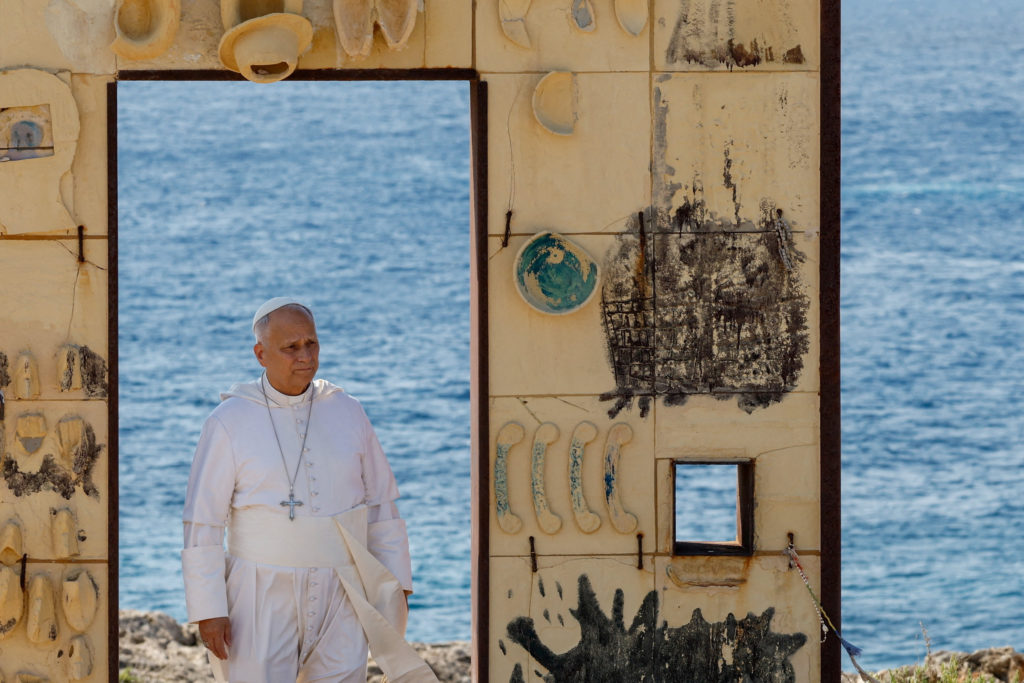
LAMPEDUSA, Sicily (AP) — As the United States marked its 250th anniversary of independence with celebrations and fireworks, American-born Pope Leo XIV visited Lampedusa, where he honored migrants by praying at a local cemetery and conducting a solemn Mass for both residents and newcomers.
Later that day, he joined U.S. Ambassador to Italy, Brian Birch, to partake in the July 4 festivities. The Vatican confirmed that Leo accepted Birch’s invitation, highlighting the significance of this cultural exchange.
Strategically positioned closer to Africa than mainland Italy, Lampedusa serves as the primary European entry point for hundreds of thousands of migrants arriving by boat from Libya and Tunisia, often at the mercy of human traffickers.
After meeting with some migrants at the port, Leo took a moment for reflection along the rugged pier, where he viewed the vast sea while his cassock danced in the wind. Before officiating the Mass, he dedicated a plaque at the docks in honor of Pope Francis, who visited in 2013.
Leo’s visit underscored the roots of America as a nation founded by immigrants and conveyed a powerful message to both the United States and Europe regarding the moral imperative to uphold the dignity of all human beings, particularly the most vulnerable among them.
In a Fourth of July letter to Americans, Leo emphasized that safeguarding the lives of the unborn and all individuals “welcomes, protects, and supports immigrants,” whose aspirations and contributions have shaped the nation’s history. He urged that compassion and generosity in welcoming immigrants is both an act of charity and recognition of their inherent dignity.
Lampedusa Emerges as a Crucial Center in the European Migration Debate
In recent years, Lampedusa has become a focal point in Europe’s migration discourse, grappling with the dual challenge of securing its borders while fulfilling its obligations to refugees escaping conflict, climate-related disasters, and poverty.
During his sermon, Leo expressed gratitude to the island’s residents for their “miracle of compassion” in welcoming migrants. He called upon European leaders to accept responsibility and address the migration crisis comprehensively, combining immediate responses with long-term strategies aimed at protecting, supporting, and integrating migrants, as well as addressing the root causes of migration in their home countries.
He poignantly remarked on witnessing the plight of countless migrants who fall victim to violence and exploitation, noting the tragic loss of life during treacherous journeys, yet emphasizing their enduring presence and the moral obligation to care for those in need.
Despite a notable decline in migrant arrivals to Italy this year—14,464 compared to 30,598 during the same period last year—the International Organization for Migration has recorded over 35,000 missing migrants in the Mediterranean since 2014. The real number is believed to be even higher due to untracked shipwrecks.
Honoring the Memories of the Lost and Following in Francis’s Footsteps
Pope Leo XIV, who arrived in Lampedusa by plane, honored the deceased by placing wreaths of yellow and white flowers at the migrant cemetery, where simple wooden crosses mark their graves. Tareke Brahane, an Eritrean migrant and president of the October 3rd Committee, remarked that this action sent a “strong message” of solidarity and the need for recognition of migrant fatalities.
Leo’s gestures not only honor those lost but also provide solace to their grieving families. His visit echoes the legacy of Pope Francis, who prioritized the plight of migrants during his papacy. When Francis first visited Lampedusa in July 2013, he condemned global indifference and memorialized those who had perished in their pursuit of safety.
Salvatore Sortino, head of the International Organization for Migration’s mission in Italy and Malta, notes that even with the decrease in arrivals, the death toll at sea remains alarmingly high, highlighting the ongoing vulnerability that persists. Leo’s presence serves as a poignant reminder of these challenges and the moral imperative to address them.
Winfield reported from Rome. Associated Press religion coverage receives funding from the Lilly Endowment Inc. and is supported through a collaboration between The Associated Press and The Conversation US. AP is solely responsible for this content.
