


Forecast of Inflation Trends Ahead of MPC Meeting
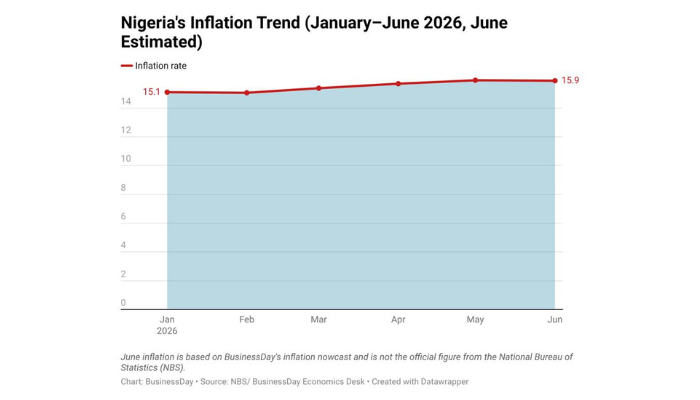
Business Day’s Inflation Nowcast anticipates headline inflation in Nigeria for June to be approximately 15.9%, with a range between 15.7% and 16.1%, ahead of the official announcement by the Office for National Statistics on July 15. Should this forecast prove accurate, it would indicate a modest decrease from May’s inflation rate of 15.93%, marking the end of three consecutive months of increases. More importantly, it reflects the dynamics of Nigeria’s ongoing inflation cycle.
After a steady decline lasting 11 months, inflation began rising in March, prompting concerns that the country’s disinflationary trend might be faltering. The June projections suggest a potential easing of new price pressures; however, they are insufficient to indicate a definitive return to sustained disinflation.
Business Day’s nowcast methodology integrates previous inflation figures, fluctuations in official exchange rates, and business activity metrics from the Stanbic IBTC/S&P Global Purchasing Managers Index (PMI). This approach also incorporates structural adjustments in anticipation of the Office for National Statistics’ 2025 inflation rebasing. The autoregressive nature of the model helps capture persistent inflation patterns, offering real-time insights before official data becomes available.
Economists surveyed by Business Day have differing views on inflation’s trajectory for June, although many expect stability. Ayo Teriba, CEO of Economic Associates, believes that exchange rate stability has markedly dampened inflationary volatility. He asserts that, in light of recent trends, both upward and downward movements in inflation will likely be minimal, estimating shifts of roughly 0.02 to 0.03 percentage points.
Conversely, Muda Yusuf, CEO of the Center for the Promotion of Private Enterprise (CPPE), warns that geopolitical tensions impacting global energy prices could lead to modest inflationary pressures. He points out that recent developments have begun influencing energy costs, which may subsequently affect transportation and production expenses.
Understanding the implications of the June data is crucial for diagnosing Nigeria’s inflation challenges. Over the past two years, inflation has predominantly been driven by macroeconomic shocks, particularly those stemming from the depreciation of the exchange rate and the elimination of fuel subsidies. While these shocks gradually dissipate, the economy continues to grapple with more entrenched structural challenges, such as insecurity, high transportation costs, unreliable energy supplies, and supply chain inefficiencies in agriculture.
This distinction is vital as monetary policy tools are generally more effective against demand-driven inflation than against structural supply constraints. Since early 2022, Nigeria’s central bank has engaged in its most assertive tightening cycle, raising the monetary policy rate from 11.5% to 27.5%, and then subsequently easing it to 26.5% this year. Current estimates indicate that this tightening has successfully halted further inflation spikes, but significantly reducing it poses a different challenge altogether.
Policymakers are now faced with complex decisions ahead of the Monetary Policy Committee meeting scheduled for July 20-21. At the last meeting in May, the MPC opted to maintain the policy rate at 26.5%, attributing the recent uptick in inflation primarily to transitory external factors, particularly the rise in global oil prices due to geopolitical tensions in the Middle East. Central Bank Governor Olayemi Cardoso emphasized that these pressures are more temporary than structural in nature.
The June estimate of 15.9% leaves the MPC without a clear direction. It neither confirms the previous assessment nor indicates a bullish trend for further monetary easing. As a result, the upcoming meeting will likely draw significant attention from the market, particularly regarding the possibility of rate cuts in September.
For investors, the current economic landscape presents some encouraging news. While interest rates remain elevated, inflation appears to be stabilizing. With the central bank’s policy rate set at 26.5% and Business Day’s inflation estimate at around 15.9%, investors engaging in Nigerian government securities can secure returns that exceed inflation, positioning Nigeria as a compelling option for those seeking high yields. Unless inflation rises sharply again, many investors are expected to maintain their positions in Treasury Bills and government bonds.
However, the situation is less favorable for businesses and households. Commercial lending rates continue to be prohibitively high, reflecting not just the increase in policy rates but also structural limitations such as increased cash reserve ratios. Even if the central bank were to initiate easing measures this year, borrowing costs are expected to remain constrained for some time.
For households, the stabilizing inflation offers little in terms of immediate relief. A stabilization in inflation rates does not equate to a drop in prices; rather, it signifies a slower rate of increase compared to previous months. Prices for essential goods and services—food, transportation, housing, and utilities—remain significantly higher than the previous year, while wage growth lags behind the rising cost of living.
This dynamic elucidates why inflation rates may statistically appear to be slowing without a corresponding improvement in economic conditions for the average citizen. The June estimates suggest that Nigeria’s battle with inflation is transitioning into a new chapter.
The nation seems to have absorbed the substantial shocks inflicted by currency deregulation and fuel price adjustments. However, the remaining inflation is predominantly structural, rooted in issues of agricultural productivity, logistics, electrical supply, infrastructural transport, and safety concerns—all challenges that cannot be addressed solely through monetary policy.
As June’s estimates take shape, the emphasis of policy discussion should shift from merely adjusting interest rates to addressing the structural reforms necessary to enhance food production, lower logistics costs, and increase overall productivity. While monetary policy has laid the groundwork, the upcoming phase of disinflation is likely to hinge on the broader economy’s capacity to produce, transport, and distribute goods more effectively—a formidable challenge ahead.
