


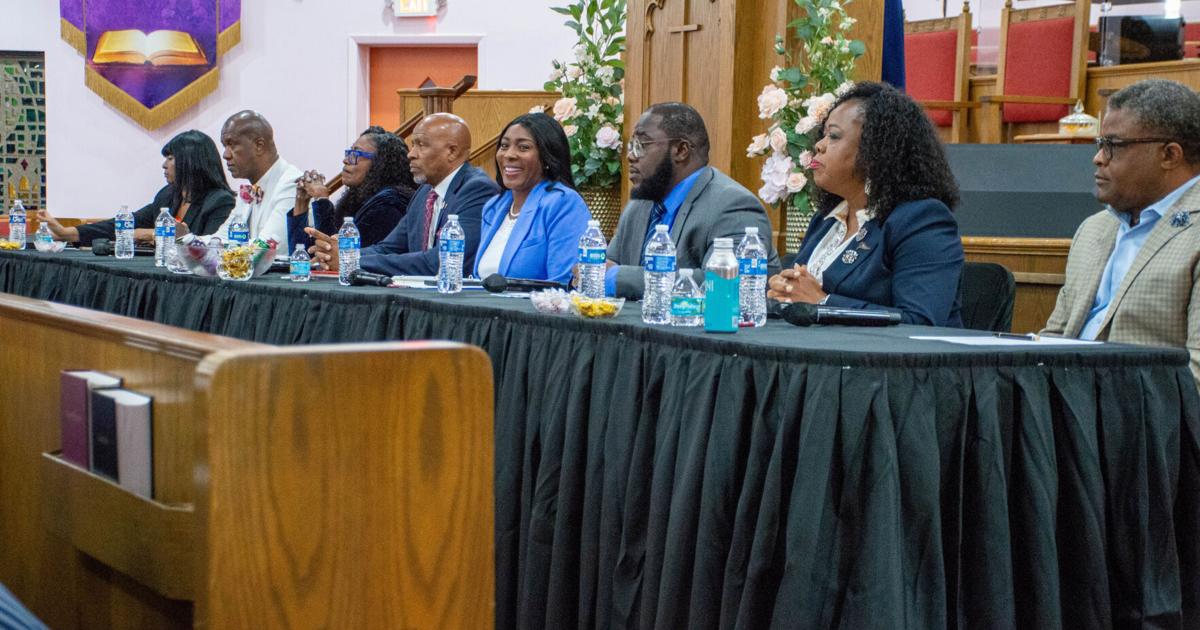
Eight candidates vying for the District 1 seat on the Miami-Dade School Board gathered with voters last week during a town hall event organized by the Miami-Dade Chapter of the NAACP at the First Baptist Church in Bunch Park. The candidates—Katrina Wilson, Bernard W.H. Jennings, Joy L. Jackson, James Wright, Lendry Mesidor, Linda Cottier, Selah Johnson, and Eljabor Ighodalo—are competing to succeed former board member Dr. Steve Garon III, who has moved on to the Miami-Dade County Commission. Wilson has previously served as a Miami Gardens City Council member and as a principal.
During the forum, candidates tackled a variety of pressing issues, including school choice, charter school co-location, immigration policies, school closures, and enhancing student achievement. These discussions come at a critical juncture for the district, which is grappling with declining enrollment, teacher shortages, and shifts in state education policies.
School Choice Debate
Most candidates expressed robust support for expanding educational options for parents. However, some argued that charter schools and private institutions receiving public funding should adhere to the same accountability measures as traditional public schools. For instance, Jackson pointed out, “If public funds are going to these schools, they should be required to follow the same guidelines and testing protocols that traditional public schools must adhere to.”
Ighodaro, a former Miami-Dade teacher and Miami Gardens vice mayor, agreed with this sentiment, emphasizing that “Parents can use that funding for private schools, yet these schools are not held accountable to the same standards.” This distinction is critical to understanding the landscape of public versus private education.
Concerns Over Campus Co-location
The candidates did not shy away from addressing Florida’s “Schools of Hope” statute, which permits approved charter operators to share facilities with “underutilized and low-performing” public schools. Earlier this year, the Miami-Dade School Board authorized the Success Academy to co-locate in five high schools, beginning with Miami Jackson and North Miami High Schools in fall 2027, prompting concerns among the candidates.
Mesidor, a teacher at a local Catholic institution, voiced strong opposition to this practice, while Jennings highlighted the detrimental effects of the state’s funding formula, which he believes harms school districts, especially when students leave prior to official enrollment counts.
Immigration Policies and Student Safety
The discussion also touched on immigration enforcement laws and the school board’s role in ensuring that immigrant families feel secure sending their children to school—a significant concern given some Florida universities’ 287(g) agreements with U.S. Immigration and Customs Enforcement. Cottier, a public school teacher and an immigrant herself, argued against such agreements, advocating for a safe educational environment for all children.
Wright echoed this perspective, asserting that when parents send their children to school, they should be assured of their safety and that educational institutions should not serve as an extension of federal immigration policy. Jennings concurred, mentioning that state law might restrict local officials’ ability to act effectively on these issues.
Community Insight and Candidate Expectations
After the forum, several residents expressed their desire for a candidate with substantive educational experience and a clear understanding of school board dynamics. Sharon Williams, who spent four decades with Miami-Dade County Public Schools, indicated her support for Jackson while noting that the candidates must also address teacher compensation as a pressing challenge.
District 1 parent Dana Magloire Seneron emphasized the critical timing of the election, given current challenges faced by schools. “It’s the kids who get hurt,” she remarked, underscoring the importance of electing someone who will advocate fiercely for their interests. Despite many thoughtful responses during the forum, some residents felt that not all candidates adequately addressed fundamental issues, particularly the complexities surrounding the 287(g) agreements.
Voters in District 1 will have the opportunity to select their preferred candidate during the primary election on August 18. Should no candidate secure a majority, the top two will compete in the general election scheduled for November 3.
