


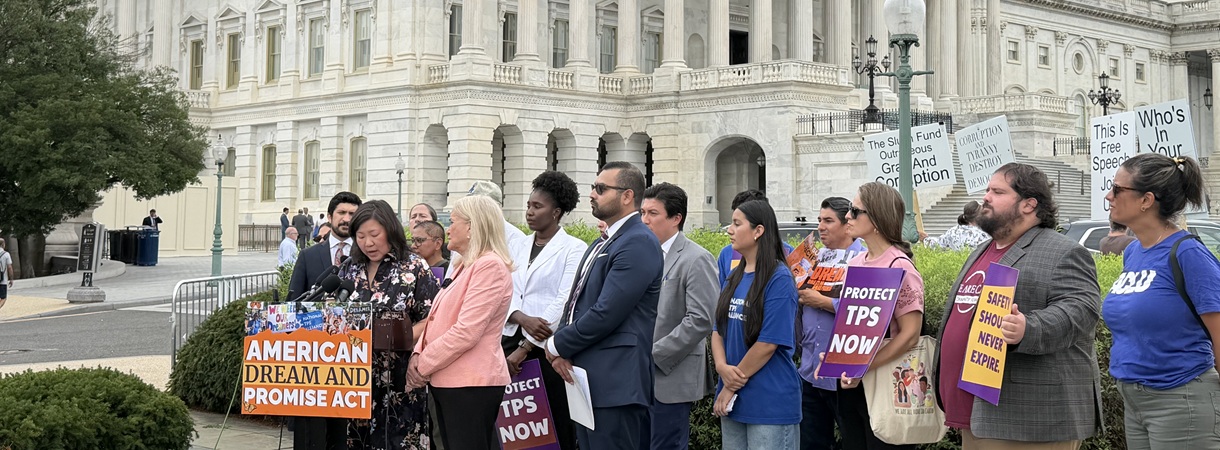
Following a recent Supreme Court ruling that empowered the Trump administration to lift critical protections for immigrants, Congress faces a pivotal opportunity to safeguard hundreds of thousands at risk of job loss, arrest, and deportation. Beginning July 20, members of the U.S. House of Representatives can sponsor petitions to advance the Dream and Promise Act. This legislation aims to provide a pathway to permanent residency for millions of immigrants currently under restrictive immigration protections.
Legislative action is increasingly urgent as the Trump administration initiates the most extensive immigration decriminalization effort in U.S. history. This includes revoking long-standing protections such as Temporary Protected Status (TPS), placing countless long-term residents in jeopardy of mass deportations. The Dream and Promise Act is designed not only to protect TPS beneficiaries but also to offer a safe haven to undocumented immigrants who arrived as children (commonly known as Dreamers), as well as Deferred Action for Childhood Arrivals (DACA) recipients and individuals benefitting from Deferred Departure (DED).
DACA, which was introduced in 2012, is an agency policy designed to shield undocumented youth from deportation while allowing them to obtain work permits. For over a decade, this initiative has provided crucial protection to hundreds of thousands of individuals, enjoying widespread public support. However, since 2025, the Trump administration has detained and deported more than 260 DACA beneficiaries, actively pursuing various legal avenues to dismantle this long-standing policy.
Simultaneously, the current administration has eliminated TPS for nearly 1 million individuals, many of whom have called the U.S. home for decades. These individuals face the loss of work permits and risk deportation. Enacted by Congress in 1990, TPS offers work authorization and protection from deportation for citizens who might encounter grave humanitarian challenges, such as conflict or natural disasters, upon returning to their home countries.
A recent Supreme Court decision now permits the Trump administration to continue efforts to terminate TPS for Syrians and Haitians, leaving hundreds of thousands of law-abiding migrants—about 350,000 of whom are Haitians fleeing an extreme humanitarian crisis—vulnerable to job loss, family separation, and deportation. Following the court’s ruling, other TPS holders from countries like South Sudan, El Salvador, and Ethiopia also face heightened risks of similar outcomes.
Mechanisms of Protection in the Dream and Promise Act
First introduced in 2021, the Dream and Promise Act outlines two distinct pathways to grant Dreamers, TPS holders, and DED beneficiaries access to permanent status.
The bill proposes a two-tiered process for Dreamers, starting with a ten-year “conditional permanent resident status.” After fulfilling specific requirements, they may then apply for permanent residency. To qualify for this process, Dreamers must have entered the U.S. before turning 18, must have arrived prior to January 21, 2021, be enrolled in a high school or equivalent program, and must not have committed certain serious crimes. After completing at least two years of college, military service, or three years of work experience, they become eligible for legal permanent residency.
For TPS and DED holders, the bill offers a more straightforward route to lawful permanent residency. TPS beneficiaries (or those eligible as of July 1, 2024, or individuals eligible for DED as of January 1, 2017) can apply for permanent residency within three years of the bill’s enactment, provided they have been physically present in the U.S. for three years and pass a background check.
Community and Economic Implications of the Dream and Promise Act
Dreamers and TPS holders play vital roles in essential sectors, contributing to the workforce, paying taxes, and bolstering local economies. In 2023, TPS beneficiaries alone added over $5.2 billion in taxes and had a purchasing power of $16.9 billion. Meanwhile, individuals eligible for DACA contributed $11.5 billion in taxes and enjoyed a purchasing power of $35 billion. Without Congressional action, families face unnecessary separation, and employers might confront a sudden workforce decline that could destabilize communities.
States with significant populations of TPS and DACA recipients will likely experience these challenges most acutely. In Florida, for instance, over 150,000 Haitian TPS holders contribute $2.6 billion to the state’s economy and create nearly 100,000 jobs, particularly within the hospitality, agriculture, and healthcare sectors. In Ohio, TPS holders represent a crucial part of the senior care industry. Given their indispensable role in the local economy, Republican Governor Mike DeWine has publicly opposed efforts to remove TPS protections. The Dream and Promise Act could therefore greatly enhance the labor force participation of millions across the nation.
The Legislative Outlook for the Dream and Promise Act
In the short term, the passage of the Dream and Promise Act appears unlikely. However, if the House moves forward and approves the bill, it could pave the way for permanent residency for vulnerable individuals in the coming years.
Typically, the majority party in Congress decides which bills are considered for a vote. Nevertheless, a “removal petition” enables any lawmaker to bring a bill to the floor by gathering the support of 218 colleagues. Currently, over 210 House members have endorsed the petition for the Dream and Promise Act, so a small group from both parties will play a crucial role in determining whether the petition leads to a final vote.
Passing the Dream and Promise Act in the House would serve as a significant countermeasure to the Trump administration’s mass deportation initiatives while highlighting widespread support for a pathway to permanent residency and citizenship for TPS holders and Dreamers. Polls consistently show that a majority of Americans endorse this approach, indicating the bill could catalyze meaningful political support—provided Congress acts decisively.
