


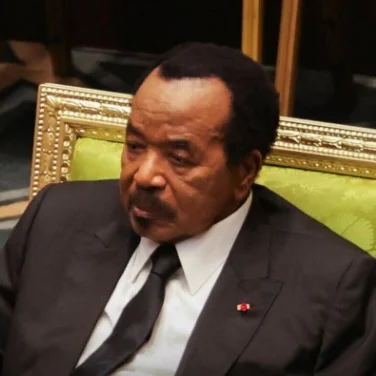
Cameroon’s President Sparks Concern Over Extended Absence
Paul Biya, Cameroon’s president and the world’s longest-serving head of state, has been in Switzerland since early June. His prolonged absence has reignited discussions around government inaction in a nation increasingly desperate for change. As of Saturday, Biya, aged 93, will have been away from Cameroon for 48 days.
An official statement indicated that he and his wife, Chantal Biya, departed on June 7 for what was described as a “short private stay in Europe.” Biya’s frequent visits to Geneva over the years have led to speculation about his health, a claim that the government has occasionally contested.
On June 18, Communications Minister René Emmanuel Sadie publicly refuted suggestions that the president had been hospitalized in a Geneva clinic. Nevertheless, critics within the opposition contend that Biya’s absence reflects a “clear institutional vacuum,” as noted by Mamadou Mota, vice president of the Cameroon Renaissance Movement (MRC), in a recent Facebook statement.
Calls for Clarity in Leadership
Earlier this month, Patricia Tomaino Ndam Njoya, president of the Cameroon Democratic Union (UDC), urged the government to develop a “fair procedure for determining the temporary or permanent incapacity” of heads of state. In response to allegations of a power vacuum, Jack Fame Ndongo, a senior official within the ruling party and the higher education minister, asserted that operations continue seamlessly regardless of the president’s location.
This isn’t the first time claims of a power vacuum have emerged; a similar situation arose in late 2024 when Biya spent approximately 50 days abroad. The opposition Social Democratic Front (SDF) expressed concerns last Friday, describing the government’s current state as “on autopilot.” Cameroonians have grown increasingly frustrated with Biya’s frequent absences, especially as the current administration approaches a record eight years in power.
Vivian Ondua Biwore, a professor of public management at the University of Yaounde, stated, “People are tired of waiting.” She highlighted the mixed results that followed the recent elections, leading many to believe this is a pivotal time for governmental renewal.
Heightening Tensions Following Elections
Protests erupted in October after Biya secured re-election for an eighth term, with government forces responding violently. Although the government acknowledged “dozens” of fatalities, the exact number remains undisclosed. While opposition parties criticized the election results, skepticism also arose from Western embassies regarding the electoral process.
In his end-of-year address, Biya pledged to form a new government “within days.” However, seven months later, no new appointments have materialized, and both municipal and parliamentary elections have faced repeated delays, with current officials’ terms extended indefinitely.
Institutional Changes Amidst Uncertainty
Despite calls for stability, Cameroonian authorities have undertaken a series of institutional reforms, including changing the leadership in both parliamentary chambers last March and initiating constitutional amendments to create the role of vice president in May. However, no individual has been appointed to this new position yet, leading to increased speculation regarding the leadership’s effectiveness.
The situation escalated in June when a fraudulent document, mimicking an executive order for appointing a vice president, was sent to a public radio station in the capital. Journalists determined it was a hoax and chose not to report it, yet the incident has only deepened concerns about a potential power vacuum in the post-Biya era.
Experts, including political scientist Stephane Akoa, have noted rising tensions among those close to the president, suggesting internal conflicts are becoming more apparent. Akoa observed, “There are increasing leaks about infighting between different factions within the inner circle.” One faction, reportedly surrounding First Lady Chantal Biya, has been more active in national politics, with her name frequently associated with key policy decisions and appointments.
In the absence of a vice president, should a power vacuum arise, Senate President Abubakary Abdullahi is poised to assume leadership until presidential elections can take place.
