


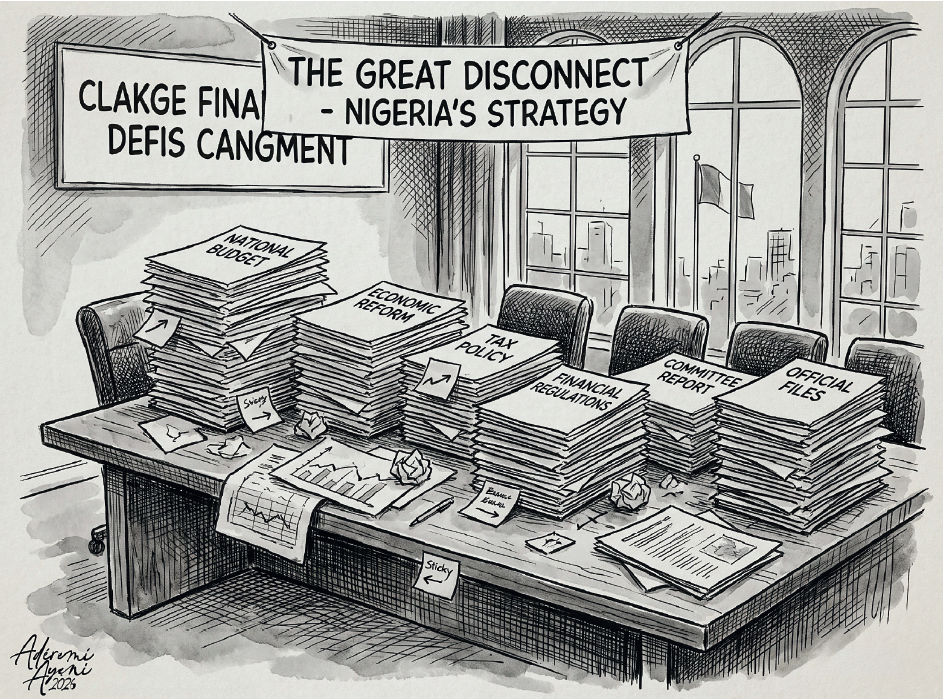
Recent Policy Initiatives Highlight Nigeria’s Economic Strategy
The recent policy events on July 7 and July 17, 2026, may initially appear unrelated, yet the actions taken by the Nigerian government within just ten days prompt deeper inquiries into the nation’s economic strategy. On July 7, Finance Minister Taiwo Oyedele announced the formation of a 15-member Ministerial Advisory Council, which includes economists, business leaders, and policy experts aimed at reinforcing economic partnerships and accelerating ongoing reforms. Following this, President Tinubu signed the Executive Order on Virtual Asset Coordination on July 17, creating a framework that unifies financial, regulatory, and security institutions to tackle issues of fraud, money laundering, and data security in Nigeria’s burgeoning digital asset landscape.
Both measures are commendable and reflect a need for expertise and regulatory clarity critical to attracting investment and establishing institutional trust. However, together they raise a more complex issue: Is Nigeria developing a coherent transformation strategy, or is it merely reacting to challenges with fragmented interventions lacking a cohesive policy framework?
Nigeria’s historical record includes some of the continent’s most ambitious policy frameworks. Despite this, the nation often fails to follow through, abandoning promising ideas almost as quickly as they emerge. The Vision 2010 Committee, created under military rule, attempted serious governance and infrastructure reforms, but the initiative collapsed after General Abacha’s death in 1998. Successor programs like President Obasanjo’s NEEDS initiative saw significant achievements, such as bank consolidation and debt relief, yet political transitions led to their discontinuation.
Over 66 years, Nigeria has devised nearly 20 national development plans, with the majority emerging in the past 26 years of democracy. Each administration has introduced its own terminologies and visions, resulting in a pattern where new governments frequently discard the frameworks established by their predecessors. This cycle leads to a loss of institutional memory and hampers continuous developmental progress.
While Nigeria boasts a wealth of technocrats capable of formulating sophisticated strategies, the primary challenge lies in systemic continuity. Development frameworks often become aligned with individual administrations, thus viewed as “previous government plans” rather than national assets deserving refinement. Consequently, through political rhetoric and policy abandonment, the nation loses invaluable accumulated knowledge and implementation momentum.
Unlike nations such as Singapore and South Korea, which have cultivated institutions allowing for strategic consistency, Nigeria has failed to build a resilient framework accommodating shifting policies without forsaking accumulated insights. The Tinubu administration now grapples with this culture of policy discontinuity, framed by election slogans that serve as organizational philosophies.
The political messaging of the “Agenda of New Hope” reflects aspirations rather than detailed strategies for governance. While such slogans resonate emotionally, true leadership requires well-defined strategies that specify problem diagnoses, key priorities, implementation plans, and accountability measures. As it stands, the administration’s vision remains largely articulated through speeches, budgets, and fragmented announcements, devoid of a cohesive document that illustrates how various reform elements interconnect.
This absence of structural cohesion complicates the evaluation of policy success. Without a transparent national framework outlining expected outcomes, public judgments are rendered void, leading to individual assessments through political rather than empirical lenses. Furthermore, this fragmentation erodes public trust; reform discourse often devolves into political debate, leaving citizens without a shared standard for assessing progress.
Despite declarations of intent and numerous reform agendas, Nigeria has witnessed stagnant per capita incomes and persistent poverty over the last decade. The real challenge lies not in the absence of planning, but rather in a lack of sustained implementation and an inadequate institutional memory. True progress will be defined not by the number of committees formed or reforms proposed, but by the government’s ability to create strong institutions capable of nurturing ideas and adaptations across administrations.
It is crucial that “a new hope” transcends mere rhetoric and evolves into a publicly articulated strategy with measurable objectives that the populace can evaluate. Until such a transformation occurs, the familiar cycle of initiatives—characterized by announcement, branding, partial implementation, and eventual abandonment—will continue unabated.
