


This article was originally published on TechCabal Insights and was written by Joseph Oloyede, TechCabal Insights Analyst.
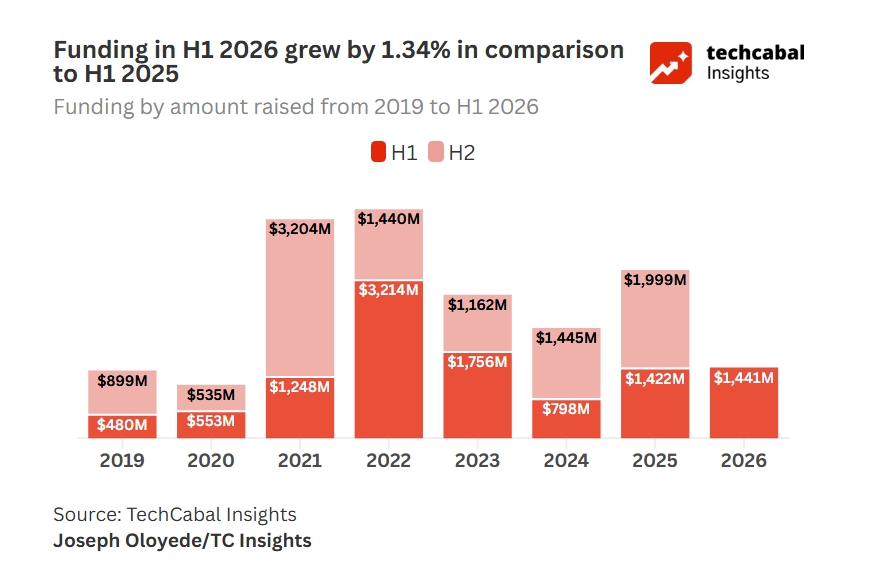
The first half of 2026 has officially closed, revealing a positive landscape for African startups, which collectively raised $1.44 billion. This figure marks a slight increase from the $1.42 billion secured during the same period in 2025. Despite facing global economic challenges, this growth reflects a robust confidence from investors in the continent’s innovative capabilities.
Evolving Funding Dynamics
This year has illustrated resilience in the African startup ecosystem. While overall funding remained strong, the transaction landscape has shifted noticeably. The most significant development in the first half of 2026 is that startups are raising larger funding rounds despite a decrease in the number of deals. In total, 146 deals were tracked in the first six months of this year, a marked decline from 252 in the earlier half of 2025.
The momentum in funding saw a major boost in early June, highlighted by the announcement of a substantial $215 million deal by Spiro, a pan-African electric mobility startup. This landmark deal not only propelled the total funding over a significant threshold but also ensured that 2026’s mid-year performance outpaced that of 2025.
Funding Composition: Balancing Equity and Debt
A closer inspection reveals that debt financing has emerged as a crucial survival mechanism for many startups. Across the first half of 2026, funding was almost evenly divided between the two quarters, with $749 million raised in Q1 and $692 million in Q2. Overall, startups secured $818 million through equity, $614 million from debt, and $9 million in grants.
This balanced approach demonstrates a strategic preference among companies to rely on loans for capital instead of relinquishing ownership. Many are focusing on stability by investing in tangible assets like electric vehicles and solar power systems.
Surge in Green and AI Technologies
The closing months of the half-year saw significant activity, particularly in green infrastructure and AI-driven solutions. Spiro led the charge with a $215 million equity round from Impact Fund Denmark and Equitane, supplemented by a further $55 million from NewTrails Capital. In the fintech space, Egyptian platform Blnk raised a total of $37.1 million to facilitate instant purchases at points of sale, while AethexAI attracted $3 million in pre-seed funding for its localized customer support automation. Other noteworthy fundraisers included Zimi Charge and Agenz, which secured $2.6 million and $5 million, respectively, for electric vehicle infrastructure and real estate valuation services.
Additionally, major funding awards were granted to green initiatives. Catalytic investments from Cascador supported projects like Agriarche, Koolboks, and Powerstove, highlighting a strong commitment to climate-friendly solutions.
Unprecedented Mergers and Acquisitions Activity
This wave of consolidation is beneficial as it creates stronger market contenders, provides essential exit avenues for investors, and reflects the ecosystem’s ability to adapt and mature even during funding downturns. We’ve observed mature companies acquiring smaller startups to rapidly gain licenses or broaden their geographic reach.
Navigating Operational Challenges Amid Technological Advancements
Within this context of significant funding, the operational landscape has shifted toward efficiency and cost-cutting. Artificial intelligence (AI) has transitioned from a mere buzzword to a central feature in business operations. Currently, over 100 AI applications are being leveraged across Africa, enhancing capabilities in areas such as credit scoring, fraud detection, and automated customer service.
While AI adoption boosts operational efficiency, it also poses challenges related to workforce restructuring. As AI tools evolve, they are increasingly replacing specific roles, leading to a rise in layoffs. Already, more than 1,000 job cuts have occurred across the continent in 2026, up from 698 in the same timeframe in 2025. Companies like Jumia and Zap Africa have openly cited AI as a reason for downsizing.
In addition to layoffs, economic pressures have resulted in 13 known company closures this year. Surviving startups have also been proactive, initiating 46 product restructurings, 39 market expansions, and 117 new partnerships to remain competitive in a dynamic environment.
