


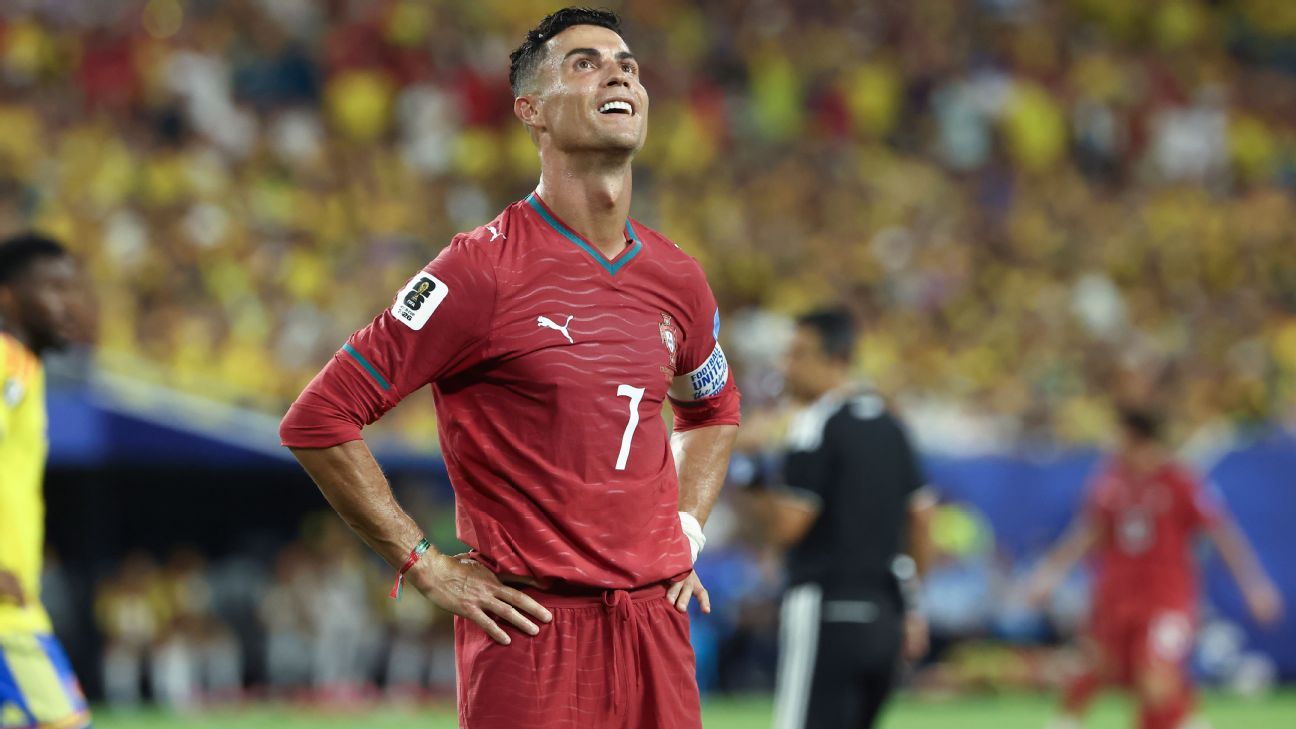
MIAMI GARDENS, Fla. – Cristiano Ronaldo struggled to keep pace in the closing minutes of Portugal’s 0-0 stalemate against Colombia on Saturday. This was hardly surprising given the oppressive heat and humidity, with the game starting at a “feels like” temperature of 106 degrees Fahrenheit. Nevertheless, questions arise about why the 41-year-old forward remained on the field when the referee finally blew the whistle after five minutes of stoppage time in this demanding Group K match.
Ronaldo, known for his relentless ambition, seems unable to accept being substituted, even when it might benefit both him and the team. His lack of impact during the last half hour in challenging conditions raises eyebrows. Finishing the match with a meager 0.17 expected goals (xG) and just 0.03 expected assists (xA) illustrates the limitations of his performance.
Impending Challenges for Portugal
Roberto Martinez’s squad is set to face Croatia in the Round of 32 in Toronto on Thursday, and Ronaldo has now played a full 270 minutes across the group stage. With stoppage time factored in, the former Manchester United and Real Madrid star may conclude this segment of the tournament with nearly 300 minutes on the clock.
While Ronaldo sets a high standard for athletes in their 40s and is a testament to how commitment and professionalism yield results, age remains an undeniable factor. Despite his rigorous training routine and strict dietary habits, the reality is that physical decline is inevitable. Even someone like Ronaldo must judiciously manage his playing time as fatigue sets in.
Coaching Decisions Under Scrutiny
Martinez’s reluctance to rest his star players has sparked criticism, leaving no party unscathed. He maintains that Ronaldo’s experience is invaluable and insists that the legendary player can still deliver results regardless of his playing time. “Cristiano is accustomed to being in the right place at the right time,” Martinez noted, emphasizing Ronaldo’s mental and physical resilience.
Ronaldo showcased his prowess in the first half against Colombia, having netted twice in Portugal’s convincing 5-0 victory over Uzbekistan earlier in the week. Yet, 25-year-old Gonzalo Ramos, currently with back-to-back UEFA Champions League winner Paris Saint-Germain, was curiously left on the bench, as Ronaldo visibly slowed in the second half.
Aging Superstars Consider Their Minutes
The reality for many top athletes is that they cannot sustain the same level of play throughout the tournament. Erling Haaland was sidelined during Norway’s 4-1 defeat to France as his coach, Ståle Solbakken, opted to preserve him for the upcoming Round of 32 match against Ivory Coast. Similarly, Argentina’s manager, Lionel Scaloni, confirmed that Lionel Messi will sit out the starting XI against Jordan on Saturday to manage his workload.
Both Haaland and Messi are eager to extend their World Cup journeys, presenting a strategy that prioritizes their longevity. Nevertheless, Ronaldo’s persistence raises concerns; his heavy workload could pose risks, especially when they clash with Croatia, a formidable opponent.
Critique of Ronaldo’s Usage
When questioned about resting Ronaldo like his contemporaries, Martinez dismissed comparisons, stating that doing so would be “childish.” The ongoing debate regarding Ronaldo’s role in the Portuguese squad continues, as Martinez steadfastly defends his right to play, considering the forward a crucial goal scorer.
However, while Martinez earns his keep making such critical decisions, many observers wonder why he hasn’t managed Ronaldo’s minutes more effectively to ensure he can step up when his team needs him most.
In a remarkable twist, even France’s superstars, Kylian Mbappé and Ousmane Dembélé, have accumulated fewer minutes than Ronaldo in this World Cup. The narrative pushes onward as Ronaldo keeps pace; if he continues, there is speculation about his potential participation in the 2030 World Cup, which will take place in Spain, Portugal, and Morocco, even at the age of 45.
Yet, it remains clear that had Martinez opted to substitute Ronaldo for a more mobile forward like Ramos, Portugal might have secured a crucial victory, ensuring a favorable position in the knockout stage. Instead, Ronaldo stayed on, and Portugal concluded the group stage second in their bracket, setting a challenging stage for their upcoming match against Croatia, where the need for agility will be paramount.
