


Nigeria’s Cement Companies Report Record Profits Amid Soaring Prices
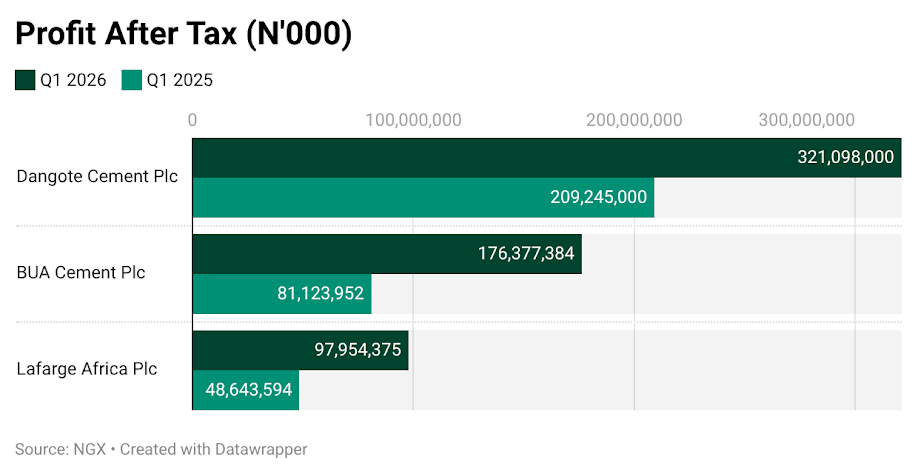
Nigeria’s leading cement manufacturers—Dangote Cement Limited, Lafarge Africa Limited, and BUA Cement Limited—posted remarkable profits, totaling approximately N762.97 billion in the first quarter of 2026. This robust financial performance is set against a backdrop of high cement prices across the nation, with costs fluctuating between N12,500 and N14,000 depending on the region. The surge in profitability coincides with increased government investment in infrastructure projects and a rebound in domestic demand.
Projected Sector Growth Fueled by Demand and Capacity Expansion
The Nigerian cement industry is anticipated to undergo substantial growth in 2026, driven by robust demand, expanded production capacities, and an improving macroeconomic atmosphere. Comparative figures indicate that the aggregate profit for the first quarter of 2026 represents a staggering 57% rise from the N484.83 billion reported during the same timeframe in 2025. This upward trajectory underscores the industry’s resilience and its key role in Nigeria’s economic development.
Individual Company Performance Highlights
In its financial results for the quarter ending March 31, 2026, Dangote Cement reported a pre-tax profit of N421.17 billion, marking a 35% increase from N311.97 billion in Q1 2025. BUA Cement also experienced notable growth, announcing a pre-tax profit of N192.68 billion, a 93% surge from the previous year’s N99.74 billion. Meanwhile, Lafarge Africa’s pre-tax profit nearly doubled, reaching N149.12 billion for Q1 2026, in stark contrast to N73.11 billion in the prior year.
Revenue Growth Across the Board
Revenue for the three companies collectively reached N1.89 trillion in Q1 2026, reflecting a 23% increase from N1.53 trillion a year earlier. Specifically, Dangote Cement reported revenues of N1.2 trillion, a noteworthy rise of 20.4% from N994.7 billion during the first quarter of 2025. This growth not only emphasizes strong sales but also indicates a broader rebound in economic activity.
Strategic Expansion and Market Positioning
Arvind Pathak, Group Managing Director and CEO of Dangote Cement, attributed the company’s success to its effective operational model and disciplined execution in various markets. He highlighted a year-on-year sales increase of 20.4% to N1.2 trillion, driven by a 13.8% growth in volumes. Additionally, Dangote’s EBITDA grew by 22.8% to N567.1 billion, further showcasing the company’s ability to manage costs effectively while expanding its market footprint.
Key Insights on Exports and Infrastructure Initiatives
Pathak also detailed Dangote Cement’s growing export business, which saw a remarkable 71.6% increase in volumes, aided by the completion of ten clinker shipments within the quarter. He added that the company is advancing various expansion projects, including a significant crushing plant in Côte d’Ivoire and additional initiatives in Itori and Ethiopia. These endeavors are expected to bolster production capacity to 80 million tonnes by 2030.
Market Context and Future Outlook
BUA Cement charted a successful start to 2026 with sales reaching N354.98 billion—a 22.1% improvement from the prior year’s N290.82 billion. Lafarge Africa also experienced substantial growth, reporting revenue of N334.88 billion, a 34.8% increase from N248.35 billion in Q1 2025. The company’s gains were bolstered by strong performance across all segments, reflecting the prevailing demand conditions.
Analysts at Chapel Hill Denham remain optimistic regarding the future of Nigeria’s cement sector, expecting sustained revenue growth through strategic capacity expansions and a stable macroeconomic environment. They highlighted the critical role of public infrastructure funding, highlighted by the Federal Government’s N23 trillion budget for capital projects, which underscores cement’s importance as a vital construction material. As urbanization accelerates and the housing deficit remains significant, the demand for cement is not expected to wane anytime soon, ensuring the industry’s momentum continues into the future.
