


Federal Prosecutors Seek Conspiracy Charges Against Immigration Protesters
This week, federal prosecutors will aim to establish that three activists involved in protests against immigration enforcement last summer transitioned from political dissent to criminal conspiracy. This controversial legal approach previously prompted the resignation of the acting U.S. attorney for eastern Washington, who opted not to pursue charges.
This case has attracted significant attention as it serves as a critical test of the Trump administration’s strategy to prioritize immigration-related prosecutions and its approach of targeting protesters who have not been directly implicated in violent acts.
Mary Huang, a former federal prosecutor and law professor at the University of Washington, commented on the implications of this strategy. She explained that typically, arrests are made in response to protests that escalate into violence or property damage. However, the government is moving to broaden the scope of conspiracy charges to include individuals organizing protests, rather than those committing specific harmful acts.
Charges Arising from Spokane Protests
Bajung Mavalwala II, Judge Foral, and Jack Archer are set to stand trial on charges alleging conspiracy to obstruct and injure federal officers. These charges stem from protests held in Spokane, Washington, on June 11, 2025. Six other individuals have also been charged but opted for plea deals to circumvent a trial.
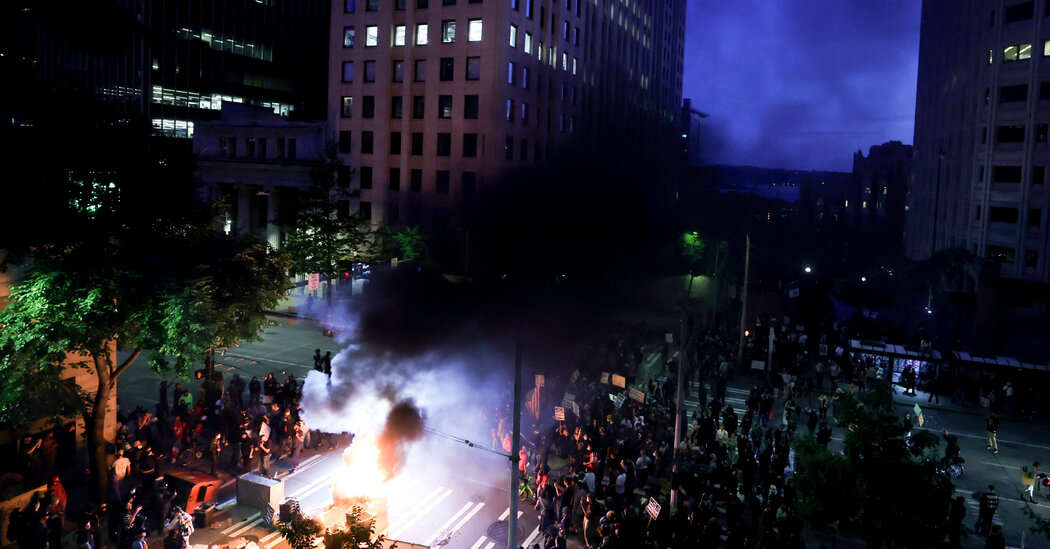
During the Spokane protests, demonstrators attempted to block Immigration and Customs Enforcement (ICE) officers from transferring two Venezuelan immigrants who, despite being legally present in the country, had outstanding immigration warrants. Protesters assembled makeshift barriers and reportedly vandalized a van designated for transporting the migrants, with allegations of deflation of tires and spray-painting windows occurring amid the chaos. Local authorities utilized smoke grenades and pepper balls to disperse the crowds, resulting in over 30 arrests, primarily on misdemeanor charges.
Wider Context of Protests and Federal Response
The Spokane protests coincided with other nationwide demonstrations reacting to the Trump administration’s aggressive immigration policies, driven by a Justice Department directive for U.S. attorneys to prioritize cases involving immigration protests. In the aftermath of the Spokane demonstration, Richard Barker, the then-acting U.S. attorney for the Eastern District of Washington, instructed his team to explore potential conspiracy charges against the protesters. However, he chose to resign instead of proceeding with the case.
Barker expressed concern regarding the federal government’s engagement in policing civil dissent, highlighting a significant shift in the application of federal authority. His successor, Stephanie Van Marter, later oversaw the indictment issued by a federal grand jury, placing the Spokane protests among several recent instances where federal prosecutors have pursued conspiracy charges against anti-ICE activists. Earlier this year, similar tactics were used in Minnesota, where prosecutors invoked conspiracy and civil rights laws to indict dozens involved in a protest at St. Paul’s Church, claiming organized disruption of religious services.
Defendants’ Stance and Legal Implications
Mavalwala, Foral, and Archer have all rejected lesser charges, arguing that their First Amendment rights were infringed upon. They are accused of physically obstructing federal officers but maintain that these allegations do not reflect the most serious incidents from the Spokane protests. In charges filed against Archer, prosecutors highlighted his alleged attempts to block exits to ICE using social media, and he faces a potential maximum sentence of six years if convicted.
While prosecutors were unavailable for comment, charging documents indicate that the nine protesters aimed to obstruct law enforcement operations and were open to utilizing violent tactics. Allegations include a defendant who brought a box cutter to the demonstration and another who retaliated against law enforcement with an incendiary device. U.S. attorneys noted that they could have pursued more severe felony charges for property damage but chose not to do so.
First Amendment Concerns and Local Sentiment
The legal proceedings will unfold in a county that supported Mr. Trump in the 2024 election, revealing a conservative lean compared to other areas of Washington west of the Cascades. The Rev. Emily Cuenker, an active participant in Spokane’s civil rights movement and a pastor with the Evangelical Lutheran Church in America, voiced her concerns, hoping the community recognizes this legal action as an attempt to suppress dissent. She emphasized her commitment to continue the fight for civil rights, prompting community discussions about the implications of this case for free speech in America.
