


Lagos Court Rulings on Extrajudicial Statements in High-Profile Fraud Case
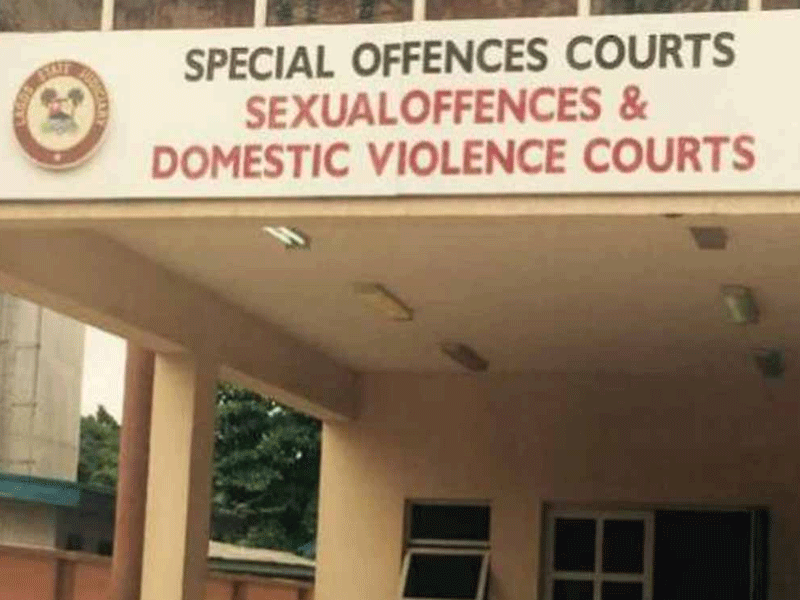
The Special Offenses Court in Ikeja, Lagos State, delivered two significant rulings on the admissibility of extrajudicial statements from a co-defendant in the ongoing $4.5 billion fraud trial involving former Central Bank of Nigeria (CBN) Governor Godwin Emefiele. The court upheld one statement while dismissing another due to procedural deficiencies.
Justice Rahman Oshodi presided over the trial and concluded that the prosecution successfully demonstrated that the statement made by the second defendant, Henry Omoyile, on February 26, 2024, was collected voluntarily and in accordance with legal protocols.
Conversely, the court rejected Omoyile’s second statement dated February 27, 2024, citing that it failed to meet essential legal standards as outlined by the Supreme Court.
In delivering the judgment, Justice Oshodi expressed confidence that the prosecution had shown beyond reasonable doubt that the earlier statements were provided without any form of coercion, threat, or inducement.
Justice Oshodi remarked on the thoroughness of the evidence presented during this mini-trial, noting the absence of physical harm to the defendant and the overall integrity of the statement-taking process. The statements that were accepted have been designated as Exhibits 1 through 3 and will contribute to the prosecution’s case as the trial unfolds.
In contrast, the court’s refusal to accept the second statement highlighted the importance of procedural safeguards in criminal investigations. Justice Oshodi emphasized the lack of requirements such as video documentation of the interrogation and the absence of a lawyer’s approval at the time of the statement’s preparation, both of which are critical to ensuring the legitimacy of confessions, as mandated by past Supreme Court rulings.
This determination followed a mini-trial that scrutinized the contested statements after Omoyile asserted they were obtained under duress by agents of the Economic and Financial Crimes Commission (EFCC). The court subsequently suspended the main proceedings to fully explore the conditions surrounding the statement’s emergence.
The court’s dual rulings not only reinforce elements of the prosecution’s case through the admission of one statement but also reflect the judiciary’s commitment to upholding due process, particularly in complex and high-stakes cases. Omoyile faces three charges related to unlawfully accepting gifts as an agent, while Emefiele is embroiled in 19 counts from the EFCC alleging corruption and seeking benefits during his time at the helm of the CBN.
Both defendants have maintained their innocence regarding the charges. Following the judgments delivered, Justice Oshodi scheduled the next hearings for June 26, June 30, and July 6 and 8, 2026, to continue the trial’s proceedings.
