


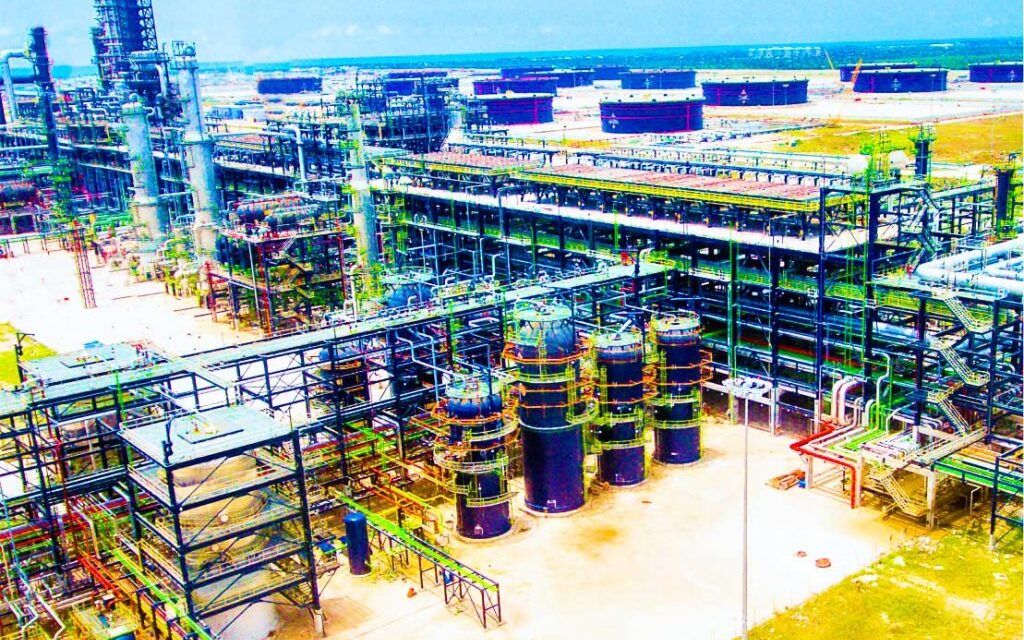
Denying Export Claims, Dangote Petroleum Refinery Clarifies Position on Local Sales
Dangote Petroleum Refinery has rejected allegations that its products are exported to Lomé, Togo, for re-importation into Nigeria. The company described these claims as unfounded and contrary to commercial logic.
This statement comes amid escalating discussions about fuel prices in Nigeria, particularly in light of recent fluctuations in the global oil market following a ceasefire between the United States and Iran.
Petrol prices in Nigeria have surged dramatically since conflicts erupted earlier this year involving the US, Israel, and Iran. Concerns over potential disruptions to global oil supplies, particularly through the Strait of Hormuz, have contributed to rising international oil prices and corresponding domestic price adjustments.
As a key supplier of refined petroleum products, Dangote Refinery has raised its ex-warehouse prices multiple times during this crisis. Previously priced at about ₦870 per liter, petrol has now escalated to nearly ₦1,500 per liter in certain regions, with rates around ₦1,340 per liter at many fuel stations in Abuja and other major cities.
Market Expectations Fail to Align with Reality
Following the ceasefire announcement, many Nigerians anticipated a decline in fuel prices, especially with the subsequent drop in oil prices. During the conflict, Brent crude prices exceeded $100 per barrel, but they have since decreased significantly.
In recent trading, Brent crude fluctuated between $74.95 and $75.07 per barrel, sparking debate across social media as users expressed confusion over why domestic petrol prices have not decreased accordingly.
Refinery Responds to Allegations
In a statement titled “Responding to Unfounded Claims and a Series of Lies,” the refinery acknowledged that while it typically refrains from addressing rumors, it felt compelled to clarify its position. It highlighted that assertions regarding the shipment of products to Lomé and their re-importation lack support from available trade data and are devoid of commercial legitimacy.
The refinery emphasized that advocating for imports that directly compete with its offerings conflicts with its strategy to enhance its role as a primary supplier of petroleum products in Nigeria. The company’s sales agreements explicitly prohibit the resale or re-importation of its products.
The Economic Case Against Re-Importation
From an economic standpoint, the refinery argued that the logistics of such re-importation would not be financially viable. It estimated that costs for transporting products from Nigeria to Lomé and then back would range between $82 and $90 per tonne, which would significantly erode profit margins.
Furthermore, Dangote Refinery noted that it does not provide export discounts large enough to resolve the associated logistics, storage, financing, and handling expenses. Consequently, there is little incentive for producers to incur the additional costs when competing in their nearest and largest markets.
Commitment to Local Market Integrity
In its statement, the refinery reiterated that it maintains comprehensive records of all product sales, including loading locations, vessels, trading partners, and delivery points. The refinery asserted that any claims implying its involvement in facilitating product re-importation contradict its contractual restrictions and compliance protocols.
Moreover, these allegations stand against the refinery’s long-standing mission to reduce Nigeria’s reliance on imported petroleum products. The company expressed concern that increasing fuel imports would undermine local refining capabilities, place a strain on foreign exchange reserves, and hamper domestic industrial growth.
Ultimately, the Dangote Refinery articulated that supporting or encouraging practices that drive imports into Nigeria would contradict both its corporate interests and its publicly declared position. The government has supported this viewpoint, stating that the claims do not hold up against trade economics, contractual agreements, and ongoing efforts to bolster domestic refining and improve Nigeria’s energy security.
