


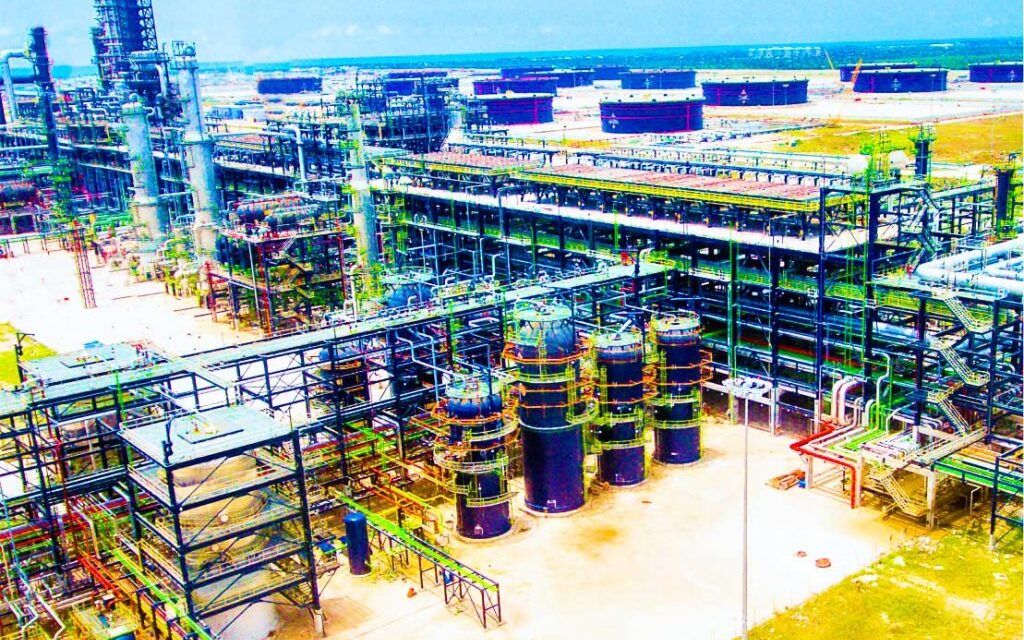
Dangote Petroleum Refinery Exceeds Processing Capacity
Dangote Petroleum Refinery and Petrochemicals has announced an increase in its crude oil processing capacity to 700,000 barrels per day (bpd), surpassing its nameplate capacity of 650,000 bpd. This enhancement follows a performance evaluation conducted by a process licensor, marking a notable operational achievement for a facility recognized as the world’s largest single-train oil refinery.
Strategic Expansion Toward Energy Independence
In a statement shared with PREMIUM TIMES, Anthony Chiejina, Group Chief Branding and Communications Officer at Dangote Group, emphasized that this increase demonstrates the refinery’s capability to optimize operations while processing additional feedstock. Devakumar Edwin, Vice President of Oil and Gas at Dangote Industries Limited, highlighted that this production boost forms part of a larger strategy aimed at elevating capacity to 1.4 million bpd over the next 30 months.
Ambitious Growth Plans for the Future
Mr. Edwin articulated that the planned expansion has the potential to position the refinery among the largest refining complexes globally, further solidifying Nigeria’s commitment to energy self-sufficiency. He stated that the trajectory of the refinery’s growth is indicative of a strategy not only focused on national supply sufficiency but also aimed at achieving dominance in both continental and global refining markets.
Current Production Levels and Future Goals
Recent disclosures indicate that the refinery has already reached a production capacity of 70,000 barrels per day, a target anticipated to be met by 2028. During remarks made at the S&P Global Energy Middle East Oil and Gas Conference in London, CEO David Byrd revealed that the refinery is currently operating at full nameplate capacity, implementing a “ruthless replication” approach to expand production. He projected that a fully complex refining capacity of 700,000 bpd would be achieved by the end of 2028, bolstered by procurement of long-lead equipment and ongoing construction contracts.
Impact on Global Jet Fuel Exports
The Dangote oil refinery has had a significant impact on Nigeria’s energy landscape, transforming the nation from one grappling with fuel scarcity to becoming fuel-abundant. Data from Kpler indicates that the refinery exported approximately 57 million barrels of jet fuel between April 2024 and April 2026, with exports rising sharply from 20,000 bpd in April 2024 to 160,000 bpd by the end of the review period.
Diverse Product Offerings and Regional Influence
Since commencing production in 2024, the refinery has broadened its output to include gasoline, diesel, aviation fuel, and other refined petroleum products. The facility services both domestic and international markets, exporting to various African nations as well as European countries, including the UK, France, Spain, Italy, and the Netherlands. Notably, products are also reaching the U.S. market, with jet fuel exports expanding to Saudi Arabia. As geopolitical tensions disrupt supply chains, the refinery is increasingly viewed as a stabilizing force in the regional fuel market.
Future Economic Contributions and Industrial Development
With plans to reach a capacity of 1.4 million bpd by 2028, Dangote Industries envisions significant economic benefits, including job creation, heightened industrial activities, and an improved trade balance. The refinery aims to foster downstream industrialization by supplying liquefied petroleum gas (LPG), polypropylene, and essential raw materials, as well as producing linear alkylbenzenes (LABs) to enhance Nigeria’s petrochemical value chain.
