


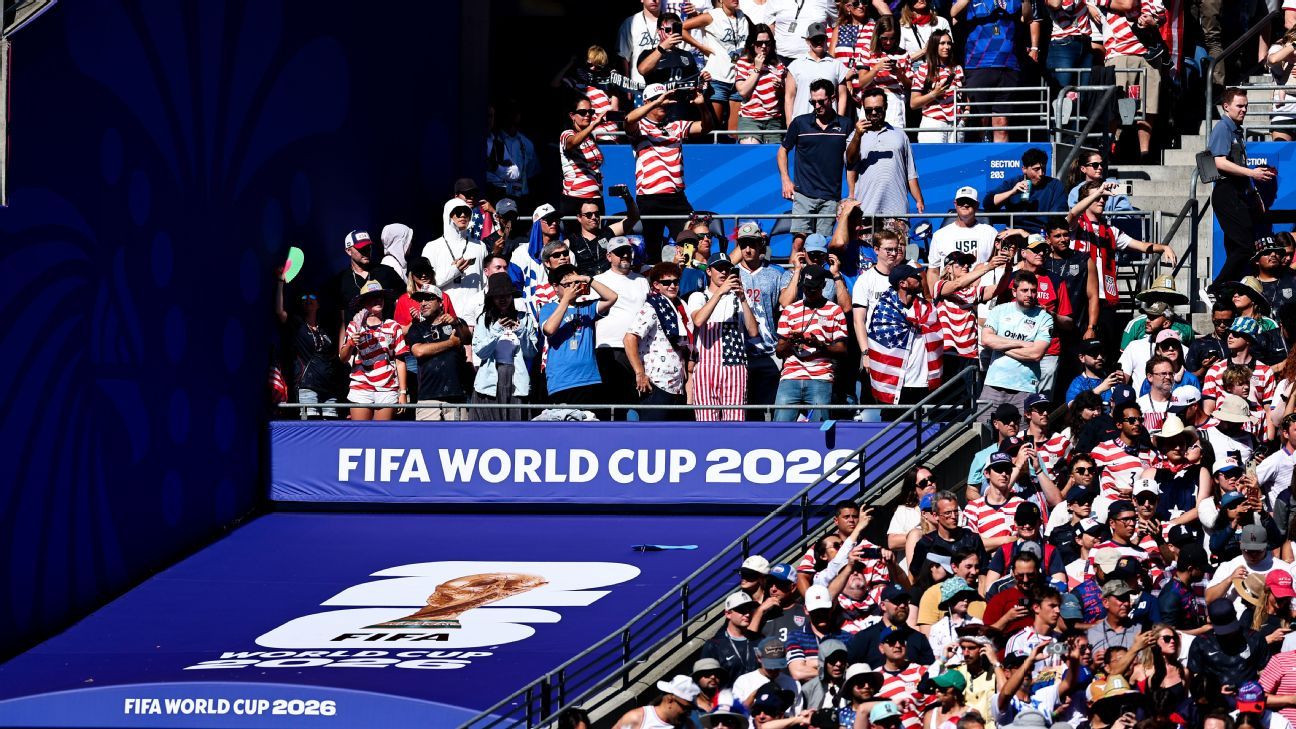
The U.S. men’s national soccer team faced a challenging exit in the 2026 FIFA World Cup, losing 4-1 to Belgium in the Round of 16. Despite the defeat, the team secured $16 million in prize money from FIFA.
Should the U.S. women’s team qualify for the upcoming 2027 Women’s World Cup, they and their male counterparts will share this prize money evenly, with 26 players on each roster benefitting equally from the financial support.
Equitable Distribution of World Cup Prize Money
Under a progressive collective bargaining agreement (CBA) ratified by U.S. Soccer with both national teams, prize money from World Cup tournaments will be evenly split between men’s and women’s players. This agreement was achieved after years of advocacy and legal battles for equal pay by the women’s national team.
As stipulated in the CBA, U.S. Soccer will retain 20% of each World Cup’s prize money, while the remaining 80% will be distributed equally among the players on each team’s tournament rosters. This translates to $6.4 million allocated to each squad, resulting in approximately $246,154 per player.
The prize money structure for the 2027 Women’s World Cup will follow a similar equitable distribution model, although it is contingent upon the women securing a spot in the tournament. Currently, they must advance past El Salvador in the Concacaf quarterfinals on November 27, a feat widely expected from the four-time champions.
Furthermore, the per-player prize amount is likely to rise, provided the U.S. women successfully qualify for the World Cup. Upon receiving the prize money from FIFA, U.S. Soccer must disburse the men’s players’ share within 31 days, as outlined in the agreement.
However, the distribution for the women’s team hinges on their successful qualification, and the roster won’t be finalized until next spring. As a result, the $6.4 million earmarked for the women will initially be deposited into an interest-bearing account managed by the federation.
Any interest accrued on this money will be shared equally between the 52 World Cup participants—26 from the men’s team and 26 from the women’s team, reflecting the prize money obtained during the women’s 2027 tournament. All payouts must occur within 31 days of the federation receiving funds from FIFA.
The total prize pool for the 2027 Women’s World Cup has yet to be finalized. FIFA President Gianni Infantino has expressed a commitment to achieving equal prize money for both men and women by that tournament. His remarks followed a significant financial increase for the men’s prize pool, which nearly doubled from four years ago, coinciding with an expanded men’s competition format.
The planned prize money for the 2023 Women’s World Cup is set at $110 million, a substantial increase from the $30 million awarded in the 2019 tournament, although the full scope of these financial commitments remains to be seen.
It is important to note that U.S. Soccer also compensates its men’s and women’s players with a guaranteed payment of $10,000 for each World Cup match, regardless of the outcome. Had the U.S. men’s team progressed further in the tournament by defeating Belgium, the financial ramifications would have been significant, potentially yielding $20 million in prize money, which would benefit both teams accordingly.
The most recent quarterfinal appearance by the U.S. men’s team was in the 2002 World Cup, while the U.S. women’s team, which has clinched the World Cup title four times, found itself eliminated in the Round of 16 in 2023, an unexpected outcome. During that tournament, they earned $1.87 million from FIFA for their performance.
Prize distributions for the 2026 Men’s World Cup have also seen increases from previously announced amounts, according to a FIFA spokesperson. Adjustments made after the FIFA General Assembly in Vancouver unveiled higher expected payouts, though exact figures for the latest prize pool are still pending.
Current projections for the 2026 Men’s World Cup prize money include $51 million for the winner, $34 million for the runner-up, and $30 million for third place, diminishing incrementally down to $10 million for the lowest-ranked teams from 33rd to 48th place.
This article includes contributions from ESPN writer Jeff Carlisle.
