


Written by Michael Olugbord
New ECOWAS Headquarters Unveiled Amid Regional Aspirations
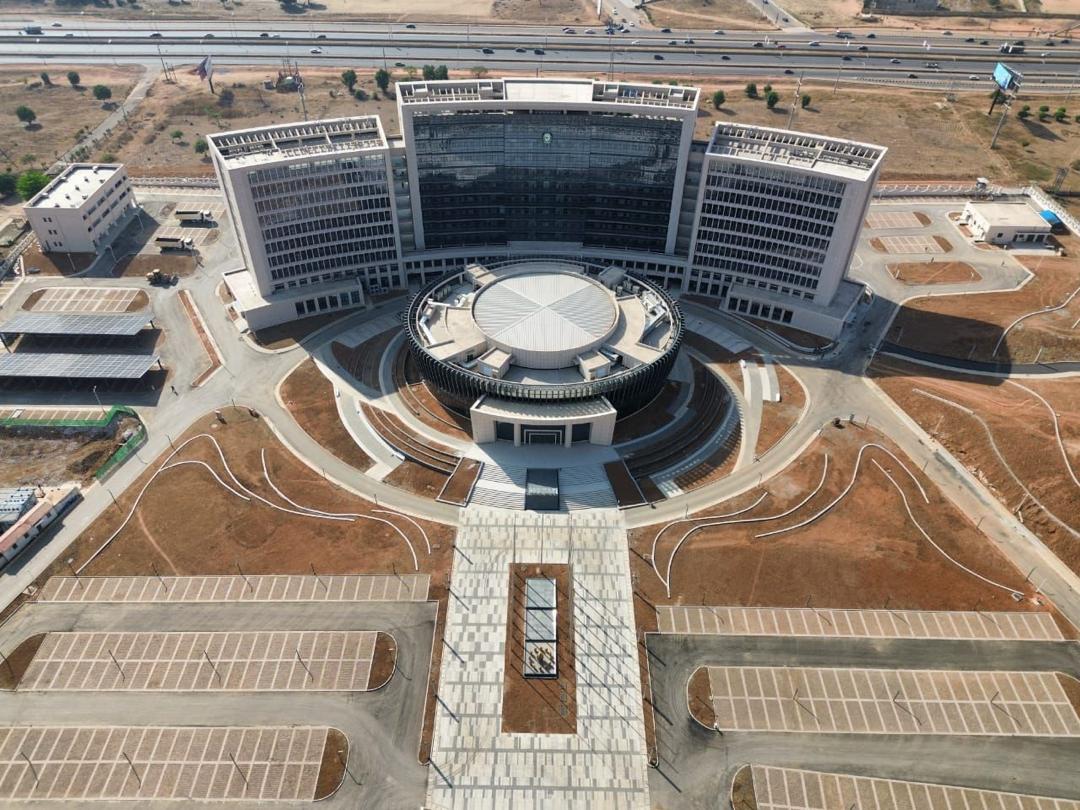
On a rain-soaked morning in Abuja, the inauguration of the new headquarters for the Economic Community of West African States (ECOWAS) marked a significant event transcending mere ceremonial gestures. This building stands as a potent emblem of regional ambitions, global partnerships, and the shifting political landscape of West Africa. Often referred to as the “Eyes of West Africa,” this project has been termed by Chinese Ambassador Yu Dunhai as “a groundbreaking…China’s flagship aid project for ECOWAS.”
Leadership Reflections on Integration Milestones
For ECOWAS Commission President Omar Aliu Touray, the occasion was both a cause for celebration and a moment of contemplation. He emphasized the historical importance of this day within ECOWAS’s 50-year journey towards integration, yet urged caution against viewing the completion of the building as a final milestone. “This event symbolizes the completion of the project and the transfer of the building,” he stated, noting that a formal commissioning will take place later this year. Nevertheless, he asserted that the new headquarters serves as a critical tool to foster regional integration and enhance peace and prosperity for all ECOWAS citizens.
Buildings as Instruments of Unity and Commitment
The perspective that infrastructure can serve as a foundation for broader ambitions resonated throughout the ceremony. Bianca Odumegwu Ojukwu, Nigeria’s Minister of Foreign Affairs, articulated the moment’s significance as extending beyond mere physical structures. She framed it as a reaffirmation of unity and a renewed dedication to regional integration, peace, and sustainable development. She noted that ECOWAS continues to serve as “a beacon of cooperation and unity,” engaging in pivotal initiatives ranging from peacekeeping missions to democratic governance across West Africa.
A Vision for Cooperative Development
This sense of collaborative responsibility was central to her address. “The strength of ECOWAS lies not solely in its institutions, but in the unity, commitment, and shared resolve of its member states,” she cautioned. Highlighting the region’s array of challenges—including security threats, political transitions, and economic strains—she emphasized that solidarity among nations is not optional; it is essential for survival.
Strengthening Abuja’s Diplomatic Role
The occasion further allowed Nigeria to showcase Abuja’s role as a diplomatic center. Federal Capital Territory Minister Nyesom Wike, represented by Minister Mariya Mahmoud Bounkure, articulated that the new headquarters transcends infrastructure. “This event represents the handover of a vision—one of cooperation and community solidarity,” he said. Wike underlined that this impressive structure is more than a mere amalgamation of concrete, steel, and glass; it is a powerful testament to the importance of ongoing collaboration. He declared Abuja as not just the nation’s capital but also a meeting point for international diplomacy.
China’s Strategic Engagement in African Infrastructure
For China, the new headquarters symbolizes a strategic partnership and a long-term commitment to supporting African institutions. Ambassador Yu Dunhai described it as “China’s flagship aid project for ECOWAS” and contextualized it within the broader continental framework, likening it to the African Union headquarters in Addis Ababa. Highlighting the construction process, which spanned over 1,200 days, he celebrated the transformation of a “dreamy blueprint into concrete reality.”
Balancing Expectations with Regional Challenges
Yu emphasized that the building is designed not only with architectural significance but also with a focus on harmonizing Chinese techniques with West African culture, while aiming to enhance the operational capacity of the ECOWAS Commission. His remarks touched on ideological implications—China’s vision contests the notion of a “survival of the fittest,” aspiring instead toward an egalitarian and multipolar world. He asserted that future cooperation will prioritize impartiality and long-lasting commitments, encapsulated in his statement: “One building carries common hopes, one partnership leaves a legacy.”
The Path Forward: Requests and Responsibilities
The ambition behind this project emerges amidst a landscape of political uncertainty and security challenges in the Sahel region, underscoring the building’s dual role as both an opportunity and a reminder of the work to be done. Wike noted, “As our region grapples with significant challenges, this structure serves as a reminder that West Africa must resist division.” Meanwhile, Touray underscored the need for forward-thinking approaches that honor past legacies while paving the way for future generations.
Throughout the ceremony, the theme of legacy resonated strongly. Touray spoke of the enduring influence of the founding fathers, while Wike declared, “History will always remember the builder.” Ojukwu highlighted the moment as not merely an end, but a new beginning, with Yu articulating a shared vision: “One building carries a common hope.” The “Eyes of West Africa” embodies ECOWAS’s commitment to enhancing its institutional capacity, alongside Nigeria’s aspiration to assert itself as a pivotal diplomatic hub and China’s growing influence on African infrastructure and governance.
Ultimately, as speakers acknowledged, this building represents a starting point, not a conclusion. The challenge remains to ensure that West Africa’s most crucial regional institution harmonizes its physical stature with political efficiency, especially as expectations grow in tandem with China’s increasing involvement.
