


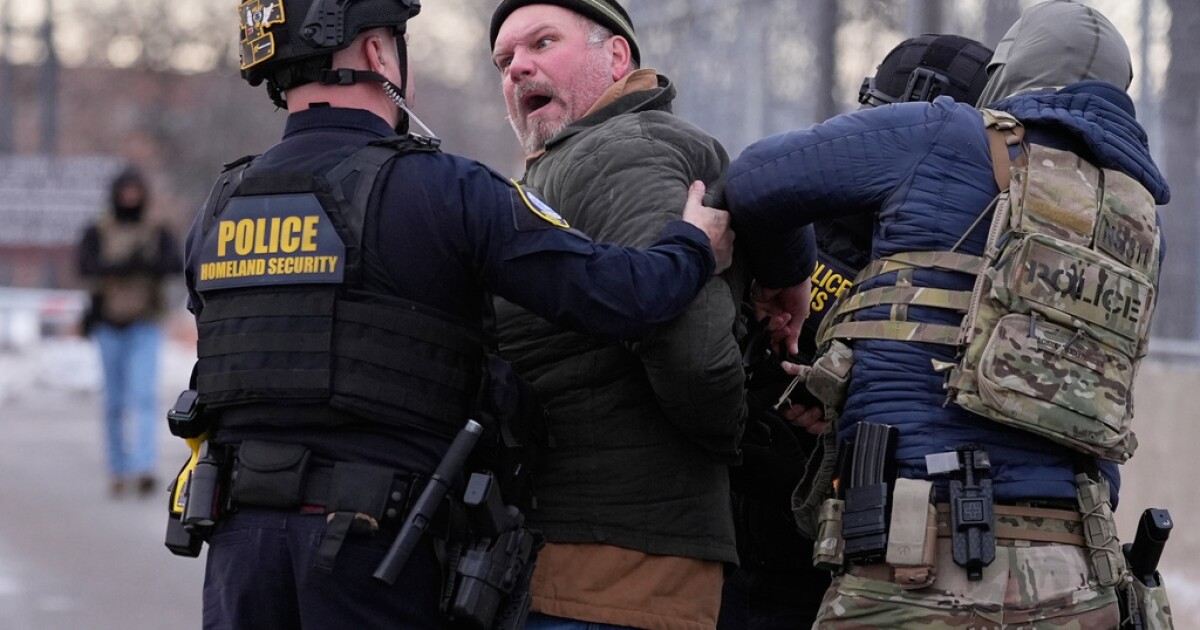
The recent decision to charge a federal immigration officer with assault after an altercation with a protester in Colorado may challenge the boundaries of immunity usually afforded to federal agents. This incident comes as states ramp up their scrutiny of law enforcement practices in light of the Trump administration’s aggressive immigration enforcement policies.
On Wednesday, Colorado prosecutors announced that the officer is facing charges of third-degree assault and criminal mischief following an investigation into his actions during protests in October. Video footage captured the moment when federal agents detained a 57-year-old woman, who alleges she was choked during the encounter.
Colorado has stringent regulations prohibiting or greatly limiting the use of chokeholds and neck restraints by law enforcement. Despite this, immunity provisions rooted in the U.S. Constitution and federal laws create obstacles for local authorities attempting to prosecute federal employees.
State Investigations into Federal Conduct
The aggressive immigration enforcement strategies of the Trump administration have prompted multiple inquiries from state and local law enforcement agencies.
Earlier this month, a federal immigration officer was charged with two counts of second-degree assault by a Minnesota prosecutor as part of an investigation into the actions of several officers during immigration enforcement operations in the Minneapolis area. Gregory Donnell Morgan Jr., an officer with Immigration and Customs Enforcement (ICE), is accused of brandishing a firearm at individuals in a vehicle after pulling them over on a freeway. Investigators noted that Morgan expressed concerns for his safety after the vehicle allegedly swerved in front of him.
In another development, Minnesota authorities filed a lawsuit against the administration seeking evidence related to three shootings during the crackdown, including incidents that resulted in the deaths of Renee Good and Alex Preti.
Legal Protections for Federal Employees
Federal law enforcement officers benefit from extensive legal protections while carrying out their duties, and the Justice Department has historically resisted state-level efforts to arrest or prosecute these individuals. Late last year, Deputy U.S. Attorney Todd Blanche characterized arrests of federal employees working within the scope of their duties as “unlawful and wasteful,” invoking the Constitution’s Supremacy Clause as a basis for this assertion.
Experts in the legal field contend that while these protections are significant, they are not absolute; the supremacy clauses do not provide blanket immunity. In response to the Colorado charges, a spokesperson for the Department of Homeland Security (DHS)—which includes U.S. Customs and Border Protection—stated that state authorities lack the jurisdiction to investigate such cases, asserting that “federal employees performing their duties may only be subject to investigation by other federal agencies.”
Growing Scrutiny of ICE Officers
The actions of ICE personnel are increasingly coming under the microscope, especially against the backdrop of a rapid hiring campaign that has raised concerns about the adequacy of background checks for new applicants.
Protests in a Colorado Community
The incident in Colorado ignited tensions during demonstrations on October 27, which were sparked by the arrest of three Colombian asylum seekers—a man and two children—while on their way to school that morning. Subsequently, protesters gathered outside the ICE facility in Durango, a college town famed for its outdoor recreational activities in the San Juan Mountains.
Footage from the event reveals federal agents placing Franci Stazi in what she describes as a chokehold. Since the death of Eric Garner in 2014 following a chokehold by a New York police officer, this technique has loomed large in public discourse concerning excessive force in law enforcement.
Stazi, a former hypnotherapist, recounted that as she attempted to get the agent’s attention by reaching for his shoulder, he retaliated by seizing her hair, placing her neck in the crook of his arm, and dragging her across the road before throwing her down an embankment. Court records allege that Customs and Border Protection officer Nicholas Rice committed third-degree assault resulting in bodily harm to Stazi, although details regarding the nature of her injuries are scant, and no representation for the officer is listed in legal documents. A spokesperson for U.S. Customs and Border Protection has not yet responded to inquiries regarding the charges.
Despite her disappointment over the severity of the charges, Stazi expressed hope that the legal action would signal a strong message: immigration officers must not resort to excessive force or engage in unwarranted aggression against civilians.
