


Authorities Avert Major Chemical Disaster in Garden Grove
In Garden Grove, California, recent developments surrounding a chemical storage tank have raised critical concerns about potential leaks or explosions. Local officials, bolstered by state and federal agencies, have been working diligently to prevent what could have become one of the most catastrophic chemical incidents in California’s history. The state of emergency has compelled authorities to communicate complex chemical mechanics to worried residents who have been evacuated without a clear timeline for their return.
Details on the Chemical Threat
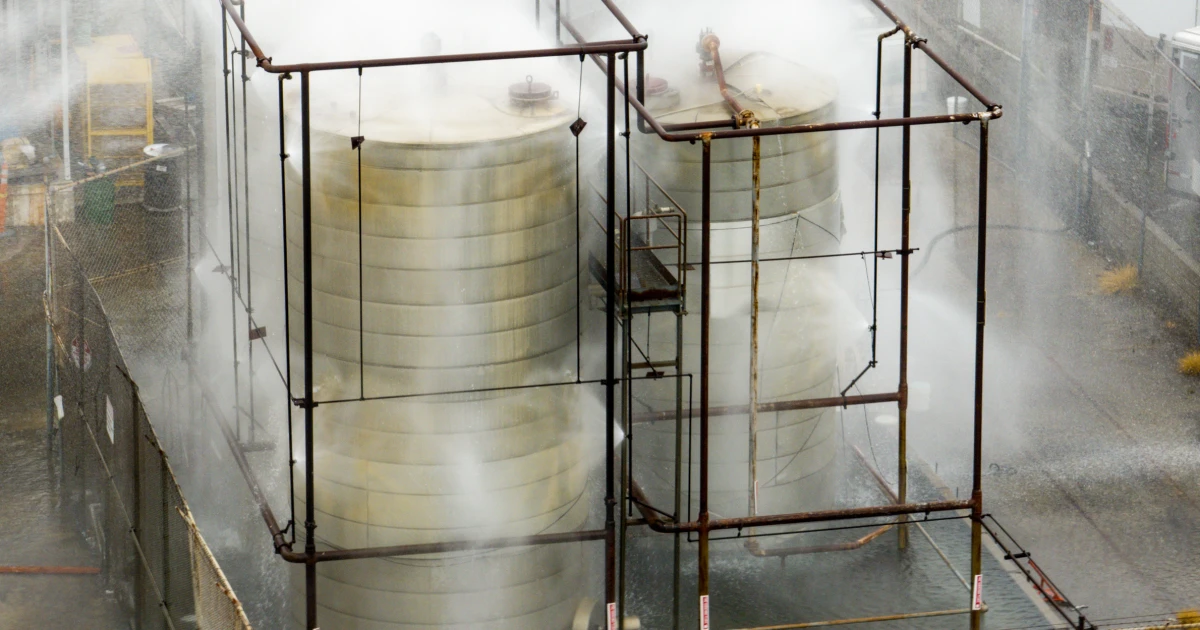
The focus is on a storage tank located at an aerospace facility, which holds approximately 7,000 gallons of liquid methyl methacrylate—a chemical essential for producing resins and plastics. Last week, the Orange County Fire Department reported alarming developments: the tank had overheated and started to expand, creating a hazardous situation.
Potential Scenarios and Expert Insights
This scenario presented two alarming possibilities. The tank could either crack due to extreme pressure, leading to chemical leakage, or it could rupture and explode, sending vaporized chemicals into the atmosphere. Experts expressed significant concern that a singular explosion could trigger a chain reaction, potentially leading to the ignition of nearby tanks holding the same substance.
Risk Factors of Methyl Methacrylate Exposure
Exposure to methyl methacrylate carries health risks including eye and skin irritation, as well as respiratory issues such as coughing and shortness of breath. By Monday morning, however, local authorities announced they had successfully mitigated the immediate threat of a boiling liquid expanding vapor explosion (BLEVE), which occurs when a flammable liquid rises above its boiling point, generating pressure that leads to an explosion.
Effective Measures and Decreasing Temperatures
Andrew Welton, a civil engineering professor at Purdue University, drew an analogy to a soda can left in a hot vehicle: if not vented, the pressure builds until it bursts. Fortunately, a crack in the tank had allowed excess pressure to escape, resulting in a drop in internal temperatures. Firefighters have also employed sprinklers and hose lines to cool the tank, with over 50,000 residents in the vicinity still under evacuation orders.
Government Response and Ongoing Investigation
Initially, temperatures inside the tank reached alarmingly high levels, peaking at over 100 degrees Fahrenheit. By Monday, the temperature had decreased to 93 degrees, which experts like Welton view as a promising sign indicating that no additional heat is being generated. Despite the progress, officials remain cautious about the potential for minor explosions or chemical spills, as some researchers speculate that the methyl methacrylate may be reacting and forming solid chains, reducing its volatility.
Legal and Environmental Accountability
The cause of the tank’s overheating remains uncertain, prompting an investigation by the Orange County District Attorney’s Office. In a related development, two residents have initiated a class-action lawsuit against GKN Aerospace, the company operating the facility. A spokesperson for GKN Aerospace stated that their technical experts are collaborating with local authorities to stabilize the situation while expressing regret for the disruption caused to residents in the area.
Conclusion: Accountability and Future Prevention
As the emergency unfolds, the need for thorough environmental and safety assessments cannot be understated. Experts stress the importance of understanding the maintenance history of the storage tanks and evaluating whether the chemicals may have solidified, causing mechanical failures. With multiple agencies involved in resolving this crisis, the hope is to prevent any release of chemicals and ensure residential safety.
