


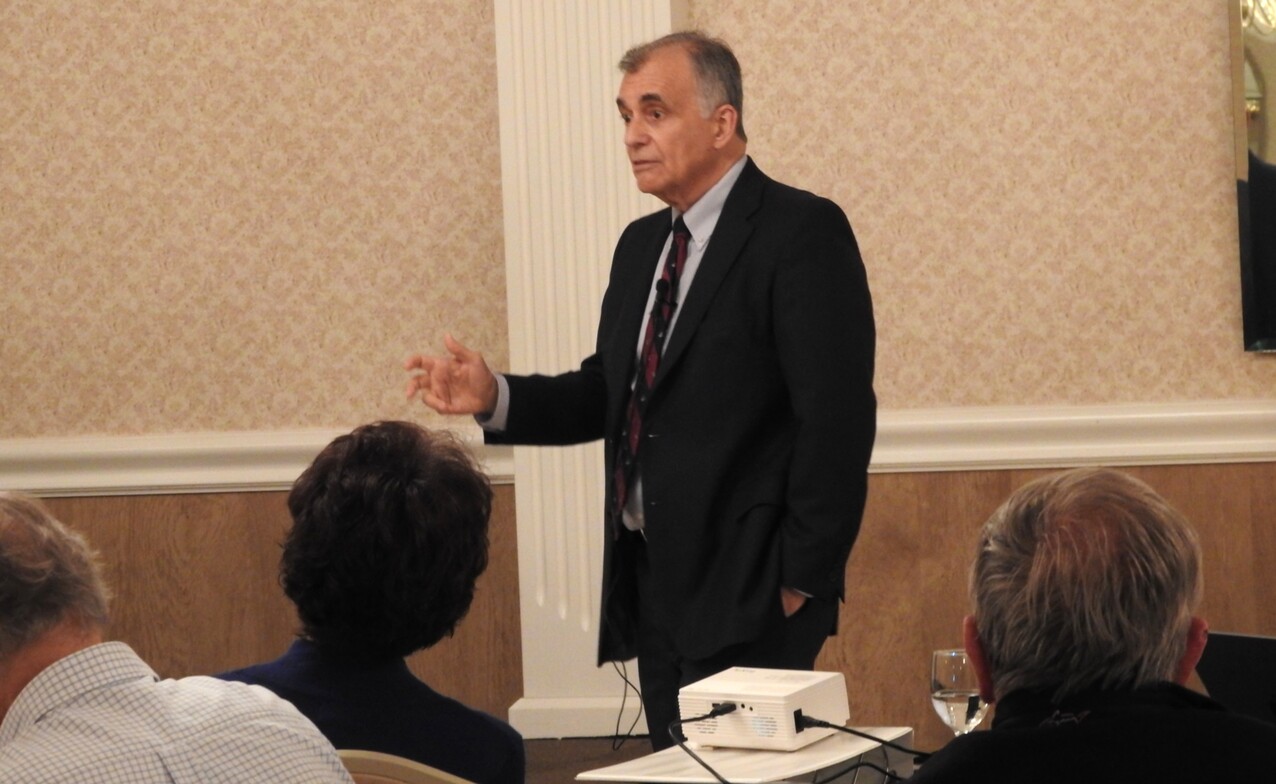
Lorain First Friday Forum Addresses Immigration Issues
At the First Friday Forum held in Lorain County on April 10, attorney Stephen Squery provided attendees with an insightful overview of the complex and multifaceted issues surrounding immigration in the United States.
A devoted parishioner of St. Ladislas, Squery has dedicated his career to immigration advocacy, offering pro bono legal services to individuals pursuing political asylum. After nearly 40 years at the prestigious Jones Day law firm, he now volunteers with the Legal Aid Society of Cleveland, Catholic Charities, and the Diocese of Cleveland’s Welcome the Stranger Initiative. Alongside his wife, Therese, Squery co-chairs the St. Ladislas Social Justice Ministries, further cementing his commitment to these causes.
During his presentation, Squery highlighted that immigrants constitute over 15 percent of the U.S. population, amounting to approximately 52 million individuals, and represent nearly 19 percent of the workforce. He also discussed the Catholic Church’s teachings on immigration, the historical context of immigration in the U.S., policy developments for individuals with protected status—including refugees and those seeking asylum—and the relationship between immigration and crime rates.
According to Squery, around 14 million individuals are classified as “unauthorized,” with approximately 6 million possessing some form of protected status under U.S. law. This group includes nearly 4 million asylum seekers as well as those benefiting from various programs such as humanitarian parole, temporary protected status, and Deferred Action for Childhood Arrivals (DACA).
In a notable announcement, Squery referenced a “special message” from the U.S. Conference of Catholic Bishops issued last November, which raised concerns over evolving immigration issues. He described the message as both “unusual” and “significant,” with the bishops voting 216 to 5 in favor, accompanied by three abstentions. The statement affirmed the Church’s position that countries should honor the inherent dignity of all individuals, including immigrants, while also noting the need for states to regulate borders and implement fair immigration systems for the collective good.
Squery traced the historical trajectory of immigration in the 19th and 20th centuries, demonstrating how certain demographics, particularly those from Asia and Southern and Eastern Europe, faced considerable opposition. The Immigration Act of 1924 established stringent quotas on immigrants from various countries, leading to a dramatic decline in influx, notably impacting European Jews fleeing persecution.
Since the last significant immigration reform passed in 1986, which allowed amnesty for undocumented residents who had been in the country since 1982 and increased Border Patrol personnel, efforts to amend what Squery describes as “a broken system” have proven unsuccessful.
He also explained that refugees undergo rigorous vetting processes that can extend for years and emphasized that there are strict caps on applications for humanitarian parole or Temporary Protected Status (TPS). An internal review for refugees arriving between January 20, 2021, and February 20, 2025, has suspended green card processing for this group, while many asylum seekers are currently under detention to mitigate asylum claims.
Despite recent spikes in arrivals at the southern border, Squery cautioned against exaggeration, highlighting that border security efforts remain robust, with around 4 million individuals having been arrested and deported. Addressing the contentious issue of immigration and crime, he cited research indicating that immigrants have lower crime rates relative to native-born U.S. citizens and that areas with significant immigrant populations often experience reduced crime rates.
Contrary to claims that the Biden administration has permitted thousands of “immigration killers” into the country, Squery dismissed these assertions as misleading. He clarified that the reported numbers date back to the Reagan administration and lack evidence linking migrants released from prisons or asylums in other nations to crime in the U.S. Only about 5 percent of undocumented immigrants have ever faced violent crime convictions, with 73 percent having no criminal record at all. Additionally, he debunked the notion that immigrants are exploiting taxpayer-funded social welfare programs, explaining that immigrants are generally ineligible for such assistance.
Squery argued convincingly that immigration yields tremendous economic benefits and that expelling immigrants would be detrimental to the U.S. economy. He emphasized the necessity of recognizing immigrants as vital contributors to economic growth and advocated for a fair immigration system that benefits society as a whole.
Veteran broadcaster Paul Orlowski is set to explore community engagement within the church at his upcoming May 1 luncheon at Tom’s Country Place in Avon. Doors will open at 11 a.m., with lunch served at 11:30 and the program commencing at noon. Attendance costs $25.
