


Growing Network of Texas Counties Embraces 287(g) Agreements
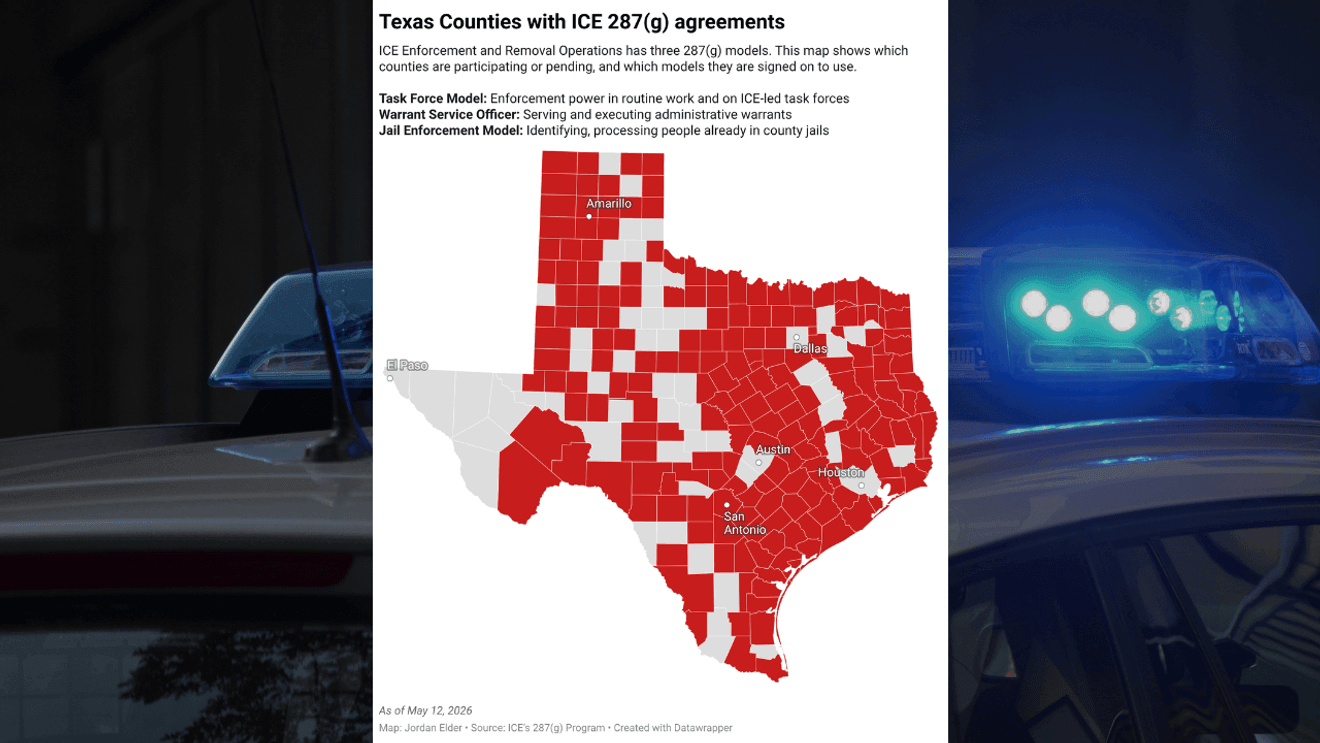
SAN ANTONIO — An expanding 76% of Texas counties have established agreements with U.S. Immigration and Customs Enforcement (ICE) under the federal 287(g) program, which enhances the involvement of local law enforcement in immigration enforcement activities.
Deadline Looms for County Agreements
Per Texas law, sheriffs from counties with populations exceeding 100,000 are mandated to formalize these agreements by January 1. However, counties have until the end of 2026 to adopt one of three enforcement models outlined in the program.
Broader Participation Beyond Counties
The investigation by the News 4 I-Team revealed that participation is not limited to counties. Several local cities and institutions around San Antonio, such as Balcones Heights, Hollywood Park, China Grove, and St. Hedwig Marshall’s Office, have also entered into 287(g) agreements with ICE.
Local Governments’ Discretion on Agreements
While local governments have the option to adopt these agreements, they are not currently mandated by Texas law. The program offers flexibility, allowing agencies to choose from or combine three models, depending on their desired level of involvement in immigration enforcement.
Types of Enforcement Models in the Program
The task force model enables law enforcement to exercise enforcement powers in their daily operations or alongside ICE-led task forces. The Warrant Officer Program allows local officers to issue and act on administrative warrants for immigrants in custody, while the Jail Enforcement Model focuses on identifying individuals for processing from county jails. Civil rights advocates have raised significant concerns, particularly about the task force model, fearing it may extend enforcement into communities rather than confining it to prisons.
Community Concerns on Impact of 287(g) Agreements
Sara Cruz, policy and advocacy strategist for the ACLU of Texas, emphasized that the task force model poses a heightened risk for residents traveling through cities with 287(g) agreements. This model is more frequently implemented than others, and the ACLU has voiced broader apprehensions regarding racial profiling, civil rights violations, and potential litigation risks for law enforcement.
Participating Law Enforcement Agencies and Financial Benefits
Among Texas’s most populous counties, Bexar County, which includes San Antonio, is the only one currently employing the 287(g) model. Even though it is not mandated, Bexar County’s 3rd Precinct signed the agreement. Officer Mark Vojvodich of the 3rd Precinct acknowledged the public perception of the task force model but does not foresee significant changes in daily operations for deputy constables.
Financial Motivations Behind Participation
ICE provides participating agencies with financial benefits, such as annual salary and benefit reimbursement for trained 287(g) employees and overtime compensation up to 25% of an employee’s salary. Additionally, agencies can qualify for quarterly financial merit awards based on their success in locating undocumented immigrants. Hollywood Park confirmed that three of its employees have received training under the 287(g) agreement, with indications of compensation being sought. Similarly, Balcones Heights reported that 23 out of its 29 officers have been trained and appointed, with officials emphasizing their commitment to public safety over political implications.
Status of Statewide Participation
The Texas Department of Public Safety has confirmed that 100 troopers from the Texas Highway Patrol have completed the program training, in addition to 28 specially trained agents in the Criminal Investigation Division. Noncompliance with state law regarding these agreements may expose counties to legal liabilities, with the Texas Attorney General empowered to pursue violations in court. Currently, about 200 counties and 90 cities or law enforcement offices across the state have signed some form of agreement with ICE.
