


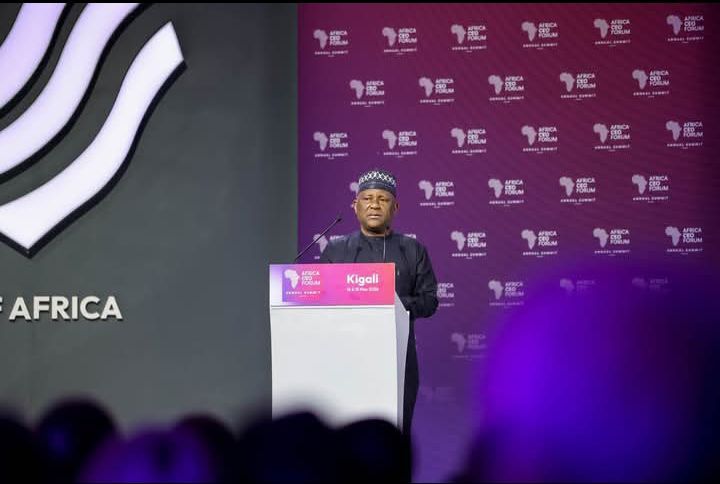
Travel Experience Highlights Challenges in African Mobility
Abdul Samad Rabiu, the founder of BUA Group, recounted a frustrating travel experience that underscores the challenges Africans face in their own continent. Speaking at the Africa CEO Forum in Kigali, he revealed that while European nationals were permitted entry into South Africa without visas, he was turned away due to his visa expiring a day before his arrival in 2025.
Rabiu detailed his ordeal after landing in Cape Town, where he waited for hours at the airport before being sent back to Lagos. He emphasized that this incident reflects broader issues regarding mobility for Africans traveling within Africa.
“I had a personal experience last February when I was traveling to Cape Town for the Indaba mining conference. We arrived at 6 a.m. after departing from Lagos the previous evening,” he stated. Upon reaching immigration, he was informed that his visa had expired, a detail overlooked by his crew. After four hours of waiting, he had no choice but to return to Lagos.
Interestingly, passengers on three international flights, predominantly from Europe, were granted access to Cape Town without visa restrictions, which Rabiu found troubling. He expressed understanding concerning his personal visa status but criticized the inconsistency that allows non-Africans easier entry while hindering African nationals.
“As an African, I encountered a problem in Africa. Foreigners were allowed entry without a visa, whereas I was denied because of my expired visa. This disparity needs to change,” he asserted.
Lack of Regional Cooperation Affects Business Expansion
Rabiu pointed out the lack of cooperation among African countries, which he believes hampers the movement of people and inhibits the expansion of businesses across borders. He explained that while seeking to grow BUA Group’s presence in various African markets under the African Continental Free Trade Area (AfCFTA), his organization faced bureaucratic obstacles in some nations.
“While some countries embraced the spirit of the AfCFTA, others imposed administrative barriers that limited participation in regional trade,” he said, adding that the AfCFTA is currently not functioning as effectively as intended. This sentiment was reinforced by his own experiences in attempting to penetrate certain markets.
Rabiu emphasized that real economic integration is essential for transforming Africa’s potential into tangible economic scale. The AfCFTA aims to unify a market of over 1.4 billion people across 55 nations, but uneven implementation remains a significant hurdle.
Capital, Policy, and Infrastructure are Key to Transformation
Looking ahead, Rabiu believes the future transformation of Africa hinges on five critical areas: capital, policy, infrastructure, value addition, and integration. He expressed the need for adequate capital to support growth ambitions, supportive policies for implementation, and robust infrastructure as a foundational element for success.
“Let’s focus on capital. While institutional capital—including pension funds and private investment vehicles—is on the rise, funding for infrastructure remains woefully inadequate,” he noted. His assertion is clear: Africa is not short on capital; it simply lacks the coordinated deployment necessary for large-scale impact.
He argued that enhancing capital markets is equally vital, proposing the need for cross-border listings, interoperable payment systems, and expanding local currency trading as not just technical reforms but essential strategic initiatives.
Rabiu also identified fragmented legal frameworks and inconsistent enforcement as significant barriers to investment, highlighting the need for clarity and coordination in industrial strategies across nations. “Collaboration does not diminish sovereignty; rather, it enhances overall economic performance,” he asserted.
Finally, he stressed that infrastructure remains a cornerstone of Africa’s growth, indicating that successful industrialization relies on dependable energy, efficient transport networks, high-quality roads, and comprehensive digital connectivity.
