


Acrimonious Primaries Pose a Crisis for Political Parties
With just eight months remaining until the 2027 general election, political analysts and stakeholders are increasingly alarmed by the flaws affecting Nigeria’s electoral process. These flaws threaten the credibility of public opinion polls, raising significant concerns about the democratic landscape.
The ongoing bitter disputes between political factions, coupled with allegations of vote manipulation, financial influence, and sectarian control, have led many to fear that Nigeria is poised for its most contentious election since 1999.
Major Parties Face Internal Strife
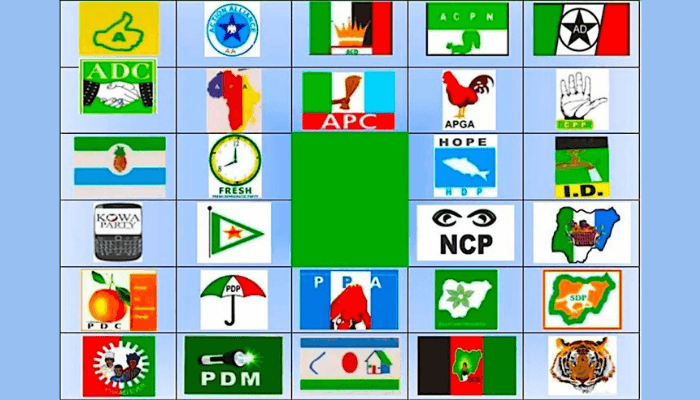
Among the primary political players, the All Progressives Congress (APC), the African Democratic Congress (ADC), the People’s Redemption Party (PRP), the Social Democratic Party (SDP), and the African Action Congress (AAC) have all introduced presidential candidates. Additionally, the Nigeria Democratic Congress (NDC) has publicly endorsed Peter Obi, the former presidential candidate of the Labor Party, to represent them.
However, rather than strengthening the democratic fabric, the primaries have laid bare significant internal divisions, marked by competing claims to leadership and disputes over delegate lists that further complicate the political landscape.
ADC Division Marks a Key Flashpoint
The ADC has emerged as a notable flashpoint in this turmoil. During a convention in Abuja, a faction endorsed Dumebi Kachiku as their consensus presidential candidate while simultaneously dissolving the leadership of David Mark and Rauf Aregbesola, thereby establishing a new National Working Committee (NWC).
However, the Mark-led faction—recognized by the Independent National Electoral Commission (INEC) following a Supreme Court ruling—conducted a separate direct primary, which resulted in former Vice President Atiku Abubakar being declared the party’s candidate. This contradictory outcome has ignited further controversy within the opposition.
Contention Deepens in the People’s Redemption Party
The PRP has also been engulfed in challenges, as candidate Nunaoke Ufele’s campaign organization contested the legitimacy of the primary that was won by former Cross River State Governor Donald Duke. Ufele’s team alleged considerable electoral manipulation, inflated vote counts, and procedural irregularities. They even claimed that the official vote totals exceeded the number of certified members submitted to INEC.
The campaign’s secretary-general, Ishak al-Hassan, stated that the integrity of the party was at stake and called for the annulment of the primary in favor of a new election.
Complex Dynamics Within the PDP
In the Peoples Democratic Party (PDP), uncertainty looms as Oyo State Governor Seyi Makinde has thrown his hat into the presidential ring. He has secured acceptance as the candidate from the Allied Peoples Movement (APM), which aligns with his faction of the PDP. This complexity has been compounded by reports suggesting that former President Goodluck Jonathan may pursue candidacy under the PDP following a court ruling affirming his eligibility.
Although Jonathan has yet to confirm these reports, the speculation has intensified the already chaotic situation within the party.
APC Grapples with Internal Controversies
Meanwhile, the APC is struggling with its own controversies, as primaries in several states have been marred by claims of godfatherism and candidate manipulation. Discontent among candidates has led to defections, with several prominent figures citing exclusionary practices as a catalyst for their departure. The APC leadership is making attempts to reconcile differences, although many view these efforts as superficial.
Stakeholders Raise Concerns Over Electoral Integrity
Political analysts caution that the growing discord among parties and the prioritization of personal ambitions over collective interests could severely undermine public trust in the electoral process. Jackson Lekan Ojo, a political analyst, has warned that if political parties continue to sideline internal democracy, the legitimacy of the 2027 elections may be jeopardized.
Ikechukwu Obiola, a governance advocate, echoed these concerns, pointing out that Nigeria’s leadership crisis stemmed from long-standing electoral malpractice. He argued that the integrity of elections must be restored for the system to serve as a genuine reflection of the people’s will.
Systemic Issues Threaten Future Elections
The fragmentation of the opposition, according to former presidential adviser Akin Osuntokun, has only fortified the ruling APC’s grip on power as the country heads toward 2027. Analysts contend that the challenges surrounding the upcoming elections stem from deep-rooted systemic failures related to political recruitment, internal democracy, and value orientation within the political class. This confluence of issues suggests a troubling road ahead for Nigerian democracy.
