


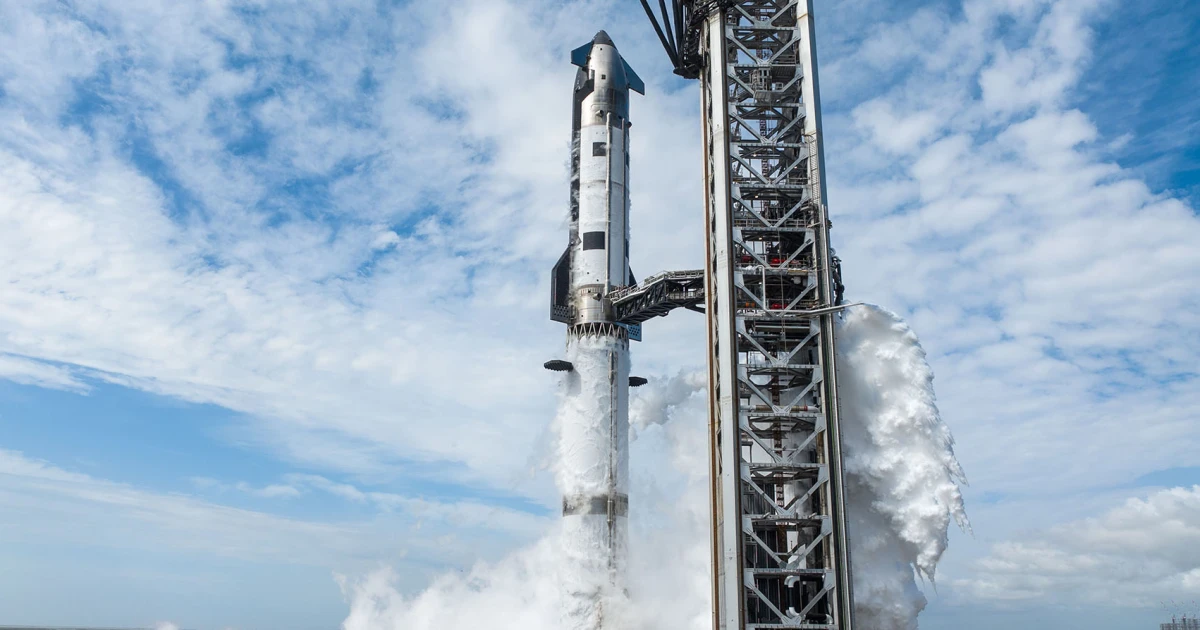
SpaceX to Test New Starship Prototype in Key Flight
SpaceX is set to conduct a crucial test flight of its new Starship prototype on Thursday. This flight represents the 12th mission for the Starship program, but it will mark the inaugural launch of the upgraded third-generation Starship, known as V3. The latest version promises improvements in size, power, and reusability, further aligning with SpaceX’s ambitious goals.
Launch Details and Expectations
The launch is scheduled to occur from a new pad at SpaceX’s Starbase facility located in southern Texas. The launch window is set to open at 6:30 p.m. ET, with weather conditions currently deemed 55% favorable for successful liftoff. A live broadcast of the event will commence around 5:45 p.m. ET, allowing viewers to witness this significant milestone in space exploration.
Navigating NASA’s Artemis Program
This test is particularly significant as NASA plans to rely on the Starship for lunar landings as part of its Artemis program. Both SpaceX and Blue Origin, led by Jeff Bezos, are developing lunar landers for NASA’s anticipated 2028 moon landing mission. The agency intends to test these new vehicles in low Earth orbit with the upcoming Artemis III mission, scheduled for late next year.
Future Plans for SpaceX
In addition to the test flight, SpaceX CEO Elon Musk recently revealed plans to take the company public, which could potentially result in the largest initial public offering (IPO) in history. Musk is expected to retain 85% of the company’s voting rights post-IPO, maintaining his roles as CEO, chairman, and chief technology officer. This move could significantly increase his wealth, with some speculating he could attain trillionaire status.
Technical Advancements and Modifications
Since the last test flight seven months ago, SpaceX has undertaken substantial redesigns of both the Super Heavy booster and the Starship itself. The V3 variant stands at an impressive 408 feet when fully assembled, exceeding its predecessor in height. Notably, enhancements have been made to the rocket’s engines, enabling a thrust output of approximately 18 million pounds.
Improved Features for Enhanced Functionality
Other important upgrades include a reduction in the number of booster grid fins, which aid in the controlled return of the rocket’s first stage, as well as increased propellant tank capacity for Starship. These modifications aim to enhance the overall functionality of the spacecraft, paving the way for its core uses such as full reusability, in-space propellant transfer, and the deployment of Starlink satellites.
Planned Test Flight Activities
During Thursday’s suborbital flight, Starship will attempt to deploy 22 mock Starlink satellites and will also aim to reignite one of the upper stage’s six Raptor engines in space—a critical step for its eventual deorbit burn. The expected duration of the test flight is around 65 minutes, concluding with the upper stage’s splashdown in the Indian Ocean. SpaceX aims to eventually make this spacecraft reusable by utilizing a mechanical arm for retrieval at its South Texas facility, similar to techniques previously demonstrated with the Super Heavy booster.
Aiming for NASA’s Approval
SpaceX faces a challenging timeline ahead, particularly as it prepares the Starship for the Artemis III mission, requiring coordination with NASA’s Orion capsule. Following a series of failures in earlier flights, including an uncontrolled reentry and mid-flight explosions, the success of this upcoming test is crucial. A successful outcome would enable SpaceX to work towards qualifying its Starship for carrying astronauts to the moon by 2028.
