


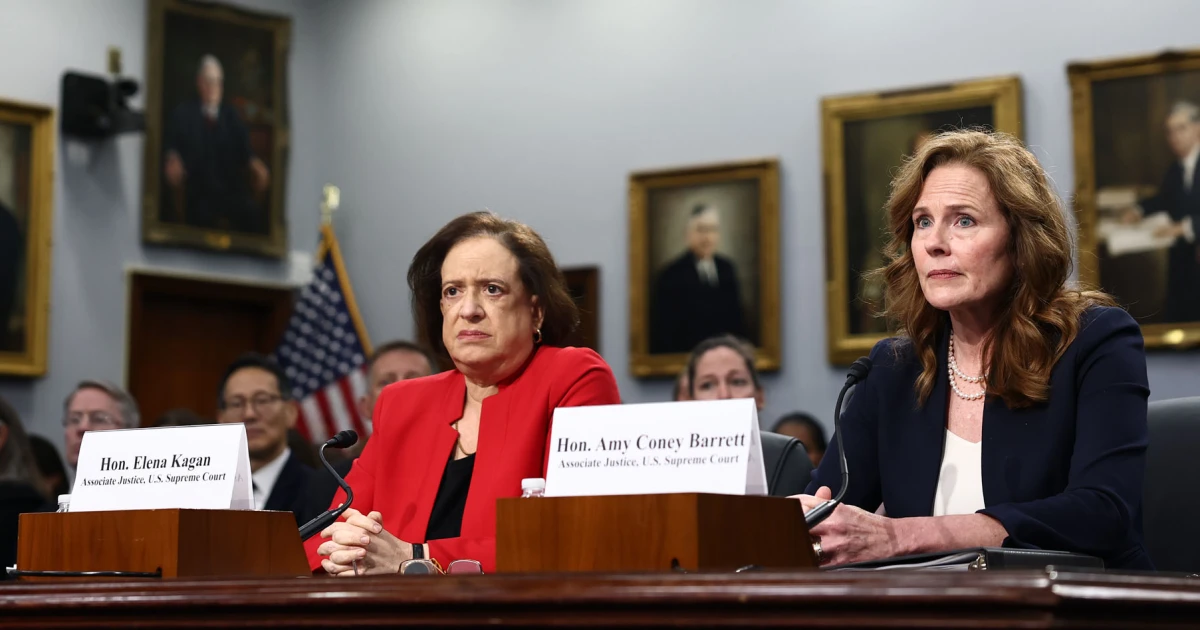
Supreme Court Justices Testify on National Security Funding
WASHINGTON — In a significant appearance, Supreme Court justices addressed Congress on Tuesday for the first time in seven years, advocating for increased funding to address escalating national security threats.
Concerns Among Justices Over Growing Threats
Liberal Justice Elena Kagan and conservative Justice Amy Coney Barrett participated in consecutive hearings held by the House Appropriations Subcommittee on Financial Services and General Government, followed by a similar session in the Senate. Both justices expressed unease over an increase in “swatting” incidents—false emergency calls regarding threats or violence made against judges’ residences.
Personal Experiences with Security Threats
Justice Barrett revealed she was personally affected by a swatting incident in May. Kagan remarked on the seriousness of these threats, indicating that many justices live with the knowledge that such dangers could resurface. Nonetheless, Kagan emphasized that justices continue to fulfill their judicial responsibilities while remaining committed to legally sound decision-making, untainted by fear or bias.
Congressional Acknowledgment of Security Issues
Representative Dave Joyce (R-Ohio), chairman of the House subcommittee, acknowledged the rising security concerns echoing Kagan’s sentiments. He stated, “Regardless of one’s view on a particular Supreme Court decision, judges must be able to serve without fear for their safety or that of their families.” This recognition received bipartisan support, with Rep. Steny Hoyer (D-Md.) affirming the need for adequate funding to ensure the security of judicial personnel.
Calls for Increased Funding and Resources
The Supreme Court is requesting $228.4 million for the upcoming fiscal year, a notable increase of $20.5 million from 2023. Even though the Supreme Court stands at the apex of the federal judiciary, it operates under a separate funding structure. Concurrently, the U.S. Administrative Office of the Courts is pursuing additional security funding through a distinct budget proposal.
Enhancements to Security Measures
The Supreme Court’s budget proposal includes $14.6 million dedicated to enhancing the security of its police department and courthouse. Recently, the responsibilities of these officers have expanded to include safeguarding judges’ homes—an initiative previously managed by the Sheriff’s Office. This change followed heightened security measures enacted in 2022 after the leak of a draft opinion signaling a potential overturn of Roe v. Wade.
Addressing Cybersecurity and Visitor Screening
In a comprehensive approach to safety, the projected budget allocates an additional $6.5 million for establishing new visitor screening facilities on Supreme Court grounds and $2.3 million targeted at mitigating cyber threats. Overall, the court anticipates a total expenditure of $40 million for protection against physical threats and $18 million against cybersecurity risks.
Increasing Intimidation Tactics Against Judges
The uptick in threats against judges has coincided with increased political hostility, particularly from prominent figures. Reportedly, judges are facing harassment and intimidation tactics, such as anonymous deliveries to their homes. In one notable incident from October, a woman was arrested near Justice Brett Kavanaugh’s home while carrying a gun and was subsequently sentenced to eight years in prison. Additionally, Capitol Police apprehended a gunman outside the Capitol, who had inquired about directions to the Supreme Court.
Surge in Threat Levels and Congressional Testimony
Chief Justice John Roberts highlighted in his 2024 annual report that threats against judges have tripled over the past decade, with the U.S. Marshals Service recording 370 threats against federal judges in the fiscal year beginning in October. Historically, justices have testified about the court’s budget before Congress, but this marks the first House hearing appearance since 2019, with no Senate testimony since 2011.
