


Red Stripes on Welsh Rocks Confirmed as Ancient Prehistoric Art
LONDON — Once dismissed as a natural occurrence, the red stripes found on Welsh rocks have now been revealed as the oldest known prehistoric artwork in Britain and northwestern Europe. Recent research indicates that these markings, created by human hands, date back 17,100 years.
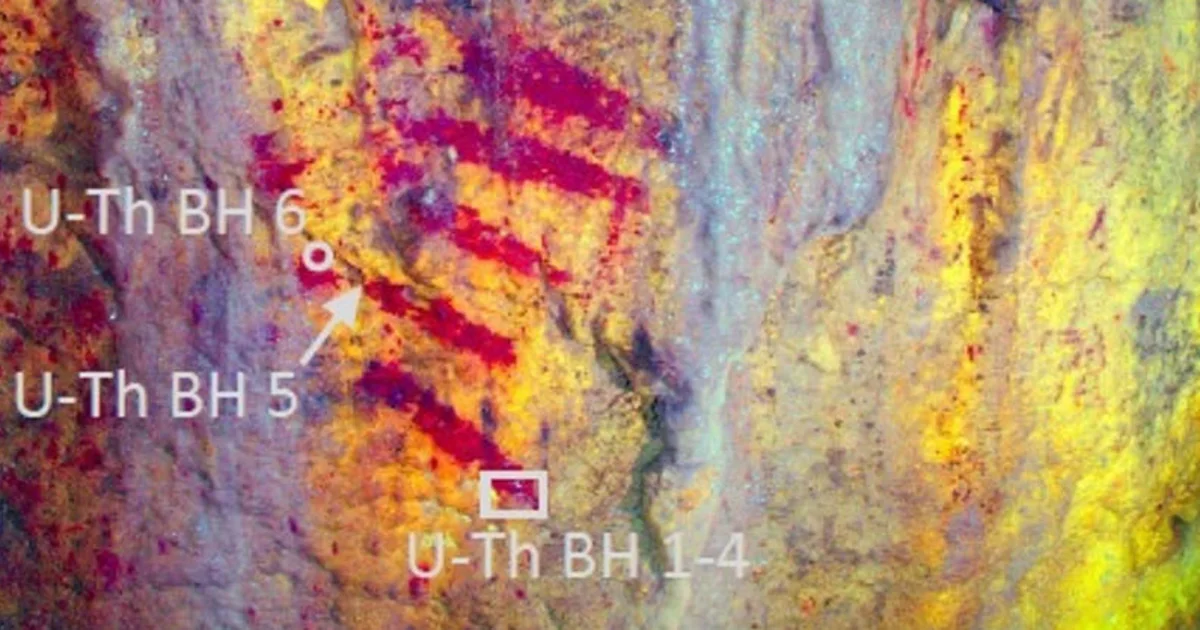
An international team of researchers revisited Bacon Hole, a cave located near Mumbles in south Wales, where a series of horizontal red stripes had first been identified in 1912. Initially, the red pigment was thought to be a natural phenomenon due to mineral seepage in the rock, as noted in the study.
George Harold Nash, an archaeologist and expert in prehistoric art, expressed concern over the historical oversight. “Overlooked and unrecognized, this panel became a historical footnote, forgotten by the archaeological community,” he stated in an email to NBC News.
More than a century later, Nash’s team affirmed the original findings. Their study, published in the journal Quaternary, concluded that the pigmented lines were intentionally created by human action and not through natural processes. This discovery marks the red stripes as the earliest known example of cave art in Britain and northwest Europe.
Nash described his elation upon the discovery, reflecting on the experience: “It was extraordinary to stand before a painted panel discovered over 110 years ago, only to be ignored and later rediscovered.” The study involved a diverse team from China, Germany, Italy, Portugal, Spain, and Wales, employing advanced dating techniques to analyze pigment samples and contextual observations.
The evenly spaced horizontal lines of red pigment indicate a deliberate and structured pattern, reinforcing earlier theories. Evidence suggests that the pigment was likely applied with human fingers, consistent with the original observations made by Breuil and Sollas.
Nash emphasized the cultural significance of cave paintings across Europe, which are often linked to ritualistic practices and symbolic expressions. Historically, these markings went unrecognized for decades, partially due to graffiti by a local fisherman in 1894 that obscured the site’s interpretation.
During the time this artwork was created, the landscape was transitioning from an ice age, which had rendered much of the area inhospitable. The caves, like Bacon Hole, provided a suitable habitat for hunter-gatherer groups. Nash remarked that these sites held deeper cultural meanings beyond mere shelters, suggesting a significant role in the lives of Ice Age artists.
Today, Bacon Hole is situated within a limestone cliff overlooking the Bristol Channel and is managed by the National Trust Wales, which collaborates with the Bradshaw Foundation to support ongoing scientific research. The organization is set to formalize its findings and potentially designate Bacon Hole as a site of archaeological significance.
Nash advocates for stringent legal protections for this heritage site, highlighting that “prehistoric art is an extremely rare and fragile part of our archaeological heritage.” He warns that once such treasures are damaged or destroyed, they cannot be replaced.
