


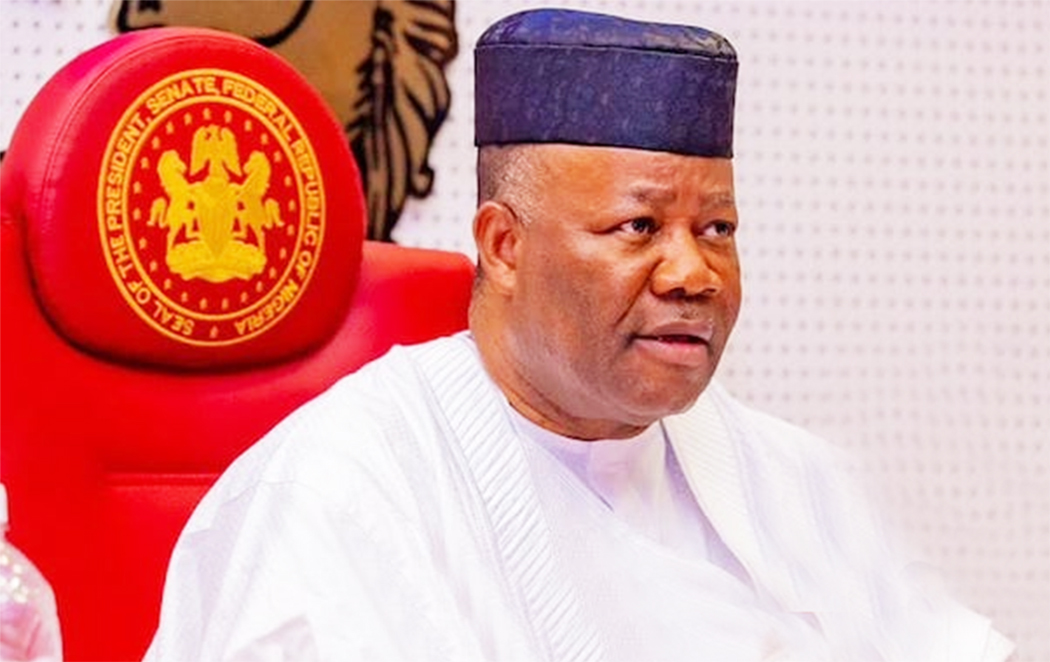
Nigerian Politics: The Unopposed Rise of Senator Godswill Akpabio
There’s a disconcerting aspect to politicians who seem to navigate their roles with ease, particularly in the often chaotic atmosphere of Nigerian politics. In this landscape, where outlandish rhetoric often masquerades as significance, primary elections can resemble wrestling matches, and effective delegate management requires skills akin to hostage negotiation. When a candidate enters an election unopposed, it transforms the entire process into little more than a mere rehearsal.
On May 18, 2026, at the Ukana Methodist Primary School in Essien-Udim Local Government Area, Senator Godswill Akpabio experienced this phenomenon firsthand. With no competition in sight, he secured his position as the All Progressives Congress candidate for the Akwa Ibom North West Senatorial District without any challengers.
While many politicians are entangled in the demanding cycles of factional negotiations and survival strategies, Akpabio’s adept maneuvering has introduced something far rarer than financial backing into Nigeria’s political arena: genuine consensus. An unopposed result often leads observers to assume a lack of competition, but that perception can be misleading. Political ambition flourishes as naturally as light attracts insects, and the allure of power invariably invites interest.
The true significance of an unopposed candidacy is more profound. Potential contenders assess the political landscape closely, examine the numbers, gauge networks of influence, and thoughtfully determine that any attempt to challenge Akpabio would likely be futile. The distinction between having no opponents and the absence of a credible opposition is pivotal. Opponents understand that Akpabio has crafted a political stronghold that is not merely a structure of authority, but a fortress built on loyalty, strategic generosity, and a long-standing network of relationships.
On the day of the unopposed election, the atmosphere felt less like a political gathering and more like a celebratory carnival. Community leaders, supporters, and party members united not to deliberate a contested outcome, but to affirm support for a leader solidly entrenched in the collective consciousness. Whispers of Akpabio’s dominance echo not just from his supporters but also from his rivals. They might not fear his voice but are certainly wary of the repercussions of opposing him. Within his political ecosystem, the dynamics are calculated with remarkable precision.
While others continue to negotiate fragile coalitions, Akpabio has cemented existing alliances. He has shifted his focus beyond the immediate election, contemplating how to sustain political power in a way that ensures meaningful impact. This shift distinguishes a seasoned politician from a political architect; one is preoccupied with obtaining office, while the other meticulously develops the landscape that facilitates such pursuits.
Since becoming President of the 10th Senate, Akpabio has been tasked with instilling much-needed stability within a historically tumultuous institution. The Nigerian Senate is notorious for its internal strife and upheaval, and amidst this chaos, a Senate president who can foster institutional coherence becomes rare. His supporters view him as a figure who merges deep institutional authority with loyalty that spans from local constituencies to the international stage. His rise from governor to minister to Senate president illustrates a remarkable understanding of timing, coordination, and the nuanced art of transforming social capital into enduring political influence.
It’s important to highlight that political capital can easily be squandered, and goodwill can be destroyed through arrogance or exclusion. Whereas many politicians exhaust their resources through self-serving pursuits, Akpabio appears to have grasped a fundamental truth about leadership: goodwill flourishes when individuals feel recognized, valued, and included. Over time, he has nurtured relationships not solely through political lines but through genuine approachability and loyalty, creating a support network that resembles a community forged from shared experiences.
This commitment to collaboration extends to his ongoing relationship with President Bola Ahmed Tinubu and Governor Umo Eno, sending a powerful message about continuity and strategic partnerships. While fragmentation may be tempting for many in his position, Akpabio has opted for a strategy of accommodation, reinforcing the political calculus that benefits both him and those he works with.
As the political narrative advances, Akpabio’s accumulating political capital will not dissipate; it will compound. The goodwill he has built, the balance he maintains, and his pragmatic focus on results rather than rhetoric are more than mere tools for a Senate term; they lay the groundwork for future endeavors. A Senate president who has skillfully managed to stabilize a historically contentious chamber while securing grassroots legitimacy has solved a complex equation within Nigerian politics.
Akpabio’s actions have demonstrated his ability to deliver, instill trust within party ranks, and align closely with the electorate. This blend of qualities is rare. When discussions about the leadership of the 11th Senate arise, they may unfold more swiftly than anticipated—not due to a lack of candidates, but because the unquantifiable arithmetic of loyalty and institutional experience has undertaken its silent but significant work. Akpabio has not publicly indicated his intention to lead the 11th Senate; yet, his movements and steady stewardship signal a leadership trajectory that many have already discerned.
The essence of Nigerian politics resonates with those who genuinely understand their constituencies rather than merely engage in performative theatrics. Effective politicians grasp that power is neither declared nor automatic; it is demonstrated. This truth becomes especially evident when no contenders emerge to oppose it.
As drums echoed in Ukana and applause filled the air, a clear political message resonated: in Akwa Ibom North West, the dialogue has transcended the notion of competition. The audience now awaits the next chapter in this ongoing political saga, solidifying Akpabio’s status as a figure who does not rely solely on loud proclamations but instead wields influence through strategic quietude. Those skilled enough to navigate the complexities of Nigerian politics recognize that mastery often lies beyond noise and performance.
Senator Godswill Akpabio embodies the political acumen of a man who perceives the future and understands that sometimes, the strongest influence is one that requires no grandstanding, as the truth often resonates more powerfully when left unspoken.
Eseme Abo is a former member of the House of Representatives and Press Secretary, currently serving as the Special Advisor on Media and Public Affairs and Official Press Secretary to the President of the Senate.
