


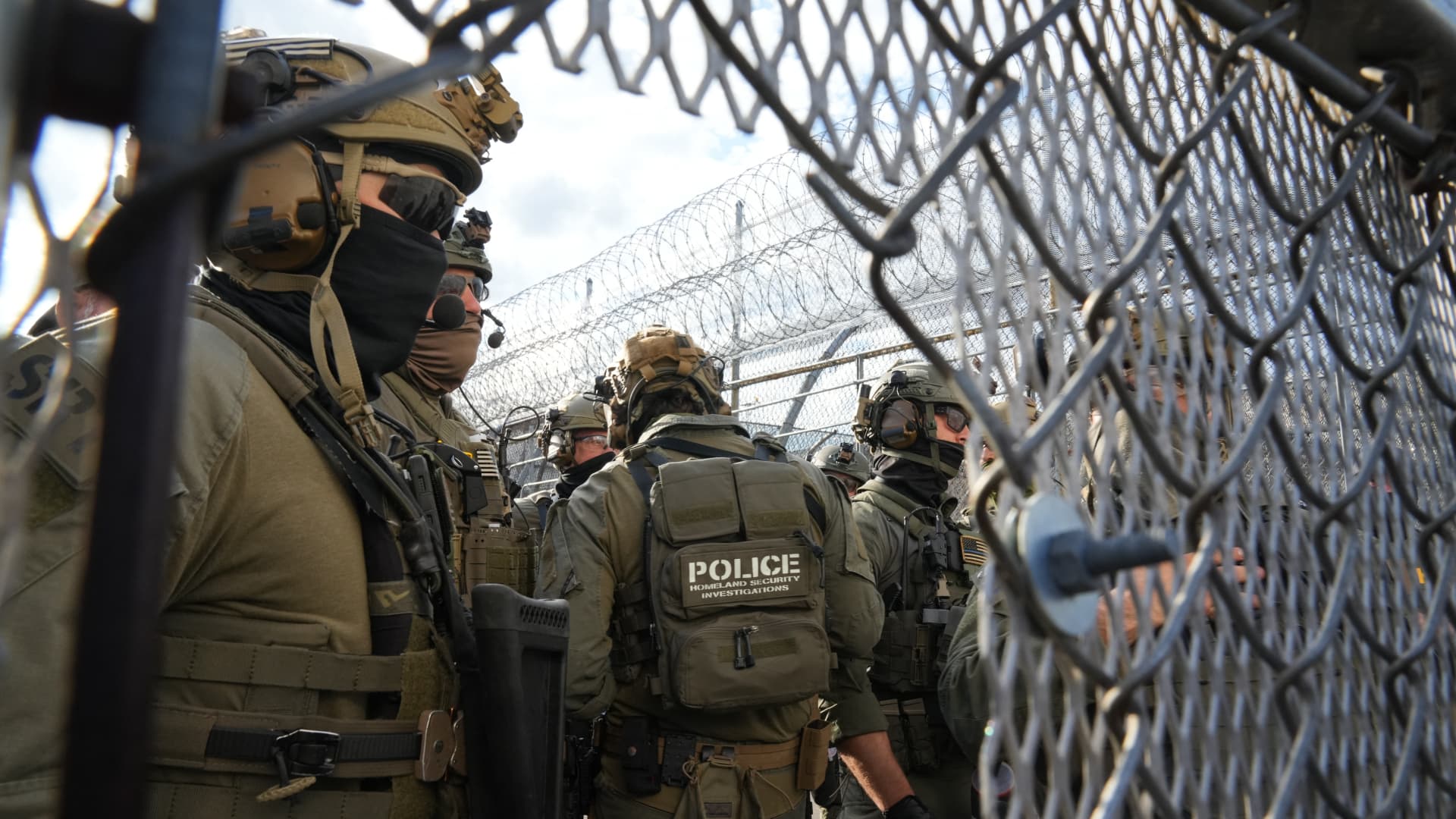
Clashes Erupt Outside New Jersey Detention Center Amid Hunger Strike
On May 29, 2026, tensions escalated outside Delaney Hall, an Immigration and Customs Enforcement (ICE) detention facility in Newark, New Jersey, as protesters clashed with law enforcement. This unrest followed reports of inmates initiating a hunger strike over unsatisfactory conditions within the facility. The response from authorities has been swift, resulting in several arrests as the Trump administration faces intensified scrutiny over its detention policies.
Appeals Court Ruling Affects Immigration Detention Policies
A recent ruling by a divided panel of the 5th Circuit Court of Appeals has significant implications for U.S. Immigration and Customs Enforcement’s policies. Under the Trump administration’s mass detention policy, detainees cannot be held for more than 90 days without a chance for bail. This decision, made by a 2-1 vote, could impact thousands of individuals within Texas and Louisiana, states affected by aggressive immigration enforcement.
Legal Interpretation of Immigration Law Under Scrutiny
The court’s ruling marks a critical moment as it was the first in the nation to uphold the administration’s interpretation of federal immigration law. This interpretation allows for the mandatory detention of noncitizens residing in the U.S., a move that has raised numerous legal questions regarding due process rights.
Due Process Clause and Immigration Hearings
Despite significant rulings in February, the court did not clarify whether due process protections necessitate that these individuals be granted a hearing before an immigration judge for bail consideration. U.S. Circuit Judge Leslie Southwick, who penned the majority opinion, emphasized that the Due Process Clause applies to all individuals, referencing a Supreme Court ruling from 2001 and its implication for those in custody.
Constitutional Authority and Immigration Matters
Dissenting opinions came from U.S. Circuit Judge Corey Wilson, a Trump appointee, who argued that the majority overlooked Congress’s constitutionally granted authority regarding immigration matters. The division in opinion highlights the complexities surrounding immigration law and the federal court system’s interpretation of these statutes.
Responses from Immigration Advocacy Groups
Rebecca Casler, an immigration attorney with the American Immigration Council, expressed satisfaction with the ruling, noting its affirmation of essential constitutional rights. She stated that the decision reinforces the principle that indefinite detention without due process is unconstitutional.
Ongoing Developments in Immigration Law
The U.S. Department of Homeland Security, overseeing ICE, has not yet commented on the recent ruling. Federal immigration law specifies that “applicants for admission” to the U.S. are subject to mandatory detention during their immigration proceedings, without bail hearings. This includes not only individuals arriving at the borders but also established residents, as clarified by the Department of Homeland Security last year and subsequently adopted by the Board of Immigration Appeals.
As the debate continues, the Trump administration has requested the Supreme Court’s intervention to resolve conflicting interpretations among federal appeals courts, indicating that the legal landscape regarding immigration detention remains highly contentious.
