


International Expansion Transforms Group Revenue as Access Holdings Reports 73.5% Profit Increase
Access Holdings’ international focus has led to its UK subsidiary surpassing its Nigerian operations as the largest profit contributor for the first time, signaling a significant shift in the company’s profit landscape.
An analysis of Access Holdings’ first quarter 2026 financial results reveals that Access Bank UK Limited, established in 2008, has become a greater source of revenue than its Nigerian arm. This marks a historic transformation for the bank, which has long been anchored in Nigeria, Africa’s most populous nation.
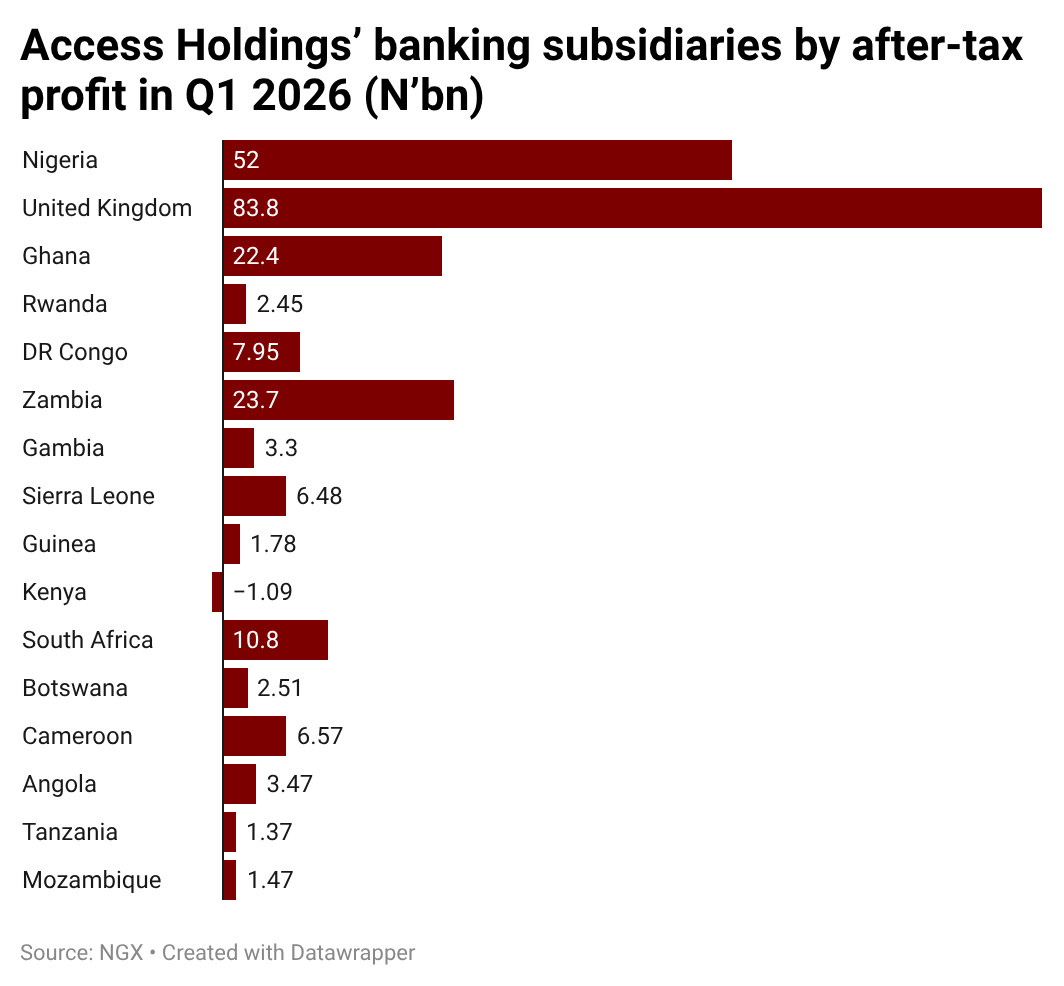
Profits after tax in the UK surged by 73.5% to Naira 83.8 billion for the first quarter compared to Naira 48.3 billion during the same period in 2025, driven by a remarkable increase in operating profit from Naira 87.4 billion to Naira 175.5 billion. Conversely, profits from the Nigerian business declined to NOK 52 billion from NOK 79.9 billion year-on-year.
This overall performance boosted the group’s net profit from N182.8 billion to N216.5 billion, with the UK operations accounting for 38.7% of total revenue, while Nigeria contributed 24%.
This strategic shift is a result of a long-standing plan to lessen the reliance on Nigeria by fostering a diversified banking franchise across Africa and beyond. Ayokunle Olubunmi, head of financial institutions ratings at Agusto & Company, explained that this approach aims to balance profit contributions rather than diminish the Nigerian business’s performance.
Olubunmi noted that Access UK has transformed from a typical offshore subsidiary into a pivotal trade finance hub for the group’s African operations. He emphasized the importance of increasing subsidiary contributions outside Nigeria as part of Access Holdings’ long-term objectives.
Growth in Trade Finance Bolsters UK Operations
The burgeoning significance of trade finance for Nigerian banks is evident, especially as global financial institutions reduce their presence in certain African markets. Leading banks like Access Bank, First Bank, and the Nigerian Export-Import Bank (NEXIM) are intensifying their trade-related services, offering payment assurances, structured financing, foreign exchange solutions, and cross-border payment assistance.
Trade finance is a crucial revenue stream in Africa, accounting for nearly 15% of total banking revenues, according to the African Development Bank Group. The ongoing rise in trade volumes between the UK and Nigeria is creating more opportunities for Access Bank, particularly following the naira’s steep devaluation, which has escalated the local currency value of cross-border transactions.
Total trade between the UK and Nigeria reached an all-time high of £8.1 billion in the four quarters leading to the end of 2025, marking an 11.4% increase and the highest figure in a decade. During this period, Nigeria remained Britain’s primary export market in Africa, with UK exports to Nigeria growing by 14.2% to £5.7 billion and imports from Nigeria rising by 5.1% to £2.4 billion, thus giving the UK a trade surplus of £3.4 billion.
Shifts in Profit Distribution Highlight Decline of Nigeria’s Dominance
The latest financial results underscore the rapid decline of Nigeria’s influence within Access Holdings. Nigeria constituted 37% of the group’s pre-tax profit in the first nine months of 2025, plummeting from 61% in the same period in 2023—marking the lowest share in over three years.
Meanwhile, profits from other African subsidiaries climbed to 35%, with contributions from UK and other international operations rising to 28%. This trend is mirrored in the balance sheet, which shows that Africa’s share of total assets grew from 12% to 21%, while overseas assets increased from 13% to 32%. Nigeria’s share fell from 75% to 47%.
This redistribution reflects a broader trend among West Africa’s largest financial institutions, which are increasingly using new capital from the Central Bank of Nigeria’s recapitalization program to drive regional expansion, diversify income sources, and mitigate risks associated with concentration.
Access Holdings Expands Revenue Streams through Subsidiaries
Access Holdings is actively restructuring its revenue profile as it broadens its presence across Africa. Among its 16 banking subsidiaries, Gambia recorded the highest profit growth at 192%, with profits rising to NEB 1.13 billion. Following close were Tanzania and Guinea, with profit increases of 169.2% and 133.6%, respectively.
In contrast, Nigeria, Ghana, and Botswana saw profit declines of 20.3% and 32.7%, respectively. This performance aligns with statements from Access Bank Nigeria’s Managing Director and CEO, Roosevelt Ogbonna, who highlighted an investment of approximately $1.2 billion in subsidiaries last year to foster sustainable growth.
Regulatory Challenges Accompanying Rapid Expansion
Despite rapid international growth, Access Holdings is facing increasing regulatory scrutiny. Recently, the group announced plans to scale back equity stakes in certain overseas subsidiaries due to new limits imposed by the Central Bank of Nigeria on offshore investments.
Under the new regulations, banks are instructed to halt new overseas ventures and limit equity holdings in offshore subsidiaries to 10% of shareholder funds, alongside a 12-month compliance period. Currently, Access Holdings’ offshore exposure stands at 19.4%, prompting considerations for potential divestitures.
The bank is also weighing options to refinance a $500 million Eurobond maturing in September, focusing on extending its debt maturity profile, rather than addressing immediate liquidity concerns. Additionally, decisions are pending regarding another $500 million perpetual bond expiring in October.
Active Acquisitions Shape Access Holdings’ Future
Access Holdings remains a dominant force in the African banking landscape, recently acquiring Standard Chartered Bank’s subsidiary in Gambia and obtaining a 76% controlling stake in Mauritius-based AfraAsia Bank. The group has also concluded the purchase of the National Bank of Kenya from KCB Group.
The acquisition of AfraAsia resulted in preliminary goodwill of N16.3 billion ($10.6 million), influenced by fair value adjustments made during the transaction, as detailed in the bank’s first quarter financial report. The group is expected to finalize the allocation of the purchase price within a stipulated measurement period not exceeding twelve months following the acquisition date.
