


Stakeholders Applaud Tinubu’s Reforms in Nigeria’s Creative Economy
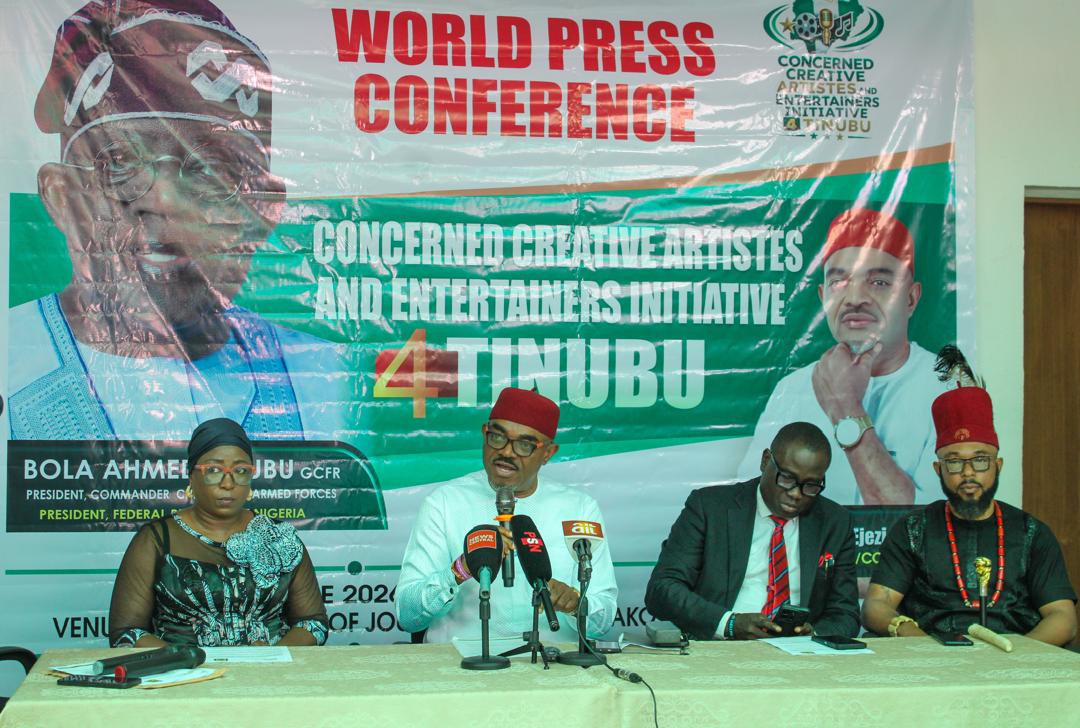
In a recent gathering, stakeholders in Nigeria’s creative economy expressed their support for President Bola Ahmed Tinubu’s unprecedented reforms aimed at elevating the sector as a crucial driver of economic growth. This endorsement was articulated by members of the “Concerned Creatives Artistes and Entertainers Initiative 4 Tinubu” during a press conference held at the Nigeria Union of Journalists (NUJ) Secretariat in Utako, Abuja.
Confidence in Government’s Commitment to the Creative Sector
Industry representatives from diverse backgrounds voiced their optimism that under Tinubu’s leadership, the federal government possesses the necessary expertise to transform the creative economy into a sustainable alternative to oil dependency. As the country aims for economic diversification, they urged for continuous support to ensure the success of Tinubu’s initiatives in this vital sector.
Evaluation of the Administration’s Progress
Dr. Emeka Loras of Montana, the National Chairman and Convenor of the initiative, emphasized that the group’s backing stems from a careful assessment of the Tinubu administration’s efforts to position the creative economy as a centerpiece for job creation and national development. He noted that a favorable environment for private sector investments in entertainment, culture, tourism, and media has been established, further enhancing the sector’s global cultural influence.
Significant Steps Toward a Focused Creative Economy
Loras, a former president of the Actors Guild of Nigeria, pointed out that the current federal government has demonstrated a commitment to reinvigorating the creative economy. A notable advancement is the establishment of an independent Federal Ministry of Arts, Culture, Tourism, and Creative Economy, which has streamlined leadership and focused attention on the sector.
Influential Appointments and Historical Context
Under Tinubu’s administration, respected industry figures, including Mr. Ali Nuhu, Mr. Shaibu Husseini, Mr. Obi Ashika, and Dr. Olayiwola Awakan, have been appointed to key positions within the ministry, reflecting strong leadership and political will. Loras acknowledged that the creative industries have garnered significant recognition as a vital part of Nigeria’s economic diversification agenda, tracing Tinubu’s support back to his tenure as the Governor of Lagos State, where he laid the groundwork for the state’s emergence as Nigeria’s entertainment capital.
Financial Initiatives to Fuel Growth
One of the most substantial financial interventions in Nigeria’s creative sector is the establishment of the $100 million Creative Economy Development Fund. Loras highlighted that this fund is set to provide essential capital to filmmakers, musicians, and digital innovators. Additionally, the Tinubu administration is implementing a $617.7 million investment program targeting young Nigerians in the digital and creative sectors, emphasizing the need for sustainability to maximize the benefits of these initiatives.
Seizing Opportunities Amid Challenges
Reflecting on the creative sector’s potential, Loras acknowledged that for years, Nigerian artists and creators have excelled despite limited institutional support, inadequate infrastructure, and ongoing challenges like piracy and poor distribution networks. He praised the resilience of Nigerian creatives, who continue to generate employment and attract global audiences while shaping the nation’s cultural identity.
Commitment to Build a Thriving Creative Ecosystem
Loras pointed out that the government has begun establishing Renewal Hope Creative Villages to provide world-class infrastructure for training, production, incubation, and innovation. These creative hubs aim to recognize that talent alone isn’t sufficient; modern infrastructure is essential for creating a competitive edge globally. The administration is also focusing on human capital development through various training programs aimed at thousands of young Nigerians across multiple creative domains.
Despite acknowledging the pressing security and economic challenges facing the nation, Loras affirmed that governments should be evaluated not only on their challenges but also on their proactive responses. In a moment of reflection, he called for a tribute to honor the recent victims of violence in Oyo State and other Nigerians affected by insecurity.
