


Activists worldwide convened for May Day rallies and protests on Friday, advocating for peace, higher wages, and improved working conditions amidst rising energy costs and declining purchasing power exacerbated by the ongoing conflict in Iran. May 1 serves as a public holiday in numerous nations to mark International Workers’ Day, a date when labor unions typically rally around issues such as wages, pensions, inequality, and broader political matters. Demonstrations took place in major European cities and across the United States, as well as in Seoul, Sydney, and Jakarta.
The European Trade Union Confederation, representing 93 trade unions across 41 European countries, declared that workers will not bear the burden of the Middle East conflict instigated by U.S. policies. The rally’s message underscored the importance of worker activism in preserving jobs and living standards.
In the United States, a coalition of activists opposed to the policies of President Donald Trump prepared for marches and boycotts as part of their May Day efforts.
The Impact of Rising Energy Prices
The escalating cost of living influenced by the Middle Eastern conflict was a predominant theme at the rallies. In Manila, large crowds marched demanding higher wages and lower taxes, voicing their opposition to the U.S. involvement in Iran. Protesters carried banners reading, “No military, no base, no war games; resist U.S.-led war.” Clashes occurred with police as they attempted to block access to roads near the U.S. embassy.
“All Filipino workers now recognize that the local situation is intrinsically linked to a global crisis,” stated Josua Mata, the leader of Centro, an organization representing various trade union federations.
In Jakarta, Indonesian President Prabowo Subianto participated in a rally that drew tens of thousands amidst a heavy police and military presence. With prices surging and challenges in securing raw materials, workers called for increased government support.
Although May Day is a recognized public holiday in Pakistan, many day laborers lack the financial means to take the day off. Construction worker Mohammad Maskeen, 55, expressed his struggles, stating, “If I don’t work, how will I afford essential goods?” With the economy heavily reliant on support from the International Monetary Fund and its allies, surging oil prices are further fueling inflation, currently estimated at around 16% by the government.
Global Demonstrations
In Istanbul, police apprehended approximately 15 protesters who attempted to breach a government ban and access Taksim Square, known for its historical significance during the protests of 2013. The Turkish government’s long-standing prohibition on public gatherings in this area has been met with resistance from various political factions and labor unions.
In France, demonstrations were planned in Paris and other cities under the rallying cry of “Bread, Peace, Freedom,” connecting workers’ daily concerns to the ongoing conflicts in Ukraine and the Middle East. Meanwhile, the Italian government recently approved nearly 1 billion euros ($1.17 billion) in job incentives aimed at promoting job security and reducing labor abuses ahead of May Day festivities. This initiative seeks to expand tax breaks intended to stimulate employment opportunities for youth and marginalized women, although opposition parties have criticized it as mere propaganda.
General strikes and unrest emerged in Portugal last year, driven by the center-right government’s proposed labor law reforms. After nine months of negotiations, unions are still dissatisfied, contending that the proposals erode workers’ rights by extending overtime limits and reducing certain benefits.
Significance of May Day in France
This year’s May Day holds particular significance in France due to intense discussions surrounding whether employees should be permitted to work on this crucial holiday, which is designed to guarantee paid time off for most workers. On this day, virtually all businesses, shops, and malls close, with exceptions for essential services like hospitals, transportation, and hospitality.
Recent legislative proposals aiming to allow more work on May Day prompted fierce opposition from unions and members of the left. A joint statement from labor organizations proclaimed, “Do not touch May Day.” Amid this controversy, the French government proposed legislation to expand employment opportunities related to bakeries and floral shops on this day, as it is customary in France to give lily of the valley flowers as a symbol of good fortune on May Day.
French Minister of Small and Medium Enterprises Serge Papan remarked, “May 1st is not just a day. It symbolizes a century of social rules that have shaped our labor laws. It’s a truly special day.”
Activism in the United States
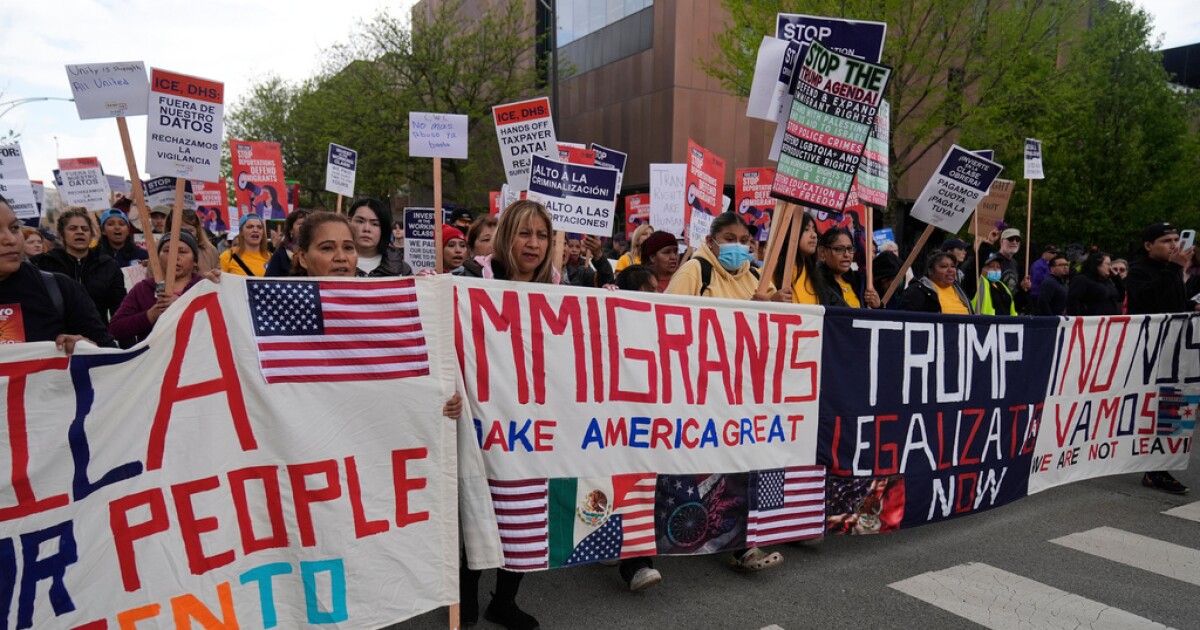
In the United States, where May Day is not a federal holiday, labor unions and activist groups have organized protests and boycotts to coincide with the occasion. Mayday Strong, a coalition of various groups, urged citizens to assemble under the slogan “Workers over Billionaires.” The demonstrations aim to showcase strong opposition to President Trump’s policies and have involved calls for an economic blackout encouraging “no school, no work, no shopping.” Key demands raised include increased taxes on the wealthy and an end to the administration’s immigration enforcement measures.
The historical intertwining of labor and immigrant rights was notably spotlighted in 2006, when May Day rallies in the U.S. underwent a significant shift toward an immigration focus. Nearly 1 million individuals mobilized across the country, with significant participation in cities like Chicago, in response to a federal bill that would criminalize undocumented residency.
The Historical Context of May Day
May Day, also known as International Labor Day, has its roots in a pivotal chapter of U.S. labor history over a century ago. During the 1880s, labor unions campaigned for an eight-hour workday through strikes and demonstrations. The movement gained tragic notoriety in May 1886, when a bomb exploded at a gathering in Chicago. The police’s violent response resulted in several casualties, leading to the conviction and execution of several labor activists, many of whom were immigrants.
The tragic events prompted labor unions to designate May 1 as a day to honor workers. Chicago’s Haymarket Square is now home to a monument commemorating those impacted, bearing the inscription: “Dedicated to all the workers of the world.”
