


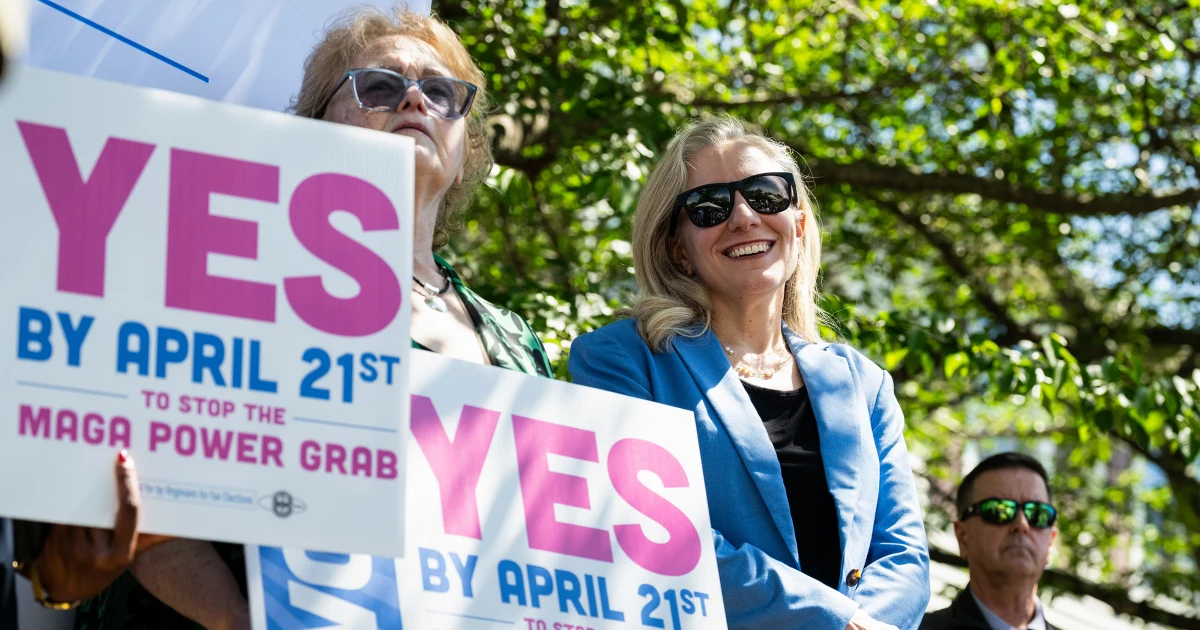
Virginia Voters Face Crucial Decision on Congressional Map
On Tuesday, Virginia voters will determine the outcome of a proposed constitutional amendment aimed at reshaping the state’s congressional map, potentially granting Democrats up to four additional seats in this year’s midterm elections.
This special election represents the latest chapter in a nationwide redistricting battle, as both parties strive for dominance in the closely divided House of Representatives. If approved, the new map under consideration would allow Democrats to secure up to ten of Virginia’s eleven congressional districts, in contrast to the six they currently hold.
Virginia Democrats are positioning this aggressive initiative as a response to the pressure exerted by former President Donald Trump on Republican-led states to redraw district lines last summer. In turn, Republicans accuse Democrats of attempting to consolidate power after gaining full control of Virginia’s government during the previous fall elections.
While Democrats enjoy a significant fundraising advantage, the upcoming race is expected to be competitive. Recent election trends suggest Virginia has shifted towards Democratic candidates, illustrated by Governor Abigail Spanberger’s victory by 15 points in November and then-Vice President Kamala Harris winning the state by six points in 2024.
However, Democrats face an uphill battle in conveying their message effectively, given their historical opposition to partisan gerrymandering initiatives. Additionally, turnout in spring special elections, which will primarily feature redistricting referendums on the ballot, is notoriously unpredictable.
The proposed constitutional amendment would temporarily bypass Virginia’s bipartisan redistricting commission—approved overwhelmingly by voters in previous years—to establish new congressional maps for the remainder of the decade. After the 2030 census, control of mapping duties would revert back to the commission.
A recent Washington Post/George Mason University poll indicates a slim majority of 52% of likely voters support the referendum, against 47% who oppose it, a difference that falls within the poll’s margin of error. In the lead-up to the election, the pro-referendum group Virginians for Fair Elections outspent the anti-referendum group Virginians for Fair Maps by a ratio of 17 to 1. However, as of Monday, that disparity had reduced to less than 3 to 1.
With both state and national figures from both parties rallying support in recent weeks, the implications of this election resonate far beyond Virginia. On the day before the election, Trump was set to participate in a conference call with House Speaker Mike Johnson, who opposes the redistricting bill. Trump also made a recent appearance on a conservative talk radio show in Virginia, urging voters to reject what he called the “unfair” maps.
Prominent Democrats, including House Minority Leader Hakeem Jeffries and former Attorney General Eric Holder, have actively campaigned for the referendum. Former President Barack Obama is featured prominently in a Virginia ad advocating for the measure, while the Republican Party counters with ads featuring Obama from previous years criticizing political gerrymandering.
Democratic leaders argue that their proposed map is a necessary response to Trump’s previous actions. Virginia Senator Tim Kaine emphasized that the measure gives voters the chance to support a congressional delegation capable of resisting potential electoral interference by Trump.
Republicans, on the other hand, are leveraging the narrative that the proposed amendment undermines the bipartisan redistricting commission, which voters passed by a significant margin in 2020. Campaign manager Mike Young of Virginians for Fair Maps argued against the measure, stating that no amount of campaigning can overshadow what voters approved just five years ago.
As the election approaches, it remains uncertain whether Virginia voters will have the final say on this contentious issue. The Virginia Supreme Court has allowed the special election to proceed but retains the authority to review the legality of the measure afterward. Heading into Tuesday, Democrats express cautious optimism, though they acknowledge the difficulty of accurately gauging the election’s outcome.
Republican observers anticipate that the prevailing political climate may still favor Democrats. Nevertheless, they caution that if the election results are narrow, Republicans will need to reconsider their strategies moving forward. Zach Roday, a Virginia-based Republican strategist, highlighted the challenging circumstances, including Democrats’ recent success and funding advantages, but acknowledged that close results could prompt reflection on their campaign approach.
