


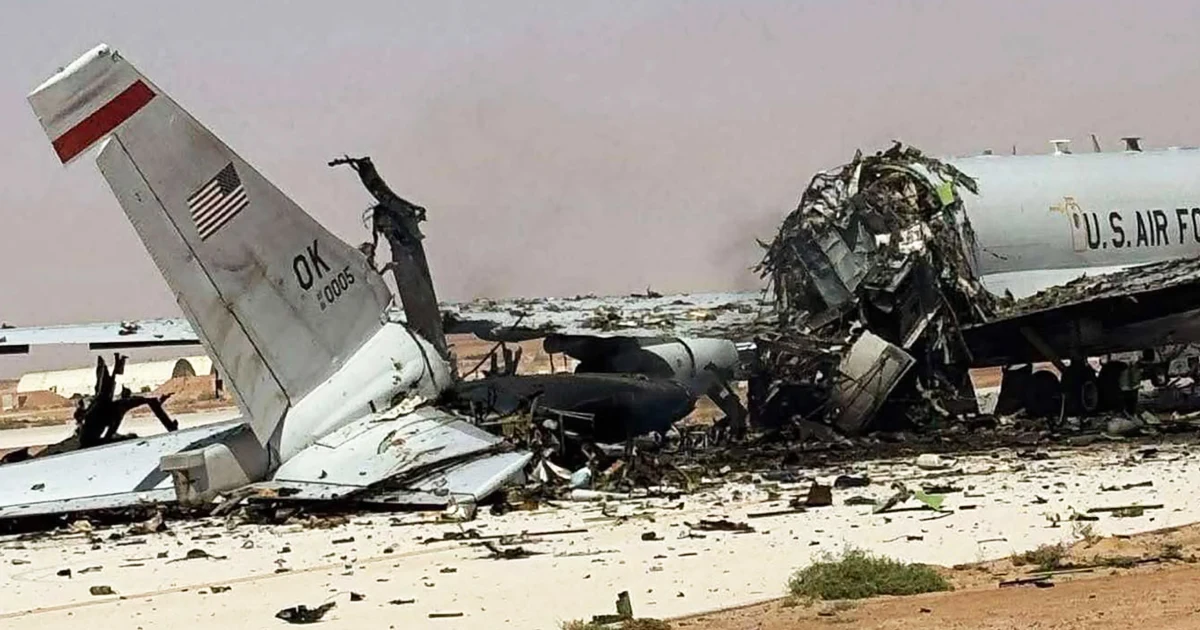
U.S. Central Command Under Scrutiny Following Recent Attacks
NBC News has sought comments from U.S. Central Command regarding ongoing military operations and security concerns in the region.
The Impact of Eroding Early Warning Systems
Andreas Krieg, a senior lecturer at King’s College London’s School of Security Studies, highlighted the alarming trend of Iran gradually dismantling the United States’ network of early warning systems established over decades. He noted that this collective destruction of radar and intelligence platforms significantly diminishes U.S. surveillance capabilities, complicating America’s defensive posture in the region.
Deployment and Pre-Attack Warnings
Air & Space Force Magazine reported that the E-3 Sentry, part of the Aircraft Warning and Control System (AWACS), was one of the aircraft stationed at Prince Sultan Air Base prior to Friday’s attack. The magazine indicated that 16 personnel were present at the base when the strike occurred, raising questions about the adequacy of the U.S. response to such incidents.
Preparation for Prolonged Conflict
Krieg argued that U.S. military planners should have anticipated such a strike, advocating for preparedness in what he described as a “long war.” He emphasized the necessity of establishing permanent installations in conflict zones, particularly against adversaries equipped with large numbers of ballistic and cruise missiles, as well as drones capable of one-way attacks.
Diverging Perspectives on Military Readiness
Despite Krieg’s assessment, Daniel Davis, a retired U.S. Army lieutenant colonel and former Bronze Star recipient, expressed a starkly contrasting view. He indicated that the current situation is deteriorating and that the U.S. is ill-prepared for a protracted conflict. He noted that a significant number of individuals in the administration underestimated the complexity and requirements of the situation, particularly in light of Iran’s robust missile capabilities.
Concerns Over Underestimating Iranian Resistance
Conversely, Burk Ozcelik, a senior fellow at the Royal United Services Institute, cautioned against downplaying the extent of damage within Iran, citing communication breakdowns in the country. Ozcelik urged a careful analysis of losses incurred by U.S. forces, calling for a measured approach to understand the current dynamics of the conflict.
Implications of Russian Support for Iranian Operations
Complicating matters further, Ukrainian President Volodymyr Zelensky shared insights that Russia might be facilitating Iranian attacks against U.S. assets in the region. In an interview, Zelensky expressed confidence that the Russian government was providing critical intelligence to Iran, thereby enabling more effective targeting of American forces amidst ongoing tensions.
Assessing U.S. Military Effectiveness
Krieg acknowledged Moscow’s strategic interests in entangling U.S. military resources in the Middle East, potentially heightening costs for the U.S. government. However, he refrained from attributing Iran’s recent success solely to Russian support, asserting that while U.S. protection during the conflict was adequate, it was far from optimal, leading to costly operational challenges.
