


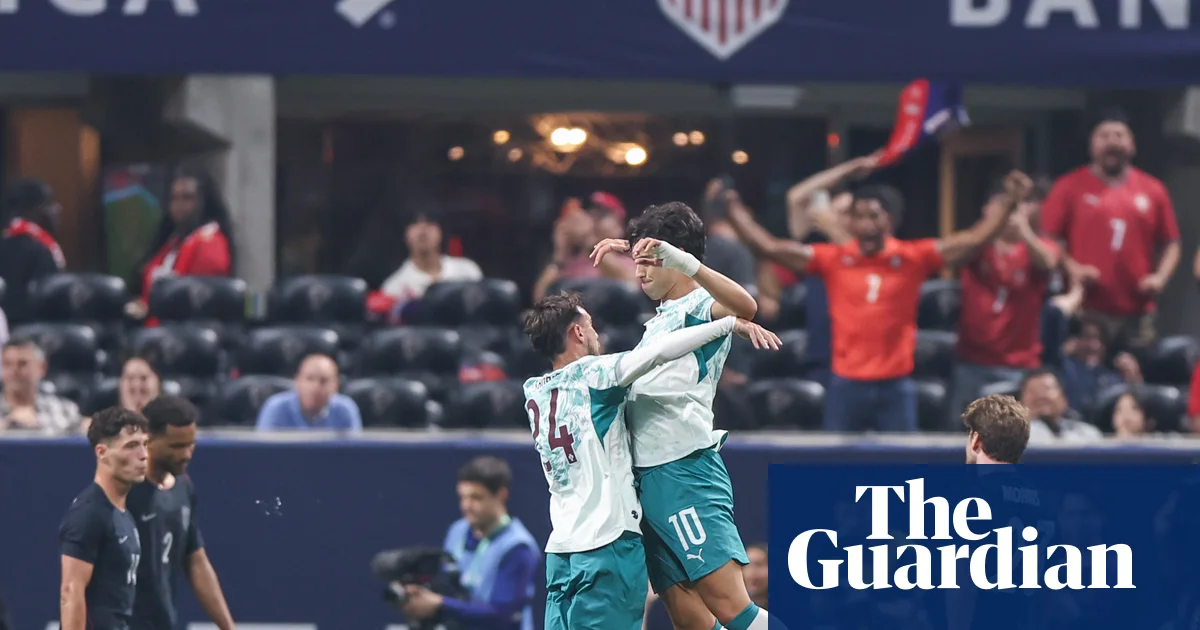
The U.S. men’s national soccer team took on Portugal at Mercedes-Benz Stadium on Tuesday night, eagerly emphasizing the need for intensity in the days leading up to the match. Following a disappointing 5-2 defeat against Belgium, both players and coaching staff underscored the importance of delivering a strong performance against the sixth-ranked Portuguese side. However, the match unfolded differently than anticipated, as the Americans produced another lackluster display, succumbing to a talented Portugal team before a sellout crowd of 72,297. This 2-0 loss marked the USMNT’s eighth consecutive defeat against European opponents, with an overall scoreline showing 22 goals conceded versus just 6 scored.
U.S. coach Mauricio Pochettino responded to the previous match’s struggles by making significant adjustments to the lineup. New England Revolution goalkeeper Matt Turner was replaced by New York City FC’s Matt Freeze, who has garnered Pochettino’s trust over the past year. In central defense, Chris Richards and Auston Trusty stepped in for Tim Ream and Mark McKenzie, flanked by Alex Freeman and Anthony Robinson. Midfield saw Sebastian Berhalter and Aidan Morris take precedence over Tanner Tessman and Johnny Cardoso. Surprisingly, Christian Pulisic assumed the role of central striker for much of the match.
Initially, Pochettino’s strategic changes showed promise, but the tide turned as the Americans failed to maintain their composure. Portugal’s Francisco Trincão opened the scoring in the 37th minute, followed by a perfectly executed shot from Joao Félix, extending the team’s lead just 15 minutes after the break. While the match didn’t spiral out of control like the previous encounter with Belgium, Tuesday’s performance did little to instill confidence among U.S. fans as they approach the World Cup, which begins in just over two months.
Pulisic Faces Challenges in Striker Role
Christian Pulisic, typically one of the U.S. team’s more understated players, exhibited visible frustration as the match progressed. In the 6th minute, he received a well-placed ball from Malik Tillman but failed to convert. Fifteen minutes later, he squandered a golden opportunity to score when he managed to volley but missed contact from just outside the six-yard box. His shot in the 35th minute came close but veered inches wide. Following a careless ball loss in the 45th minute, he lashed out at Portuguese midfielder Sam Costa, leading to a yellow card. Pochettino opted to substitute him at halftime.
Pulisic remains a key player for AC Milan, yet he has yet to score this season, and his club’s performance has been unimpressive. Many fans hoped that international play would help reignite his scoring touch, but the results were not reassuring. He appeared a shadow of his former self, lacking the confidence that fans have come to expect from him. Aside from a missed opportunity, his play lacked decisiveness, a clear departure from his usual prowess.
A telling moment before halftime highlighted his struggles. Pulisic made a strong 30-yard run through midfield, only to hesitate and ultimately fail to connect with Weston McKennie when he could have taken a shot or attempted a more decisive play. While it’s premature to invoke the image of the “old Pulisic,” there was a palpable sense that his recent performances fall short of his potential.
Déjà Vu Leads to Portugal’s Opening Goal
Seeing Portugal take the lead against the United States elicited a sense of déjà vu for fans, as the circumstances mirrored those of the match against Belgium. Just like Belgium’s opening goal, Trincão’s score in the first half felt all too familiar. The U.S. had missed a critical chance moments before, reminiscent of the earlier match. Once again, conceding the first goal proved to be a significant turning point for the U.S., which saw a decline in possession throughout the second half.
Sloppy ball control plagued the U.S. as they scrambled to regain composure, particularly after the halftime substitutions. On multiple occasions, they struggled to connect with one another, leading to Portugal’s dominance. The ease with which Portugal’s players moved through the midfield and transitioned to attack raised concerns about the fortitude of the U.S. defense.
Identifying a New Defensive Weakness
In modern soccer, teams typically strive to create scoring opportunities in the center of the box, exploiting vulnerabilities around the goalkeeper. However, both Belgium and Portugal discovered ample space just outside the U.S. 18-yard box, a territory that has become increasingly perilous for the American squad. This lack of defensive solidity, particularly at the edges of the penalty area, has contributed to the team’s recent struggles.
The absence of Tyler Adams, widely regarded as the U.S.’s best midfield enforcer, has become glaringly evident. Under Pochettino’s guidance, several players were brought in to fill the void, but the team is still grappling with defensive lapses. Portugal’s first goal exploited these gaps, with Morris caught flatfooted, allowing the ball to find Trincão for a quick score. Their second goal showcased the same vulnerabilities, as the U.S. struggled to mark effectively, allowing Felix to capitalize and seal the match.
Since his international debut in 2017, Adams has emerged as an invaluable asset, providing coverage and aggressive play essential to the team’s identity. As the U.S. looks ahead to the World Cup, the need for a cohesive and efficient midfield has never been more critical. The squad must quickly address these defensive weaknesses, or risk facing similar outcomes in future matches.
