


Shareholders Set to Receive Record Dividends in 2025
Shareholders of Dangote Cement Plc, Guaranty Trust Holding Company Plc (GTCO), BUA Foods Plc, and ten other firms listed on the Nigeria Exchange Limited (NGX) are poised to receive a staggering total of ₦3.2 trillion in dividends during the 2025 financial year.
Substantial Increase in Dividend Payouts
This amount marks a remarkable 131.8% increase compared to the ₦1.36 trillion disbursed in the previous financial year of 2024. This surge in dividends is largely attributed to robust corporate profits among listed companies and favorable economic indicators, resulting in enhanced capital gains for investors.
Corporate Profit Growth Analysis
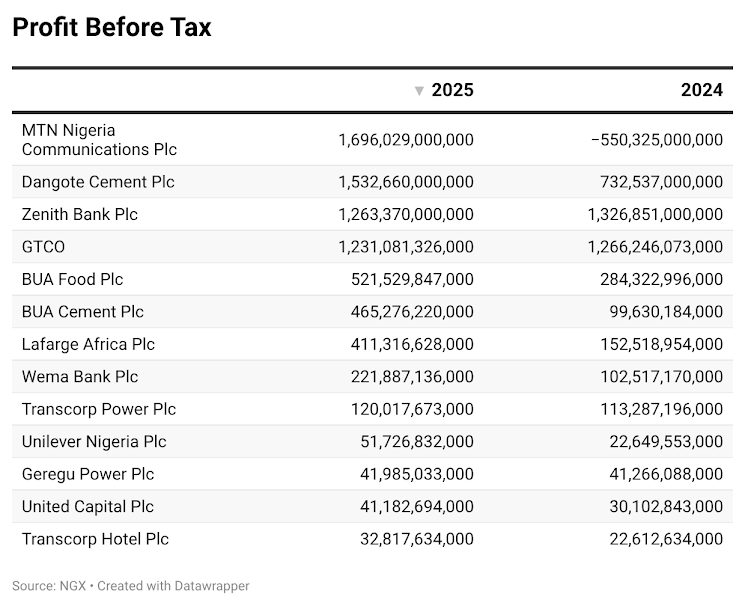
Recent financial analyses indicate that the pre-tax profit for the 2025 fiscal year reached ₦7.63 trillion, reflecting a significant 109% increase over the ₦3.6 trillion recorded in 2024. The impressive 2025 dividend figures, derived from corporate filings and disclosures on the NGX, highlight strong profitability across notable sectors, including banking, cement, consumer goods, communications, and energy.
Leading Dividend Disbursements
Dangote Cement topped the list with a pre-tax profit that surged by 109.2% to ₦1.53 trillion in 2025, resulting in a dividend payment of ₦759.31 billion. This represented a 50% increase over the ₦506.21 billion distributed to shareholders in 2024. The company’s stock price also experienced substantial growth, buoyed by revenue expansion driven by increased demand for infrastructure from both government and private sectors, alongside strategic price adjustments.
BUA Foods and GTCO Showcase Strong Performance
BUA Foods Plc also demonstrated considerable growth, with dividends rising from ₦234 billion in 2024 to ₦504 billion in 2025. This agribusiness achieved a pre-tax profit of ₦521.53 billion, marking an impressive 83% increase from the previous year’s estimate of ₦284.3 billion. This growth reflects strong consumer demand and pricing power, factors that bolster positive sentiment towards the company’s stock on the exchanges.
GTCO Maintains Dividend Strategy Amid Profit Decline
Guaranty Trust Holding Company (GTCO) achieved third place with dividends reaching ₦466.38 billion in 2025, up by 70.13% from ₦274.14 billion in 2024. Despite a 2.7% decline in pre-tax profit, GTCO’s management retained its commitment to rewarding shareholders, as evidenced by an increased stock price that attracted investor interest, particularly in light of the Central Bank of Nigeria’s recent minimum capital requirements.
Telecom Sector Contributions and Other Insights
MTN Nigeria Communications Plc is set to pay out ₦419.91 billion in dividends, benefiting from heightened data consumption and revenue growth. Notably, the telecommunications company faced challenges in 2024, which hindered returns due to losses from the Central Bank of Nigeria’s foreign exchange harmonization policy. Other noteworthy contributors include Zenith Bank, which reported total dividends of ₦410.7 billion in 2025, an increase from ₦156.98 billion in 2024, and BUA Cement, which distributed ₦338.6 billion to shareholders, up from ₦69.42 billion the previous year.
Profit Growth Across the Banking Sector
Wema Bank Plc also showcased notable progress, announcing a pre-tax profit of ₦221.9 billion in 2025, a significant increase from ₦102.52 billion in 2024. The bank plans to distribute ₦50.15 billion in dividends, compared to ₦21.43 billion last year. Wema Bank’s Managing Director and Chief Executive Officer, Mr. Moruf Oseni, emphasized the bank’s commitment to maintaining its growth trajectory and delivering value to stakeholders, citing remarkable profit growth over recent years.
Market Analyst Perspectives
Market analysts highlighted that, aside from cash dividends, investors have also benefitted from substantial price increases in the shares of these companies, strengthening total shareholder returns. They noted that the size of the dividend payouts and continuous stock price appreciation reflect the resilience of listed companies, despite ongoing macroeconomic challenges such as inflation, exchange rate fluctuations, and rising annual interest rates.
