


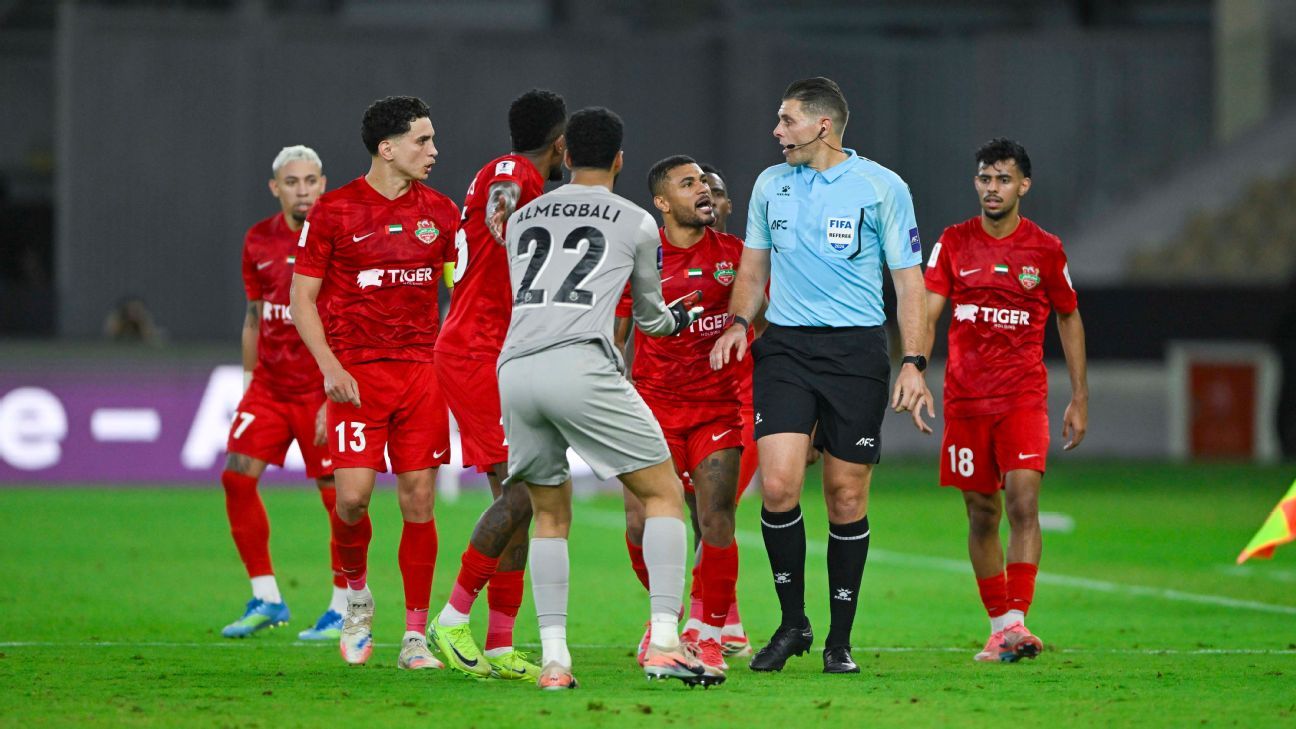
Tension erupted following Tuesday’s AFC Champions League semi-final match between Japan’s Machida Zelvia and UAE’s Shabab Al Ahly. The match concluded with Shabab Al Ahly expressing their frustration, having just been eliminated from Asia’s premier club competition.
In a closely contested battle, Shabab Al Ahly’s aspirations of achieving Asian glory came to an abrupt halt with a 1-0 loss. However, players from the UAE side were adamant that their late equalizer in the 92nd minute should have sent the game into extra time instead of being disallowed.
Controversial Referee Decisions Spark Outrage
The players immediately confronted referee Sean Evans regarding the contentious call. After the match concluded, the officials, including Evans, required police assistance to navigate back to the safety of the locker room due to the intensity of the crowd’s reaction.
The situation became notably perplexing when, in an unprecedented turn of events, Evans sought the assistance of VAR to reassess a substitution decision. This led him to overturn his initial ruling, which had recognized Guilherme Barra’s notable individual achievement.
What exactly ignited such controversy in the match? Following what appeared to be Machida’s fifth and final substitution while the score remained even, members of Shabab Al Ahly immediately approached Evans as soon as play resumed from a throw-in, raising questions that were not immediately apparent.
Key Moments and VAR Intervention
As Shabab Al Ahly moved the ball forward, player Bala initiated a remarkable 40-yard run, maneuvering past two defenders before launching an unstoppable shot into the far corner of the net. The goal triggered jubilant celebrations from the Shabab Al Ahly contingent, but Machida swiftly conveyed their concerns to Evans.
Clarity emerged when VAR prompted Evans to review the situation at the pitchside monitor. It became evident that Hotaka Machida Nakamura was still on the field exchanging pleasantries with his substitute, Henry Herroki Mochizuki, as Shabab Al Ahly’s defender, Cowan Santos, had already returned the ball to play.
As the play unfolded, Nakamura was effectively off the field yet positioned nearly on the touchline, and just moments later, Mochizuki stepped onto the pitch. Initially, Evans appeared unaware of any irregularities, interpreting the swift transition as permissible under the rules.
Legal and Ethical Implications of Substitutions
Machida may argue that Shabab Al Ahly were not genuinely prepared for the restart, especially considering that Barra had replaced Nakamura on the flank where the goal was scored. Even if the restart was deemed legal, it’s plausible that Mochizuki was not able to take his designated position in time. When the shot hit the net, he had only reached the center of the box, while Machida’s captain, Gen Shoji, had covered the resulting gap on the opposite side.
It’s important to recognize that a team isn’t mandated to wait until an opponent is fully ready to resume play after a substitution. Even with a moment’s delay in the restart, it seems likely that Bala would still have found the net. The facts remain that play continued with unyielding speed.
However, the nuances of Evans’ whistle—as to whether it occurred before or after Santos’ throw-in—remains a point of contention. Speculation arises about whether Evans rushed the restart to compel Machida to act, suggesting a tactical choice that could have had far-reaching implications.
Voices of Discontent from Shabab Al Ahly’s Side
The repercussions of this scenario left Shabab Al Ahly looking for answers after the match. Coach Paulo Sousa, visibly upset after the referee nullified the equalizer, expressed his discontent, stating, “There was a goal, but it was canceled. This was a very technical mistake by the referee.” His disappointment extended to the organization, as he criticized the insufficient quality of officiating in a tournament of this caliber.
Despite their grievances, the outcome remains unchanged. Machida will move on to Saturday’s final, marking their inaugural appearance in such a prestigious tournament, especially notable given their status in Japan’s second-tier soccer in 2023.
Yet, Shabab Al Ahly have every right to feel aggrieved over their inability to continue the contest beyond regulation without at least a chance at a penalty shootout. This incident underscores the ongoing debates surrounding VAR’s role in the modern game, particularly in the context of substitutions.
