


New Model Estimates Canada’s Permanent Resident Threshold
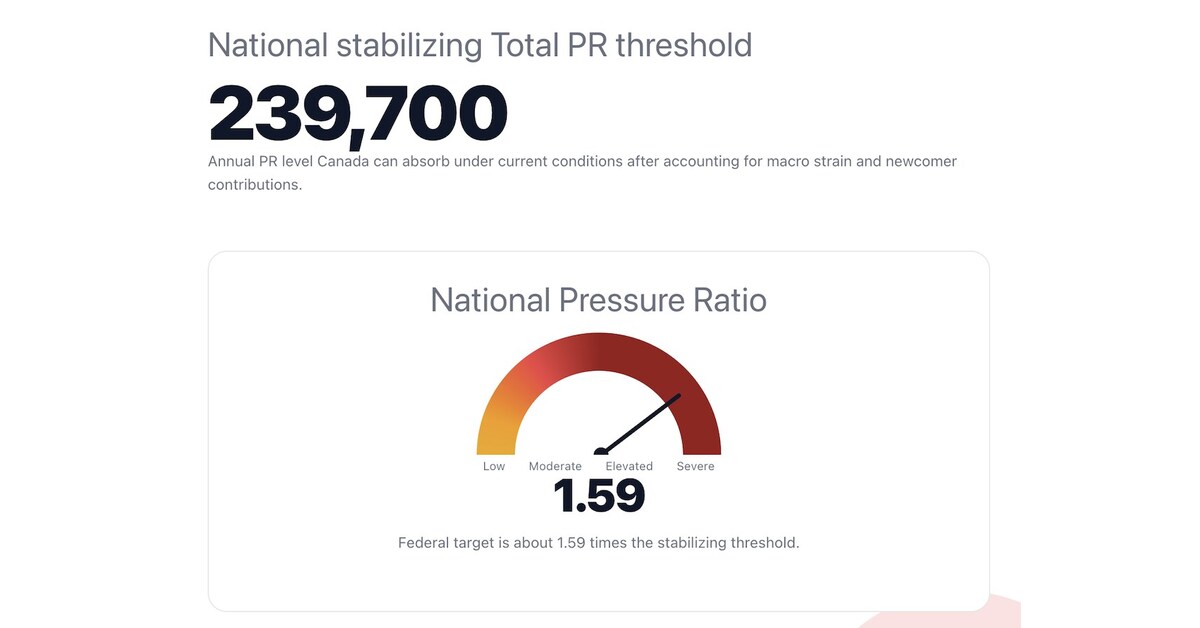
Immigration News Canada has introduced an independent model estimating that the nation’s stabilization threshold for permanent residents stands at approximately 239,700 cases annually. This figure sharply contrasts with the federal government’s target of 380,000 admissions for 2026.
Launch of the Canadian Permanent Resident Absorption Index
On May 7, 2026, Immigration News Canada, the leading immigration and visa resource in Canada, unveiled the Canadian Permanent Resident Absorption Index. This innovative benchmark aims to assess the capacity of Canada, its provinces, and major metropolitan areas to absorb permanent residents based on current economic and demographic conditions.
Access to the Interactive Index
The complete interactive index can be explored at the following link: Canada Immigration Absorption Index.
Nationwide Pressure Ratio Revealed
The model projects that Canada’s national stabilization threshold for permanent residents is roughly 239,700 per year, with a national pressure ratio of approximately 1.59 when compared to the federal target of 380,000 admissions. This significant disparity highlights the challenges facing Canada’s immigration system.
Independent Data Model’s Purpose and Scope
The Canada Permanent Resident Absorption Index is entirely independent and does not represent any official government target, cap, or quota. It was developed by Immigration News Canada to provide a clearer understanding of immigration absorption capacity, assisting readers, researchers, journalists, employers, and policymakers in recognizing areas of strength, weakness, or pressure within the immigration system.
Assessment Criteria for the Absorption Index
The index evaluates several factors, including labor market conditions, unemployment rates, job openings, rental vacancies, housing supply and affordability, wage growth, population dynamics, health service capacity, immigrant retention, and the contributions of new entrants to the labor market. Notably, it differentiates between total permanent resident admissions and conversions from temporary resident status, recognizing that the latter typically already have access to necessary resources.
Provincial and Local Stabilization Thresholds
Among provinces, Ontario holds the highest modeled stabilization threshold at roughly 92,700 admissions per year, followed by Quebec at about 51,800, Alberta at 34,800, and British Columbia at 34,200. At the census metropolitan area level, Toronto leads, followed by Montreal, Vancouver, Ottawa-Gatineau, Calgary, Edmonton, Quebec City, Winnipeg, Hamilton, and Kitchener-Cambridge-Waterloo.
Transparency in Measuring Immigration Absorption
Kamal Deep Singh, founder of Immigration News Canada, remarked on the index’s significance, stating that it represents an initial public effort to transparently measure immigration absorption capacity. He emphasized that the intent of the index is not to advocate for specific immigration levels but to present the current labor, housing, service, and retention conditions affecting absorptive capacity.
Source of Data and Methodology
This index relies on publicly available data from various credible sources, including Statistics Canada, CMHC, IRCC, and the Long-term Immigration Database. Comprehensive details regarding its methodology, assumptions, formulas, source limitations, and feedback mechanisms are provided directly on the index page.
About Immigration News Canada
As Canada’s most frequented immigration and visa website, Immigration News Canada ranks first in the Canadian Immigration and Visas category according to SimilarWeb. Founded by RCIC Kamal Deep Singh, it offers timely updates, analyses, and insights on immigration policies, permanent residence, Express Entry, provincial programs, work and study permits, and national policy developments.
