


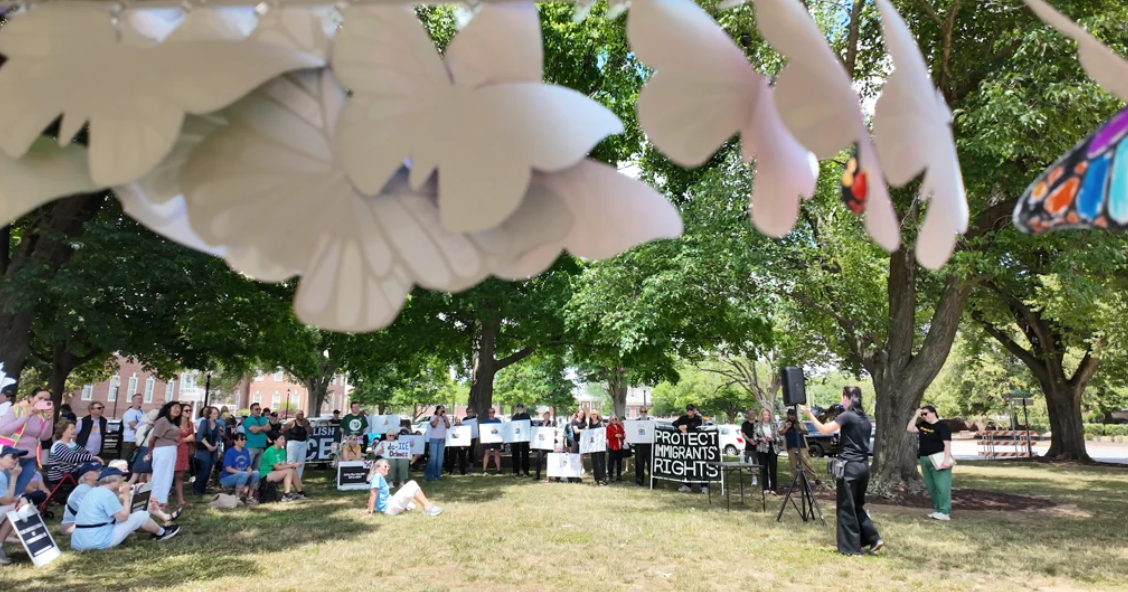
Community Rallies for Immigration Reform in Delaware
DOVER, Del. – On June 17, dozens of community members, including advocates from the ACLU of Delaware and local Indivisible chapters, congregated on the west lawn of the Legislative Building. Their mission was clear: urging lawmakers to pass pivotal immigration legislation before the Delaware General Assembly session concludes in under two weeks.
Organizers showcased over 800 elaborately decorated paper butterflies, symbolizing immigrants detained by U.S. Immigration and Customs Enforcement (ICE) in Delaware from January 2025 to March 2023, as reported by the ACLU of Delaware.
According to Helen Sarita, immigration campaign manager for the ACLU of Delaware, the data collected revealed 800 individuals affected in just a short time. “We utilized valuable public resources to gather detailed research and quantify the issue at hand,” Sarita stated. “The figures we uncovered underscore the magnitude of the problem, and we suspect that many more are affected.”
She emphasized the human impact, noting that families and communities are experiencing significant distress due to current immigration policies. “We are raising awareness and advocating for real policy changes to alleviate this crisis,” Sarita added.
Communities from all over Delaware engaged with the butterfly exhibit, a testament to the widespread concern over immigration enforcement in the state. “ICE operations are active in every county daily, prompting participation from diverse local events,” Sarita explained.
A variety of speakers addressed the gathering, including Congresswoman Mara Gorman and Latin American Community Center CEO Maria Matos. Activist Charito Calvaki Matejko voiced strong sentiments, stating, “We’re here to ensure that these lives are recognized and to oppose government actions that do not align with our values.”
Efforts continue as supporters advocate for several key bills as the legislative session approaches its end on June 30. One significant measure is House Alternative 1 to House Bill 368, aimed at prohibiting local law enforcement from detaining individuals based solely on immigration detainers or civil immigration warrants, with specific exceptions for violent felons, sex offenders, those convicted of drunk driving, and perpetrators of domestic violence.
The bill successfully passed the House on June 16 with a 23-13 vote and has been sent to the Senate Judiciary Committee. Notably, Republican State Representatives Jeff Hilovsky and Valerie Jones Giltner voted against the bill, expressing concerns over its implications.
Marvin Maley Jr., executive director of the Delaware Police Chiefs Association, previously highlighted potential conflicts between the new regulations and federal cooperation, stressing concerns about federal funding. However, Rep. Mara Gorman, the bill’s sponsor, reassured that similar laws have functioned in other states since 2019 without negative repercussions on funding or collaboration with federal agencies.
Matejko aimed to hold Congress accountable, reminding its members that they must take appropriate actions in Delaware. “While they cannot amend immigration laws directly, they are compelled to protect immigrants within our state,” he said.
Lisa Elena Williams, a local school social worker and daughter of immigrants, shared her observations about the anxieties faced by students regarding separation from their families. “They constantly worry about their loved ones during the school day,” she remarked.
Jack Dixon, representing Sussex Help, a resource for immigrant families, detailed the organization’s commitments. Founded six months ago, the initiative responds to critical needs like transportation and housing for affected individuals. “Initially, we focused on immediate necessities, but we soon realized financial aid emerged as a pressing requirement,” Dixon explained.
The Sussex Support Fund was established to assist families with housing, utilities, and other urgent expenses. Beyond financial relief, Dixon added, “We engage in legal efforts to support individuals facing immigration issues, aiming to empower them towards independence.” This holistic approach has helped numerous families regain their footing, transitioning to self-reliance.
Reflecting on the butterfly exhibit, Dixon noted, “The symbols represent the hardships facing many families. There are countless children without enough to eat and mothers unsure of their next steps.” He extended an appeal for broader community support: “It is crucial for everyone, regardless of background, to recognize the struggles of immigrant families and stand in solidarity.”
Sarita concluded with a call to action: “We must be present for our neighbors. The current crisis demands immediate and decisive action; there is no room for fear or hesitation.”
