


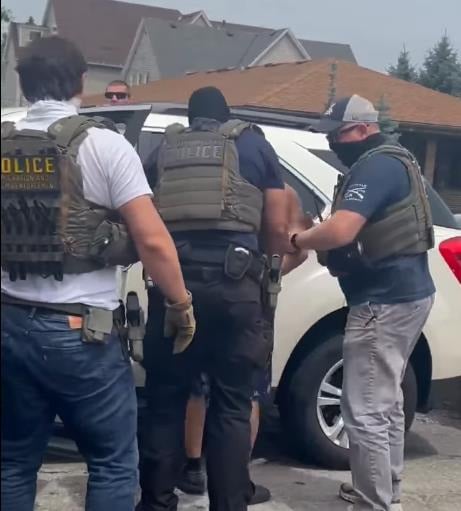
Clashes Erupt Over Mask Regulations as ICE Operations Increase in Milwaukee
The rising presence of U.S. Immigration and Customs Enforcement (ICE) agents in Milwaukee has sparked tensions between local officials and federal authorities. City and county leaders are voicing concerns regarding compliance with local ordinances, notably a recent ban on law enforcement officers wearing face coverings while on duty.
In April, Milwaukee’s Common Council approved legislation that prohibits local and federal law enforcement officers from wearing masks, with penalties ranging from $5,000 to $10,000 for violations. In response, the Department of Homeland Security (DHS) asserted its intention to disregard these local rules. DHS spokeswoman Lauren Biss characterized the ban as politically motivated and a serious risk to officer safety.
On June 30, ICE announced the arrest of 39 individuals in the Milwaukee area, further igniting local outrage against the agency’s enforcement practices. Local officials have alleged that ICE is also violating other regulations, including a county ordinance that forbids performances on county property. Milwaukee County Supervisor Juan Miguel Martinez took action after witnessing ICE vehicles at the Mitchell Park Dome on June 29, emphasizing the need to document these occurrences for potential legal action.
When Martinez arrived on the scene, he found the ICE vehicle had already departed. He subsequently contacted Sheriff Denita Ball, who was informed of ICE’s presence. Martinez noted that the objective is to ensure thorough documentation of ICE activities, which may lead to legal action against the agency for staging events without a permit.
James Barnett, spokesperson for the Milwaukee County Sheriff’s Office, clarified that the local ordinance regarding vehicular traffic in parks results in civil charges rather than criminal ones, limiting enforcement options for the sheriff’s office. Nevertheless, Martinez is advocating for new legislation aimed at restricting ICE’s access to other county properties, such as public transit systems.
Milwaukee County Executive David Crowley indicated that the county may pursue legal measures against ICE. He expressed frustration over the agency’s actions and the resultant complications for local governance. Meanwhile, Common Council member Marina Dimitrijevic highlighted a related concern regarding ICE’s use of the Milwaukee Police Department’s 2nd District parking lot, which she argued is prohibited by a resolution aimed at keeping city property free from civilian immigration enforcement activities.
Immigrant Advocates Push Back Against ICE’s Narrative
Immigrant advocacy groups have challenged ICE’s portrayal of those arrested, with Christine Neumann Ortiz, executive director of Voces de la Frontera, reporting that among the 26 to 28 arrests confirmed since June 23, most involved individuals without any prior criminal records. Many of those detained are currently involved in unresolved asylum cases or facing civil immigration issues.
An ICE spokesperson claimed that “many” of those arrested possessed criminal records but did not substantiate this assertion with specific evidence. Local media classified the arrests as part of a “targeted operation.” Neumann-Ortiz indicated that ICE often relies on pre-existing lists to track individuals, leading to arrests conducted in public spaces like homes and streets.
Eyewitness accounts have described troubling behaviors from ICE agents, including aggressive handling of detainees and the use of derogatory language, further complicating the already tense relations between federal enforcement and local communities. The broader implications of these clashes not only reflect ongoing debates about immigration policy but also highlight the growing challenges faced by cities grappling with federal overreach.
