


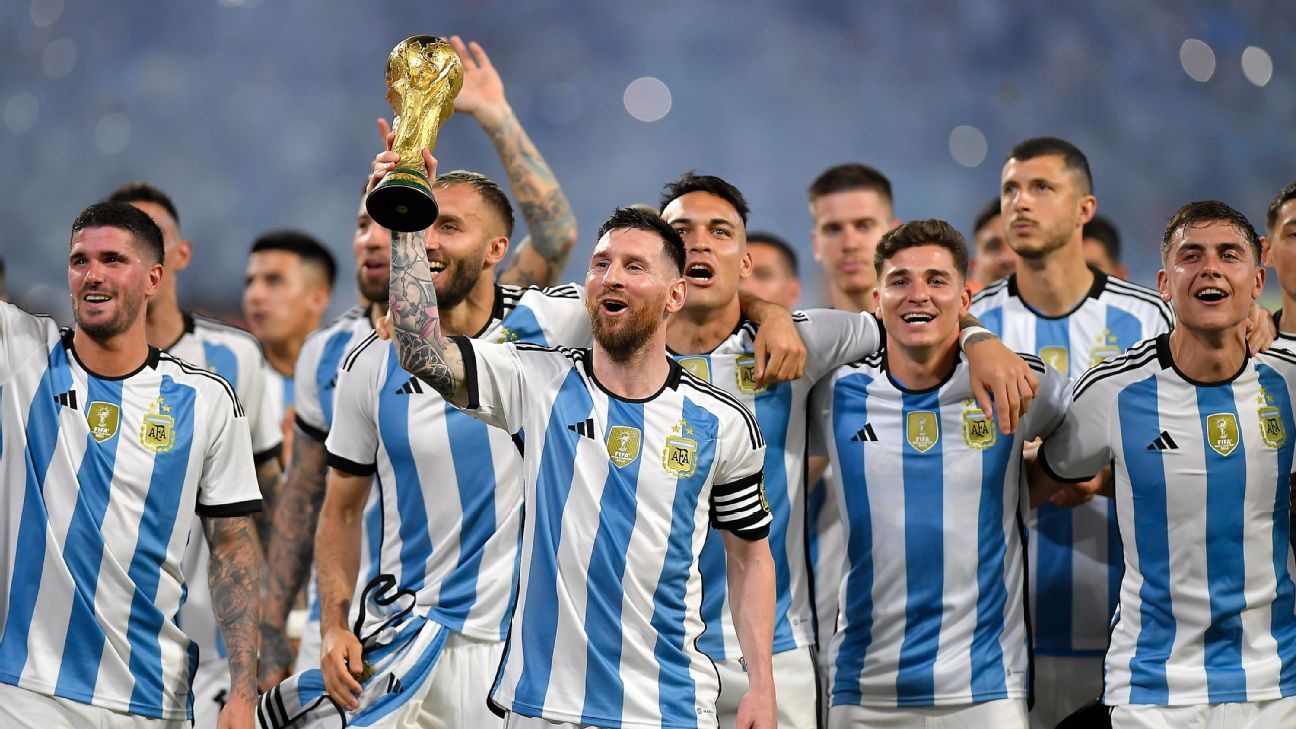
For the first time since FIFA instituted rankings in 1992, the World Cup semi-final stage features an extraordinary lineup of four champion teams: Argentina, Spain, France, and England. This historic matchup underscores the intensity of the competition, which includes five out of the six top goalscorers and one of football’s greatest rivalries.
Ranked as the top four teams globally, Argentina, Spain, France, and England are just two victories away from securing the coveted championship title. France will take on Spain in Arlington, Texas, on Tuesday, while England is set to face Argentina in Atlanta on Wednesday.
A Historic Reunion of Champions
It has been since 1990 that the World Cup’s final four comprised only previous champions. Back then, England and Argentina were in the mix, although they did not face each other. Argentina, having triumphed over West Germany to become the defending champions in 1986, lost to the same team in the finals four years later.
If France and Argentina both secure their spots in the final, fans could witness a thrilling rematch of the 2022 encounter.
Argentina’s path to the final depends on overcoming England, reigniting a rivalry that extends beyond the pitch and intertwines with historical tensions dating back to the 1982 Falklands conflict. The matchup carries significant emotional weight for both teams.
The World Cup has seen its fair share of dramatic moments between these two football giants. Notably, Argentina’s captain Antonio Rattin was infamously sent off during the 1966 quarter-final against England, while English manager Alf Ramsey attempted to prevent his players from exchanging jerseys post-match.
Fast forward to 1986: Diego Maradona’s legendary ‘Hand of God’ goal propelled Argentina to a 2-1 victory over England in the quarter-finals, securing them the trophy.
Memorable Encounters and Rivalries
The rivalry continued in 1998 when David Beckham was sent off for a minor foul against Argentina’s Diego Simeone, leading to a media storm in England. Argentina ultimately triumphed in that round of 16 match via penalties. However, Beckham redeemed himself in 2002 by scoring a crucial penalty, which helped eliminate Argentina from the group stage.
On the opposite side of the tournament bracket, France and Spain are preparing for another semi-final showdown, two years after their encounter in the European Championship, where Spain emerged victorious with a 2-1 win fueled by a goal from then-16-year-old Lamine Yamal.
Despite facing injury concerns for key players like Yamal and Nico Williams, Spain has relied on timely contributions from substitutes, including Mikel Merino, to secure victories against Portugal and Belgium in recent matches.
Rivalries and Rising Stars
Throughout the history of the World Cup and the Euros, France and Spain have become familiar adversaries, with France winning the Euro 84 final in memorable fashion. Currently, France is hailed as one of the most formidable teams, featuring a wealth of offensive talent propelled by Kylian Mbappé, who is competing for the top goalscorer title as the tournament approaches the semi-final stage.
While Erling Haaland may have been eliminated from the Golden Boot race following Norway’s loss to England, other contenders have emerged, with Mbappé and Lionel Messi leading the pack with eight goals each. Notably, Jude Bellingham and Harry Kane have each netted six goals, while Ousmane Dembele and Mikel Oyarzabal have added to Spain’s tally.
The race to become the all-time top scorer in the World Cup is heating up as well, with Messi currently boasting 21 goals, just one ahead of Mbappé. Messi, widely regarded as the greatest of all time, is set to make his first appearance against England in what is likely his final World Cup appearance at age 39.
If Messi can guide Argentina to the title, he will outshine the legendary Diego Maradona, who led Argentina to two World Cup victories. This would also mark Argentina’s first consecutive championships since Brazil achieved the feat in 1958 and 1962, a legacy reinforced by soccer icon Pelé, who was part of those Brazilian squads that celebrated their third World Cup in 1970.
Information from The Associated Press contributed to this report.
