


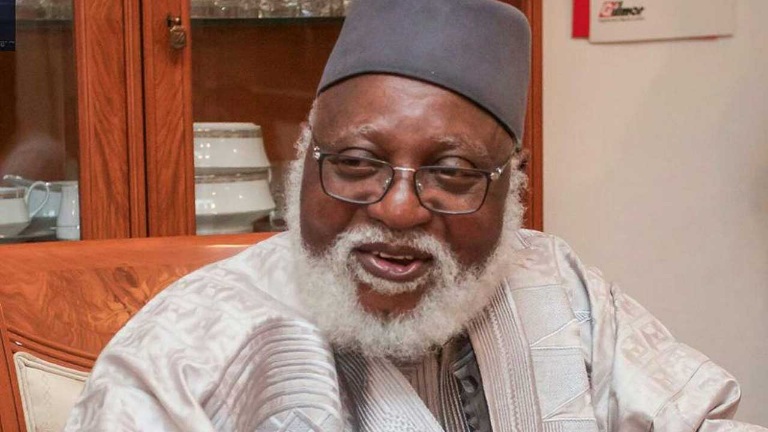
General Abdulsalami Abubakar Reflects on Abacha’s Death in New Autobiography
Former Nigerian military leader, General Abdulsalami Abubakar (rtd), has shared a gripping account of the hours following the death of General Sani Abacha, revealing that he was confined in a room at the presidential villa until he was informed of Abacha’s passing. This revelation is part of Abdulsalami’s newly released autobiography, *Call of Duty*, which was launched in Abuja to mark his 84th birthday.
On June 8, 1998, Abdulsalami received a sudden phone call indicating that Abacha wished to meet with him. Given the urgency and his expectation for another commitment, he rushed to the presidential villa dressed casually.
Upon arrival, Abdulsalami was ushered into a waiting room where he remained locked in with Major Ishaya Bamaiyi for over an hour. His sense of unease grew when he realized the door was secured from the outside.
Reflecting on that fateful day, Abdulsalami wrote, “I received an early morning call saying he wanted to meet me. I silently prayed that it wasn’t about the ECOWAS summit in Togo, as I was feeling fatigued.” With Lieutenant General Diya already detained on coup-related suspicions, Abdulsalami felt the pressure of being the effective second-in-command of the government. He communicated his concerns to his wife and ordered his staff to prepare for travel.
As he made his way to the bathroom, he received further urgent communications, leading him to the presidential villa in a jersey and slippers rather than his military uniform. Upon reaching Abacha’s residence, he was informed that he should wait. Confounded by the early hour of the meeting, he grew increasingly anxious as time ticked by—eventually deciding he would take matters into his own hands.
Upon attempting to leave the waiting room, he discovered the door was still locked. When he questioned Major Bamaiyi about their confinement, Bamaiyi acknowledged a sense of foreboding but did not take action. Their ordeal ended abruptly when the Inspector General of Police, Alhaji Ibrahim Kumasi, entered and informed them that Abacha had died. Abdulsalami’s initial shock quickly transitioned to an urgent need for clarity, though Kumasi provided little additional information.
In a moment of disbelief, Abdulsalami confirmed the reality by viewing Abacha’s body and offering a silent prayer. While he did not accuse any specific individuals for the lock-in, he hinted at the possibility that some military officers may have been plotting amidst the emerging leadership crisis. Within hours, Abdulsalami was elected by the Interim Governing Council as Abacha’s successor. He then embarked on an ambitious transition plan that ultimately led to the restoration of democratic governance under Olusegun Obasanjo in May 1999.
