


African Development Bank Highlights Trade Finance Challenges Amid Geopolitical Tensions
The African Development Bank (AfDB) has cautioned that Africa’s trade and finance gap could swell to $86.6 billion by 2027. This projection comes as a result of escalating energy prices and tightening global credit conditions, directly linked to increasing geopolitical tensions in the Middle East.
According to the report titled “Africa’s Trade Finance Supply: Post-COVID-19 Trends and New Opportunities,” the continent’s unmet demand for trade finance is expected to range from $74 billion to $92 billion by 2024. The lower estimate alone constitutes approximately 5.4% of the region’s total merchandise trade in that year.
The report credits the significant progress made to prompt and substantial interventions from multilateral development banks, governments, export credit agencies, and other stakeholders in the wake of the COVID-19 pandemic.
Anthony Simpasa, head of macroeconomic policy, forecasting, and research at AfDB, noted a nearly 10% decline in unmet trade finance demand between 2019 and 2024. This achievement has been bolstered by the collaborative efforts of multilateral development banks and governmental agencies, including the World Bank.
Such interventions are critical for maintaining trade flows. Without support from development finance institutions (DFIs), the annual trade finance gap might have surged past $100 billion during the period from 2020 to 2024, indicating the vital role of these financial entities.
However, the emergence of renewed geopolitical tensions and interruptions in global supply chains pose significant risk to the progress made post-pandemic. Simpasa cautioned that a heightened risk appetite among correspondents could lead to a widening trade finance gap, potentially reaching between $86.6 billion and $102.6 billion by 2027—an increase of at least 17.7% over the 2024 estimate, undoing years of gain.
Impact of the Pandemic on Trade Finance Recovery
The disruption caused by COVID-19 has had a substantial impact on Africa’s trade finance landscape. In 2020, bank-mediated trade finance plummeted by approximately 52%, falling from $408 billion to around $195 billion. While there has been a recovery, it has not been comprehensive—by 2024, the value is projected to reach $335 billion, still over 17% below pre-pandemic levels.
The diminished support from banks is also reflected in their role in total trade financing. Between 2011 and 2019, banks facilitated about 40% of Africa’s commodity trade, but this figure dropped to only 23% from 2020 to 2024. In contrast, bank support accounts for roughly 80% of global trade finance.
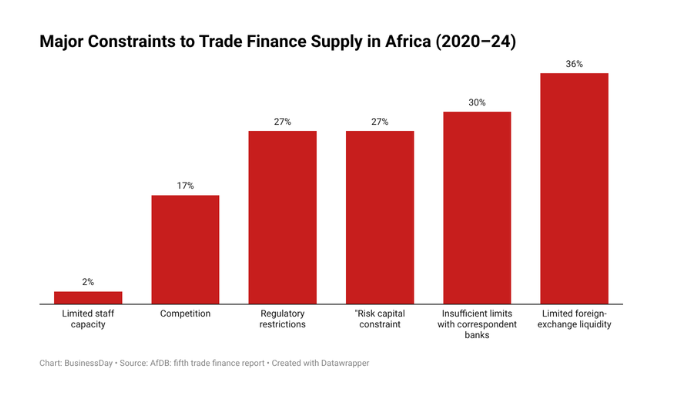
The report identifies foreign exchange liquidity as a key constraint affecting banks, with 36% highlighting it as a significant barrier—double the 18% reported in previous years. The dominance of the U.S. dollar in trade finance, which constitutes 88% of foreign exchange trading volume, has exacerbated these issues, leaving many banks and traders cash-strapped due to the pandemic disruptions, thereby depreciating local currencies.
Small and Medium-Sized Enterprises Face Financing Challenges
Small and medium-sized enterprises (SMEs), which represent at least 80% of businesses across Africa and contribute over half of the region’s GDP, are particularly vulnerable. Banks approved an average of only 63% of SME trade finance applications during the study period, compared to an 80% approval rate for larger entities. Despite having higher default rates, which hover between 8% and 9.9%, SMEs are considered more predictable and thus present an opportunity rather than a risk for banks seeking to enhance their portfolios.
The report highlights that the two primary reasons for rejected applications remain unchanged since the AfDB’s initial report in 2014: weak customer credit and insufficient collateral, cited by 48% and 39% of banks, respectively. Compliance burdens, particularly around customer visibility and anti-money laundering regulations, were noted by 20% of banks as additional constraints, with 19% pointing to restrictions related to foreign exchange liquidity.
Evolving Correspondent Banking Landscape
A significant shift in the correspondent banking landscape has emerged, with African banks becoming more prominent. In the latest study, six out of the top seven banks are now based in Africa, illustrating a notable change from previous findings, where only two African banks were among the top ten. Notable institutions include UBAF, Banque Centrale Populaire, Absa, Crown, EBI, and BMCE, while Citibank remains the leading partner with 11% of surveyed banks.
This trend reflects both a retreat of European banks due to tighter regulatory demands and the growing capabilities of local financial institutions, supported partly by DFI initiatives such as the AfDB’s Risk Participation Agreement, which has facilitated 3,100 transactions totaling $8.8 billion since its inception.
Digitalization as a Double-Edged Sword in Trade Finance
The report also dedicates considerable attention to the potential of digitalization in trade finance. Unfortunately, only 28% of surveyed banks have implemented digital tools in their operations—significantly lower than the 42% reported in the Asia-Pacific region in 2024. However, businesses that have transitioned to digital models reported marked benefits: 56% experienced substantial improvements in operational efficiency, while 47% noted increased customer satisfaction. Moreover, banks anticipating a complete digital transition expect to lower transaction costs by over 30%. The main barriers to digital adoption include high implementation costs and inadequate technological infrastructure.
Geopolitical Risks and Their Impact on Trade Finance
Recent geopolitical events, particularly the conflict in the Middle East since February 2026 and the subsequent closure of the Strait of Hormuz, have created urgent challenges for trade finance. The closure has resulted in a significant rise in energy and transportation costs, further straining Africa’s fiscal resources as a net oil importer. Since the onset of the conflict, at least 29 African currencies have depreciated, diminishing the creditworthiness of borrowers and limiting the availability of trade finance just as demand climbs.
The report models three scenarios for the evolution of the trade finance gap by 2027. Under a baseline scenario without external shocks, the gap is projected to narrow towards $65 billion. However, with sustained oil prices exceeding $105 per barrel and tighter banking risk appetites, the gap could rise to approximately $86.6 billion—an increase of 17.7% compared to the 2024 forecast. In a severe scenario involving ongoing disruptions in the Strait of Hormuz, significant currency depreciation, and reduced access to international credit lines, the gap could escalate to $102.6 billion, potentially erasing years of financial progress in the region.
The AfDB report ends on a cautionary note, emphasizing the necessity for a coordinated response from commercial banks, export credit agencies, and development finance institutions to mitigate the risk of reversing the trade finance gap to pre-pandemic averages.
