


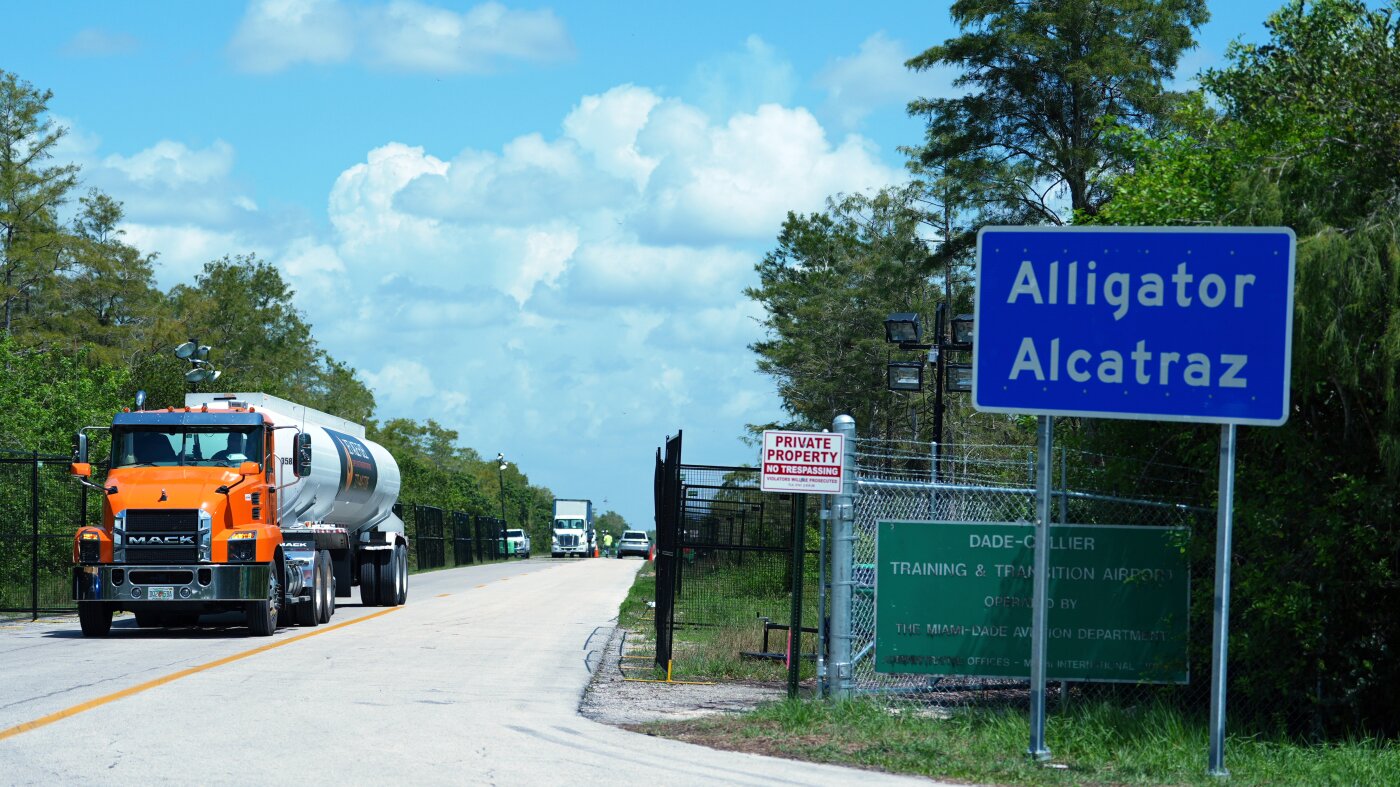
FILE – Trucks drive to and from the Alligator Alcatraz immigration detention center in the Florida Everglades, August 28, 2025 in Collier County, Florida.
Rebecca Blackwell/Associated Press
MIAMI — The U.S. Department of Homeland Security has announced that all detainees at the immigration detention center, informally known as “Alligator Alcatraz,” located on a secluded airstrip in Florida’s Everglades, have been transferred to other facilities. This decision was made in light of concerns surrounding the impending hurricane season.
The South Florida Detention Center, which has received accolades from President Donald Trump, has faced intense criticism from lawyers, human rights organizations, and families for its treatment of detainees since its launch 11 months ago, coinciding with the Atlantic hurricane season.
While the DHS confirmed the transfer of all detainees at state facilities, it did not specify the number of individuals relocated or the destinations of these transfers, leaving the future status of the center unclear.
“For the safety of illegal alien detainees, we have transferred them to other facilities,” said DHS spokesperson Lauren Biss in a statement.
Hurricane season spans from June to November. The detention center began operations on July 3, 2025, shortly after that year’s hurricane season commenced, which fortunately ended without any significant storms impacting Florida. Since then, it has continued its operations amidst growing scrutiny.
Following ICE’s announcement, the National Hurricane Center confirmed that the first tropical storm of the 2026 season had formed off the Texas coast. Detainees have reported poor living conditions, including inadequate access to legal representation, unclean living environments, and rampant insect infestations.
Constructed rapidly by the administration of Florida Governor Ron DeSantis, Alligator Alcatraz is surrounded by alligator-infested swamps. President Trump toured the facility just two days before it opened on July 1, 2025. The Florida Department of Emergency Management has not responded to requests for additional information.
Advocates for immigrants have consistently argued that the conditions within the tent facilities are inhumane. However, both federal and state officials have maintained that the center is equipped to withstand hurricanes.
Amy Godshall, an attorney with the American Civil Liberties Union, commented, “Removing people from this cruel facility is an important step, but it does not erase the harm that has already been done. The state and federal government must permanently close this facility and commit to never holding people there again.” Governor DeSantis recently stated that South Florida detention centers are always intended to be temporary and noted that the facility has processed and deported 22,000 detainees since it began operations.
Concerns Over Hurricane Season Justification
Some immigration advocates argue that citing hurricane season as a reason for the transfers is disingenuous. Arianne Betancourt, a community advocate, emphasized, “That’s a nonsense excuse, because it opened in the middle of the worst of last year’s hurricane season.” Over the past two weeks, advocates have observed an uptick in detainee transfers, losing contact with numerous individuals.
Katie Blankenship, an immigration attorney, noted that all 50 clients she has worked with in the past three weeks have been relocated from Alligator Alcatraz to different facilities across South Florida, California, Arizona, Louisiana, and Texas. “They are moved into the system and disappear, and family members and lawyers are typically unable to access them for about a week,” she explained.
Impact on Families
Renata Bozzetto, deputy director of the Florida Immigration Coalition, highlighted that the fallout from the facility’s operations will extend beyond its closure. “Many of the detainees are transferred to other detention facilities, but their families continue to face insecurity and hardship. When this detention center closes, many companies and contractors will walk away with millions of dollars in profits, and immigrant families will be left to pick up the pieces.”
