


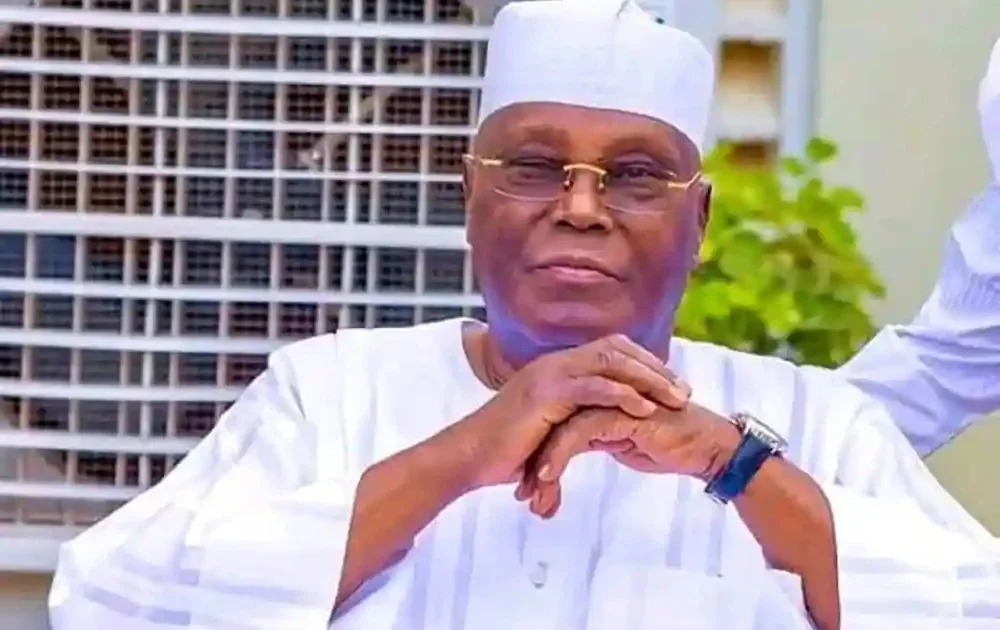
Atiku Abubakar Critiques Government on Omitted Public Spending
Atiku Abubakar, the former vice-president and presidential candidate for the African Democratic Congress, has called out the Bola Tinubu administration regarding significant public spending that the International Monetary Fund (IMF) cited as missing from Nigeria’s latest budget documentation.
Abubakar described the omission as a clear indication of rampant corruption within the upper echelons of government. His comments follow the IMF’s report, which revealed that approximately 2% of Nigeria’s gross domestic product (GDP) was unaccounted for in the country’s budget.
In a recent statement made public by his senior special assistant for public affairs, Plank Scheib, Abubakar emphasized that this oversight cannot simply be brushed off as an accounting blunder. He posed a critical question for Nigerians: “Who stole the missing 2% of our GDP?”
He elaborated that this issue transcends mere financial discrepancies, branding it a “constitutional, legal, and moral scandal.” Abubakar remarked that funds do not vanish from the national budget without approval at various levels, demanding accountability from those responsible.
The ADC leader connected the IMF finding to ongoing controversies surrounding the unverified establishment of the President’s Council for Foreign Intervention. He argued that both matters highlight a troubling trend of misuse of public institutions. Abubakar cited a stark contrast in budget allocations, noting that despite ₦218 billion earmarked for the Federal Ministry of Health, it received only ₦36 million, while the disputed council reportedly received ₦1.3 billion.
He criticized the administration’s priorities, stating, “This is not fiscal management; it is institutionalized corruption.” Abubakar also urged the Secretary to the Government of the Federation, Senator George Akume, to clarify how this questionable agency was recognized in the government process.
Abubakar pointed to allegations made by Adeniyi Adeyemi, suggesting that the conflict began following his refusal to comply with a request for a substantial kickback related to a proposed ₦27.3 billion subsidy. He deemed these allegations too severe to overlook and called for an independent investigation to ascertain the truth.
As Nigeria grapples with challenges such as the removal of fuel subsidies, rising electricity tariffs, high inflation, and escalating public debt, Abubakar underscored the irony of asking citizens for further sacrifices while the government struggles to account for vast public resources. He implored several oversight bodies, including Parliament and the Federation’s Auditor-General, to conduct thorough investigations, asserting that this issue is not merely political but central to governance and accountability.
“All expenditures must be justified, and all officials found guilty should face consequences,” he insisted. Until a satisfactory explanation is provided for the alleged off-budget expenditures, Abubakar warned that all claims of transparency from the current administration would be viewed with skepticism.
The IMF’s recent assessment highlighted significant gaps in Nigeria’s budget framework, stating that government expenditures equivalent to approximately 2% of GDP are not reflected in official reports. The Fund has called for enhanced fiscal transparency, improved budget reporting, and stricter public financial management to bolster accountability in Nigeria’s financial dealings.
This revelation coincides with increasing concerns among opposition parties and civil society groups, urging a thorough investigation into the government’s management of public funds, particularly in light of the controversies surrounding President Bola Tinubu.
