


This article is part of the Guardian’s expert network for the 2026 World Cup, a collaborative effort of top news organizations from the 48 countries that have qualified. Daily previews are being published from three nations leading up to the tournament, which kicks off on June 11.
Surprising Qualification Journey
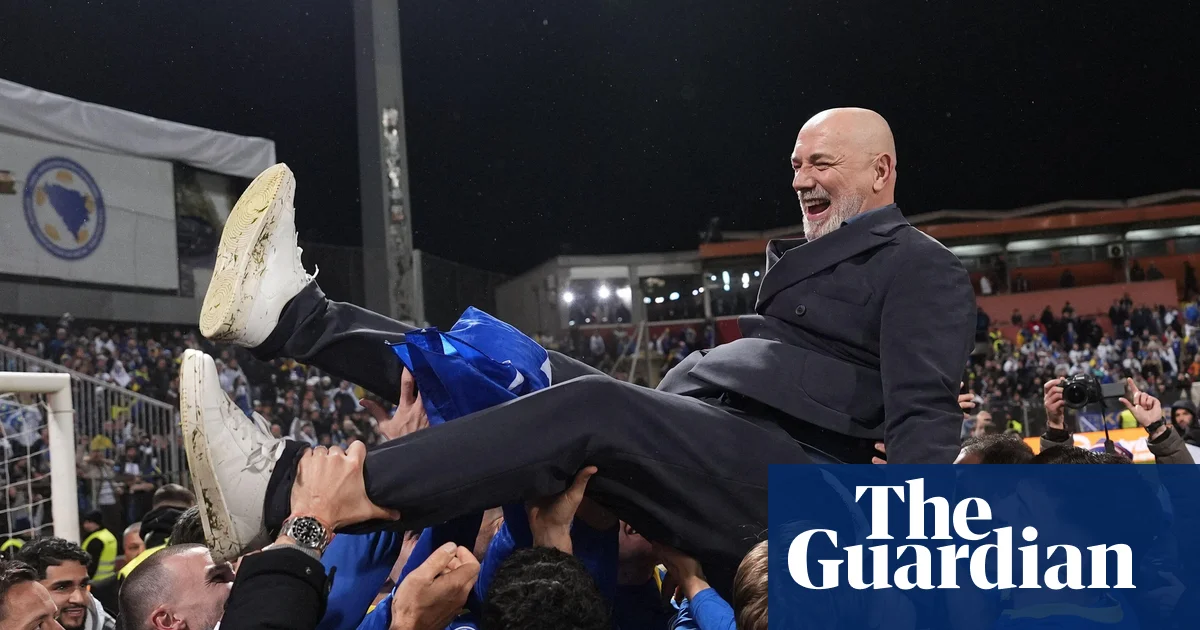
Bosnia and Herzegovina’s qualification for the World Cup has come as a significant surprise. With only four wins in their last 19 games across two qualifying cycles, the team faced a crisis when Sergey Barbares took over as coach in 2024. The ensuing campaign was marked by chaos and emotion, ultimately emerging as a true reflection of Bosnian football. Against the odds, Barbares’ team triumphed over Wales and Italy in a dramatic playoff, securing a spot in the World Cup for just the second time in the nation’s history.
Having long awaited the opportunity to lead, Barbares had spent years away from coaching, engaging in professional poker during his retirement. The call from the Bosnian Football Federation finally came, bringing together a supportive network of old friends and former teammates. Emir Spahic assumed the role of sporting director, while Sasa Papac and Zlatan Bajramovic joined the coaching staff.
Bosnia and Herzegovina: Group B Fixtures
June 12 vs Toronto, Canada (3 PM local time, 8 PM BST)
June 18 vs Los Angeles, Switzerland (noon local time, 8 PM BST)
June 24 vs Qatar, Seattle (noon local time, 8 PM BST)
During Barbares’ inaugural year, 16 players earned their first caps, many hailing from abroad, including Sweden, Germany, Austria, and the United States. This influx became the backbone of the new Bosnian squad. Although Barbares faced harsh criticism following an eight-game winless streak, he remained steadfast in his commitment to reshaping the team’s mentality.
The playing style under Barbares may not be attractive, with frequent shifts between formations like 4-2-3-1 and 4-4-2, but emotions often dictate the flow of matches in Bosnia. The team’s identity centers around aggressive defense, direct football, and rapid transitions. Young talents such as Kerim Alajbegovic, Esmir Vajraktarevic, Tarik Muharemovic, and Amar Dedić inject fresh energy, supported by the seasoned Edin Dzeko. While Bosnia may not dominate matches in Group B—against Canada, Switzerland, and Qatar—they possess enough quality and unpredictability to become one of the tournament’s most intriguing teams.
Resilient Leadership
Sergei Barbares has spent years criticizing the governance of Bosnian football, initially expressing interest in the national team role back in 2009. However, at 52 years old, he stepped into the position with no prior coaching experience, immediately facing off against England in his first match. Barbares, a former captain loved by fans, entered the role with a promise of honesty, emotional commitment, and a total reinvention after years of turmoil within the national setup. His constant messaging about passion, pride, and responsibility resonated with the younger players, propelling the team to playoff victories over Wales and Italy.
The Cornerstone: Edin Dzeko
Edin Dzeko stands apart as a monumental figure in Bosnian football. Even at 40, he continues to be the center of gravity for the team, holding the title of the country’s greatest player and all-time leading scorer. His younger teammates regard him with profound respect, acknowledging his influence both on and off the pitch. While Dzeko may not dominate as he did during his stints at Wolfsburg and Manchester City, his tactical understanding, sense of timing, and ability to thrive under pressure remain exceptional. During the playoffs, he played a crucial role when Bosnia needed him most, affirming his intention to stay involved as long as he can contribute. His presence was vital in sealing Bosnia’s spot in the World Cup.
A Rising Star
Kerim Alajbegovic, just 18 years old, is poised to be Bosnia and Herzegovina’s shining talent. Often compared to the illustrious Miralem Pjanic, the midfielder impressed during his time at Red Bull Salzburg before Bayer Leverkusen activated his buyout clause. Alajbegovic approaches competition with a refreshing audacity typical of youth. His remarkable technique is complemented by a compelling personality; Coach Barbares entrusted him with crucial penalty shots during playoff shootouts, and he handled the pressure with poise. His elegance on the field makes him a representative of Bosnia’s promising future.
Tarik Muharemovic: The Steady Defender
Bosnia and Herzegovina has long focused on developing defenders whose primary concern is solidifying the backline. Tarik Muharemovic, however, represents a shift in approach. The left-footed defender, who was born in Slovenia, raised in Austria, and honed his skills in Italy with Juventus and Sassuolo, has become one of Barbares’ most reliable players. Quiet and composed, Muharemovic may not be the most vocal or aggressive player on the field, but he brings a necessary calmness that has been missing from the defense for years, complementing his ability to advance the ball effectively.
Fervent Support from the Diaspora
Bosnia and Herzegovina boasts a passionate support base that is notable even within the Balkan region. Fans originate not only from Bosnia itself but also from a large diaspora community spread across Germany, Austria, Sweden, Switzerland, and the United States. Once gathered, they create an electrifying atmosphere, especially during pivotal matches. The World Cup holds immense importance for them, as such opportunities are rare; over 100,000 people celebrated their qualification in the streets of Sarajevo alone.
The BHFanaticos Ultra group, which organizes support for various national teams, helps cultivate this atmosphere. Fans can expect a vibrant display of giant blue and yellow flags, the fleur-de-lis symbol representing medieval Bosnia, and nonstop singing, drumming, and choreographed displays. The celebrations often extend long into the night, as Bosnians cherish every moment of football triumph.
U.S.-Bosnian Relations and Political Perspectives
Generally, relations between Bosnia and Herzegovina and the United States are positive. However, political discussions among Bosnians can mirror the fervor seen during sports debates. While many still view the U.S. as instrumental in ending the war in the 1990s, a significant Bosnian diaspora now resides in the U.S., particularly around St. Louis, humorously referred to as the “fourth largest city in Bosnia.”
Opinions on Donald Trump tend to differ significantly, with almost everyone expressing dissatisfaction for distinctly different reasons. Discussions surrounding logistics related to the World Cup—such as domestic flights, long distances, and inflated ticket prices—seem to irritate fans more than any thoughts about Washington.
Written by Sasa Ibruji for Skaut Sport
