


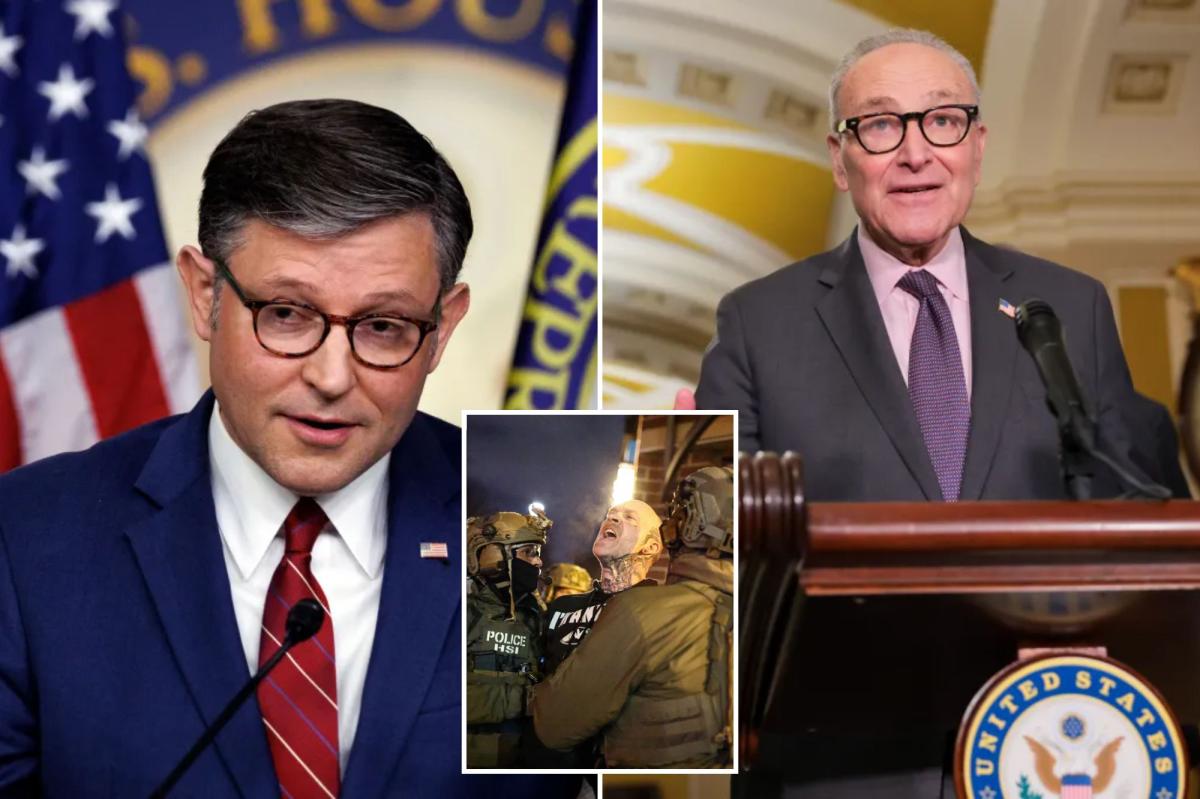
Congress Approves Immigration Enforcement Funding Bill
WASHINGTON – Congress has successfully passed a $70 billion federal immigration enforcement funding bill, concluding a four-month struggle regarding the future of President Trump’s mass deportation strategy. This legislative action comes after the Senate approved the bill last Friday, which was subsequently endorsed by House Republicans in a tightly contested party-line vote of 214-212. All Democrats opposed the measure, while Rep. Kevin Kiley (I-Calif.), who recently departed from the Republican Party, also sided with the opposition.
House Speaker’s Comments on the Bill’s Passage
In a statement, House Speaker Mike Johnson (R-Louisiana) emphasized the significance of the vote, asserting that Republicans in both chambers had concluded the third shutdown of the current Congress dominated by a Democratic administration. He attributed this outcome to what he termed the “record obstruction” by Democrats, affirming that both Customs and Border Protection (CBP) and Immigration and Customs Enforcement (ICE) would be funded for the remainder of President Trump’s tenure. Johnson also asserted that Democrats would be unable to defund these agencies in future Congresses.
Funding Issues and Bill’s Next Steps
The Department of Homeland Security (DHS) experienced funding shortages during most of the period from mid-February to April, impacting specific immigration enforcement agencies that continued to require financial support post-April. The legislation now advances to President Trump’s desk for his signature.
Amendments and Budget Reconciliation Process
During the discussions, Republicans contemplated including a $1 billion provision aimed at enhancing security for the White House banquet hall. Another proposal sought to prohibit access to a $1.776 billion judgment fund designated for compensating individuals identified as victims of “weaponized” prosecutions. However, after extensive debate, neither proposal made it into the final bill, which passed both chambers through a budget reconciliation process, requiring only a simple majority.
Democratic Opposition and Other Proposals
Sen. Lisa Murkowski (R-Alaska) stood alone among her Republican colleagues in opposing the bill. Senate Democrats objected to a spending bill introduced in January, which they linked to the shooting deaths of two Americans at the hands of federal immigration agents in Minneapolis. Their resistance led to delays in the bill’s passage for three months.
Key Provisions of the Secure America Act
The Secure America Act allocates over $9.5 billion for the hiring and salary of Border Patrol agents, alongside approximately $3.5 billion earmarked for new border surveillance technologies and initiatives to combat the trafficking of fentanyl and other drugs. Moreover, around $7.5 billion will be directed towards employing additional personnel for Homeland Security Investigations. This spending package aims to fully fund ICE and CBP through 2029, while adding $2.5 billion for various other DHS programs.
Limits on Concessions and Budget Considerations
Throughout the four-month funding impasse, Democrats sought several concessions, including a call for universal body cameras for enforcement officers and a mandate for ICE and CBP officers to work without masks when arresting individuals. However, none of these concessions were realized. Importantly, it should be noted that neither ICE nor CBP faced funding shortages during this time, as a substantial tax and spending package passed by the Trump administration last July provided additional financial resources for immigration priorities.
