


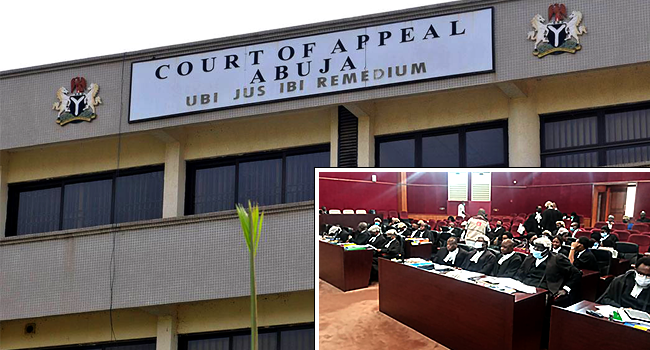
Court of Appeal Saves ADC and Other Political Parties from Deregistration
The Court of Appeal in Abuja has halted the enforcement of a Federal High Court ruling that mandated the deregistration of the African Democratic Congress (ADC) along with four other political parties, granting a significant reprieve to Nigeria’s opposition coalition as the nation gears up for the 2027 general elections.
Initial Ruling On Deregistration
On Monday, the Federal High Court ordered the Independent National Electoral Commission (INEC) to deregister the ADC, Action Peoples Party (APP), Action Alliance (AA), Accord Party (A), and Zenith Labor Party (ZLP) due to their alleged failure to meet stipulated survival criteria.
Appeals Court Critiques Lower Court’s Actions
In a unanimous decision, the three-member panel, under the leadership of Justice AB Mohammed, issued a stay on the enforcement of the earlier ruling. The panel sharply criticized Federal High Court Justice Peter Riff for pursuing the case despite a previous order that had suspended further proceedings.
Violation of Judicial Protocol
The appeals court found that the trial judge’s actions contravened a May 22 order, thereby breaching judicial hierarchy and constitutional norms. The court expressed that proceeding with the decision amidst an existing appeal was a significant disrespect to the judiciary and undermined the authority of the higher court. The judgment clearly stated, “Enforcement of the judgment is hereby stayed.”
Impact on Upcoming Elections
This ruling effectively suspends the implementation of the June 15 order which instructed INEC to deregister the aforementioned political parties. Justice Riff had determined that these parties failed to meet constitutional requirements for continued registration and participation in elections, effectively barring INEC from recognizing them or permitting their candidates to take part in the forthcoming elections.
Legal Challenge and Court Proceedings
The case was initiated by the National Forum of Former Members of Parliament (NFFL), which argued that the political parties failed to satisfy the electoral performance benchmarks outlined in Article 225A of the Constitution. However, the Court of Appeal’s recent decision restores the status quo while awaiting a determination of the appeal’s merits, preserving the legal recognition of ADC and the other affected parties for the time being.
INEC’s Response to the Ruling
At the beginning of the appeal proceedings, INEC disclosed its surprise at Justice Riff’s ruling, noting that it had learned of the decision only through media reports, without any formal notification from the court. INEC’s lead counsel, Khalil Mohammed, stated that they were aware of the Court of Appeal’s May 22 order preventing the lower court from executing the ruling, which was initially set for June 5. He expressed no opposition to the request for a stay of execution, given the lack of formal communication regarding the ruling.
Concerns About Election Integrity
ADC’s attorney, Shuaib Alwah (SAN), highlighted that the trial judge had communicated the judgment date via WhatsApp, a move that raised concerns among members of the appeals committee. He argued that the lower court’s actions posed a threat to justice and urged the appellate court to wield its constitutional authority to safeguard the integrity of the judicial process. Other political parties involved echoed this sentiment, warning that upholding the ruling could lead to substantial electoral and constitutional disruptions, especially with upcoming by-elections scheduled in six states.
