


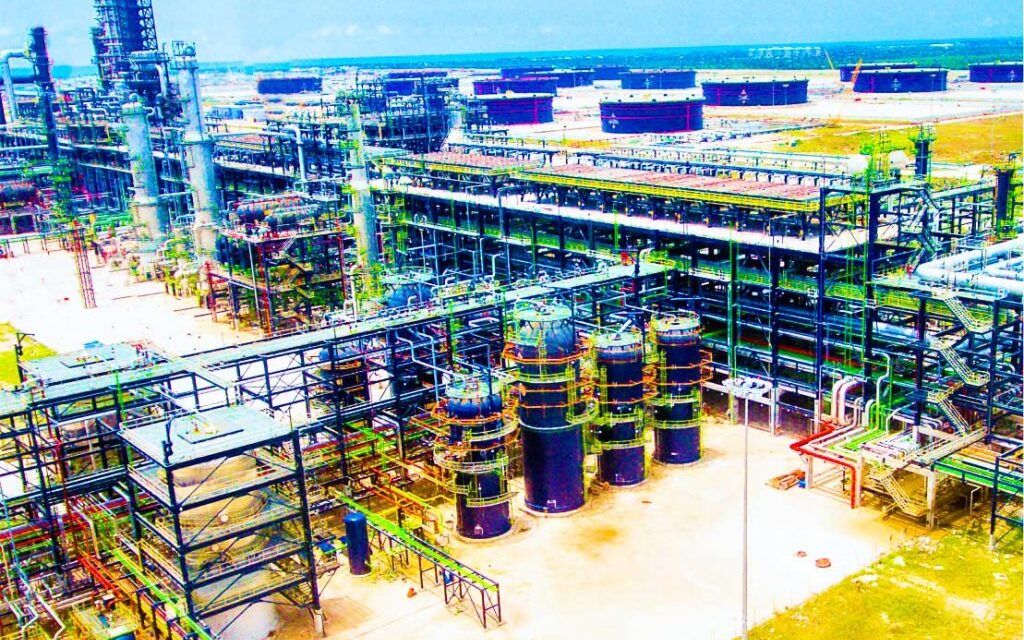
Dangote Refinery Stabilizes Nigeria’s Fuel Market Amid Global Price Volatility
S&P Global Commodity Insights reports that Dangote Petroleum Refining and Petrochemical Industries is playing a crucial role in stabilizing Nigeria’s fuel market, effectively dampening global price volatility. Despite surging international gasoline prices, elevated freight rates, and constrained global supplies, the refinery is maintaining domestic gasoline prices.
The market intelligence firm highlights that this pricing strategy is instrumental in shielding Nigerian consumers from the rising costs of imports that are exerting upward pressure on fuel prices throughout West Africa. Importers are increasingly alarmed by the sharp increase in international gasoline prices, attributing this momentum to heightened global product values and rising transportation fees.
According to market participants cited by S&P, the prices in Nigeria are effectively capped by Dangote’s pricing structure. This limitation restrains importers from transferring the increased international costs to the domestic market. One trader noted that while petrol prices in Ghana have risen significantly, those for Nigerian-spec cargoes remain relatively stable, thanks to the refinery’s decision to hold its shore selling prices steady in the face of increasing international pressures.
One trader emphasized that the opportunity for arbitrage has diminished, as the pricing from Lome has surpassed Dangote’s selling prices. The current market conditions are making fuel imports into Nigeria less viable, a situation exacerbated by sharply rising global freight costs. S&P Global indicated that the cost of transporting clean oil products from northwestern Europe to West Africa has surged from $29.70 per tonne at the end of June to $37.12 per tonne, driven by a shift in shipping routes to alternative markets.
In tandem with these pressures, the diesel market is facing tighter conditions due to decreasing supplies of Russian Black Sea cargoes, which is inflating the price of high-sulfur gas oil across West Africa and further escalating import expenses. Despite these global market dynamics, the Dangote Oil Refinery is sticking to its gradual price reduction policy.
Price Reductions Fuel Consumer Relief
Since late May, the refinery has cut the ex-depot price of Premium Motor Spirit (PMS) by over 200 Naira per liter, Automotive Gas Oil (AGO) by 300 Naira per liter, and Jet A1 aviation fuel by more than 520 Naira per liter. These reductions have occurred while processing crude oil purchased at far higher international prices, demonstrating the refinery’s commitment to price moderation.
The refinery asserts that its product prices are dictated by the actual costs involved in sourcing crude oil rather than daily fluctuations in international Brent prices. The S&P report underscores that crude oil acquisition is often completed weeks or even months in advance, based on commercial contracts tied to monthly average pricing models.
Industry experts believe that the latest developments highlight the essential role of domestic refining capacity in shielding Nigeria from external supply disruptions. As international product prices climb and transportation costs rise, coupled with regional trading hubs like Lome offering higher gasoline prices, Nigeria’s reliance on imported fuel could have led to a substantial spike in domestic pump prices. However, the operational scale of the Dangote refinery has mitigated this risk.
Regional Pricing Benchmarks Emerge
The latest analysis from S&P solidifies the Dangote refinery’s increasing influence on oil pricing in West Africa. Market participants are beginning to see the refinery’s pricing as a regional benchmark, creating challenges for importers when international exchange costs outstrip domestic refinery prices.
This development aligns with one of the principal aims of establishing the 700,000 barrel-per-day refinery: to insulate Nigeria from global market disruptions, reduce import dependence, preserve foreign exchange, and offer greater price stability for consumers and businesses alike. As geopolitical tensions, tight product supplies, and escalating transportation costs continue to reshape global fuel markets, the Dangote refinery is emerging not only as Nigeria’s primary source of refined petroleum products but also as a stabilizing force within the broader energy markets of West Africa.
