


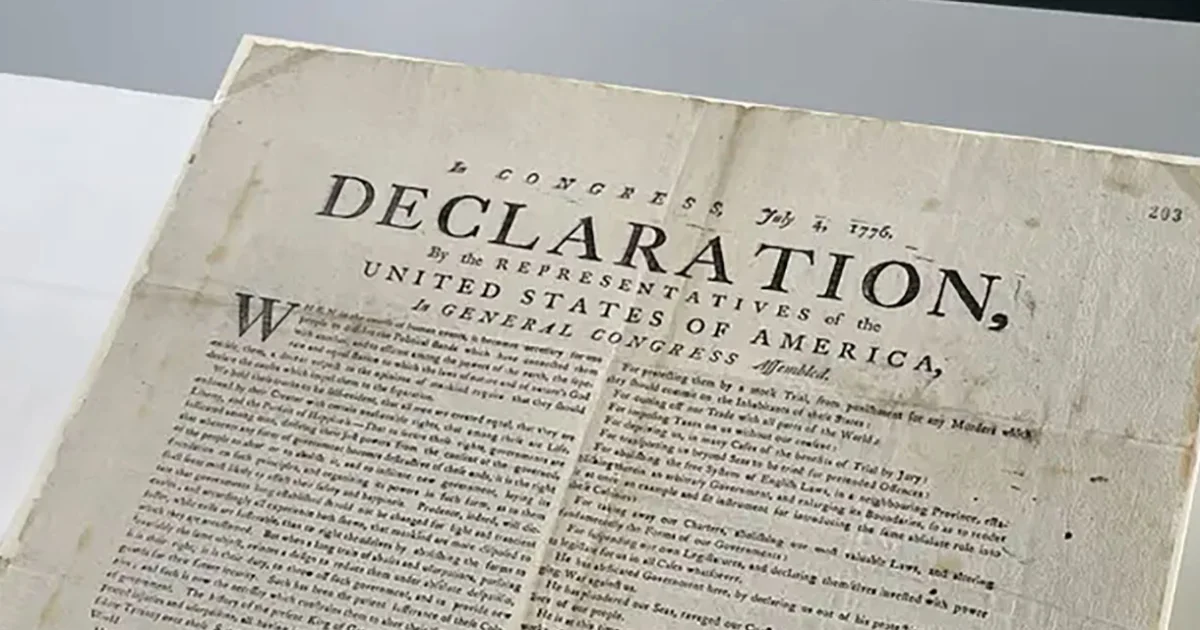
Rare Copy of the Declaration of Independence Found in London
LONDON — An extraordinary copy of the Declaration of Independence, lost for 250 years, has been uncovered in London. This rare document is now recognized as the only known example outside the United States.
Printed in Exeter, New Hampshire, shortly after the Declaration was adopted on July 4, 1776, this copy was intended to disseminate news of American independence across the colonies.
The document had remained hidden in Britain’s National Archives until May of this year when volunteers, cataloging records from the American Revolutionary War, stumbled upon it among the papers of a British naval captain.
Only 11 copies of the so-called Exeter Prints are known to exist. Until this recent find, none had been identified outside of the United States, as noted in a press release from Britain’s National Archives.
This particular declaration was part of a collection of documents captured by the Royal Navy following the seizure of the American privateer Dalton in December 1776.
Amanda Bevan, who oversees a project at the National Archives to catalog British naval communications from the Revolutionary era, expressed excitement about the find, stating that it enriches the narrative surrounding the Dalton and the privateers active during that time.
Privateers were privately owned vessels authorized by the Continental Congress to target British merchant ships, disrupting trade and supply routes throughout the Revolutionary War. Bevan emphasized that the existence of the Dalton River declaration highlights the ideological motivations of these maritime fighters.
Along with the Declaration, other seized documents included the Dalton Commission, which authorized attacks on British vessels, and directives detailing warfare rules for privateers. Bevan mentioned that such documents were typically read aloud to crew members to maintain discipline. She speculated that if Captain Johnson informed his crew about their duties, he likely also communicated the values for which they were fighting.
Unfortunately, the Dalton’s mission was ultimately a failure. On Christmas Eve 1776, the ship, armed with 18 guns and captained by Eleazer Johnson, was pursued for hours before being captured by the 64-gun HMS Resonable, commanded by Captain Thomas Fitzherbert of the Royal Navy. Johnson and around 120 of his crew were subsequently imprisoned in Plymouth, England.
The confiscated declaration remained buried in British archives for centuries, categorized simply as “another piece of paper.” It was finally rediscovered by Michael Scholar, a former insurance executive who has volunteered at the UK National Archives for over a decade.
While engaged in routine cataloging to enhance the archives’ accessibility for scholars, Scholar examined the report on the Dalton’s capture and quickly recognized the significance of what he had found.
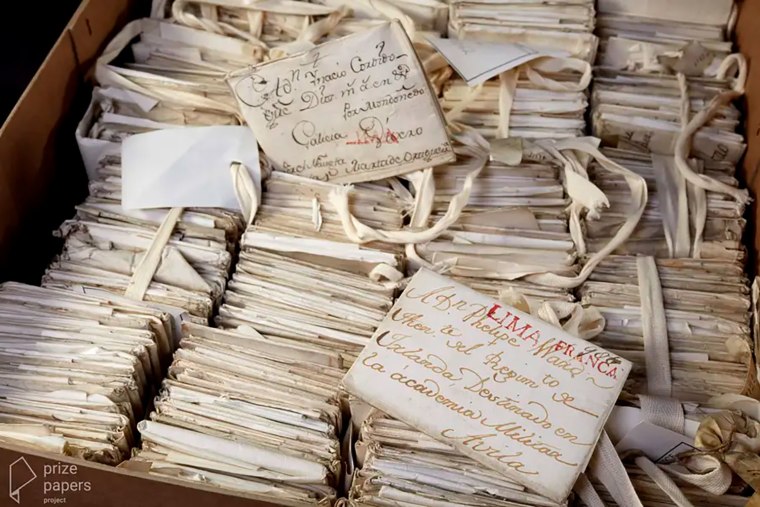
Scholar shared his excitement upon recognizing the document’s importance, noting, “I thought, oh, yeah, this is definitely a declaration of independence. How much fun is this?”
Historians explain that the document’s importance was not clear when it was initially published, contributing to its dormancy in the archives. Nicholas Guyatt, a North American history professor at the University of Cambridge, noted that at the time of the Dalton’s capture, the declaration was just one of many documents seized and likely had little significance for British naval personnel.
Guyatt underscored the value of physical archives, stating that discoveries like this one remind us of the importance of examining historical collections to gain new insights into past events.
