


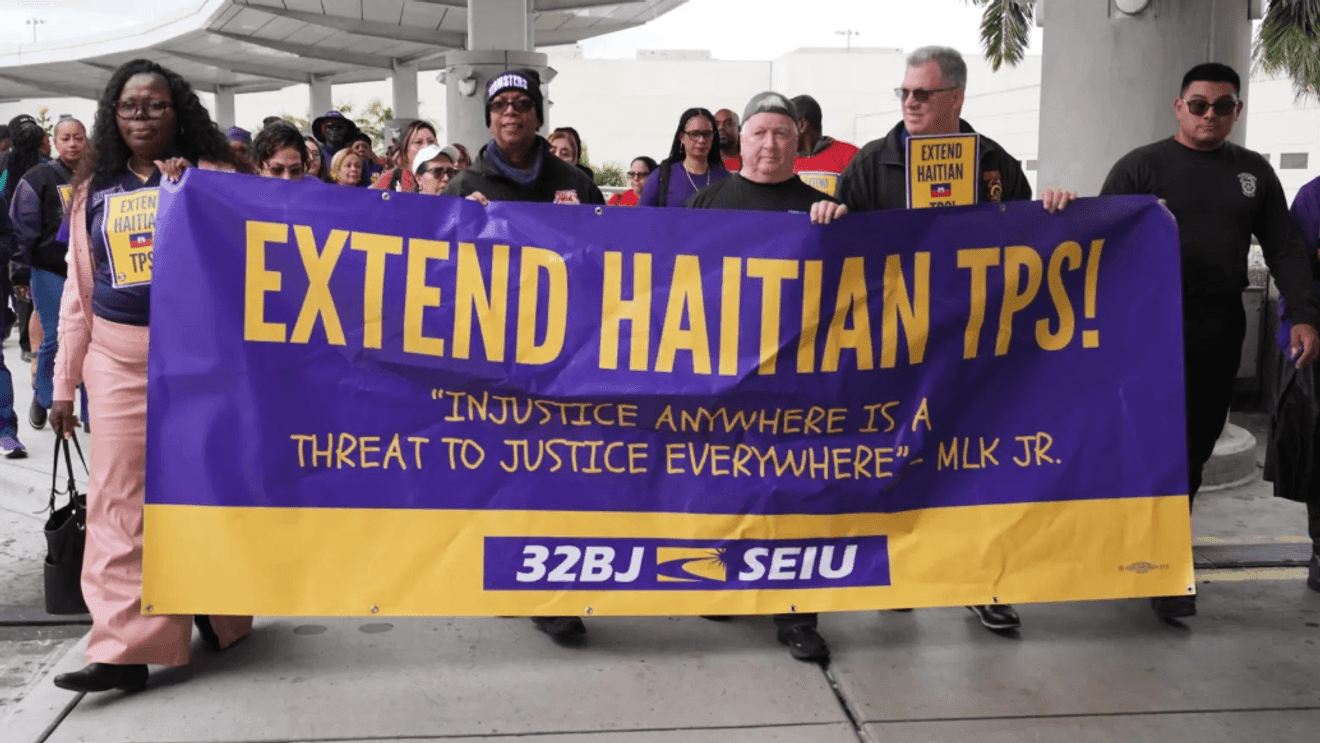
Concerns Emerge Over Supreme Court Ruling on Temporary Protected Status
Advocates for the Haitian-American community are sounding alarms regarding the Supreme Court’s recent decision to support the Trump administration’s initiative to terminate Temporary Protected Status (TPS), warning that it will adversely impact many residents in South Florida.
Community leaders and political officials highlighted the far-reaching consequences of this ruling, which threatens not only the Haitian population but also the broader community, including elderly residents who rely on Haitian caregivers and various local workers. “The decision to revoke the temporary protected status of hundreds of thousands of Haitians is not just an immigration issue; it is a moral issue,” stated Denise Brown, CEO of LifeNet4Families, during a press conference. “How should we treat individuals who are our colleagues, caregivers, taxpayers, and friends?”
Brown emphasized that over 350,000 Haitians who have lived and worked legally in the U.S. under TPS now face an uncertain future following the Supreme Court’s ruling. She noted the significance of this issue in South Florida, which is home to one of the largest Haitian communities in the country.
The TPS program, designed to offer refuge to individuals from designated countries experiencing unsafe conditions, also impacts other groups, including South Florida’s sizable Venezuelan community, as the ruling, while directly concerning TPS protections for Syrians, sets a precedent with broader implications.
Florida has the highest number of Haitian TPS holders in the nation, with approximately 158,000 individuals residing in the state, primarily in South Florida. After the Supreme Court’s announcement, Brown joined U.S. Rep. Debbie Wasserman Schultz at a press conference in Broward, where they publicly condemned the ruling.
Wasserman Schultz characterized the decision as a threat to the stability and wellbeing of people in South Florida, calling the ruling “cruel” and indicative of underlying racism. She accused President Trump of targeting TPS recipients and perpetuating hostility toward Haitian immigrants. “The court chose to overlook the blatant racism from the president, ignoring race as a factor in this critical case,” she said, condemning the ruling as a reflection of the repercussions of electing a discriminatory leader.
State Rep. Marie Woodson issued a statement following the event, rejecting any notion that Haitians could safely return to their home country. “The dire situation in Haiti—marked by violence, instability, and economic despair—creates an environment that is unsafe for repatriation,” she stated, echoing the concerns regarding the U.S. government’s travel advisory against visiting Haiti.
Sandra Shelfrere, an immigration attorney with American Immigration Justice, reiterated that TPS recipients undergo rigorous background checks during reapplication, disputing claims that they pose a threat. Wasserman Schultz shared personal anecdotes about the essential role that Haitian caregivers have played in the lives of her constituents, underscoring the community’s invaluable contributions.
In contrast, Florida Governor Ron DeSantis applauded the Supreme Court’s decision, asserting it aligns with proper judicial reasoning. Senators Rick Scott and Ashley Moody, also Republicans, have yet to comment on the ruling’s implications. The decision could significantly influence other Democrats vying for seats in the newly drawn 20th Congressional District, which encompasses a considerable portion of Broward County’s African American and Caribbean American populations.
Former U.S. Rep. Sheila Chaffils McCormick articulated a broader economic concern, arguing that the removal of hardworking individuals from the workforce would have detrimental effects on local industries and small businesses. “Sending families back to a country beset by violence and instability is not only unjust; it undermines our economy,” she stated, highlighting the potential repercussions for both the local community and the nation’s welfare.
As candidates like Dale Holness and Elijah Manley expressed their disapproval of the ruling, the community remains united in advocating for the Haitian population and addressing the complexities and challenges surrounding immigration policies. The repercussions of this landmark decision continue to unfold, leaving many to question its broader social and economic implications.
For further insights and developments on this issue, follow Anthony Mann at am**@*********el.com and on various social platforms.
