


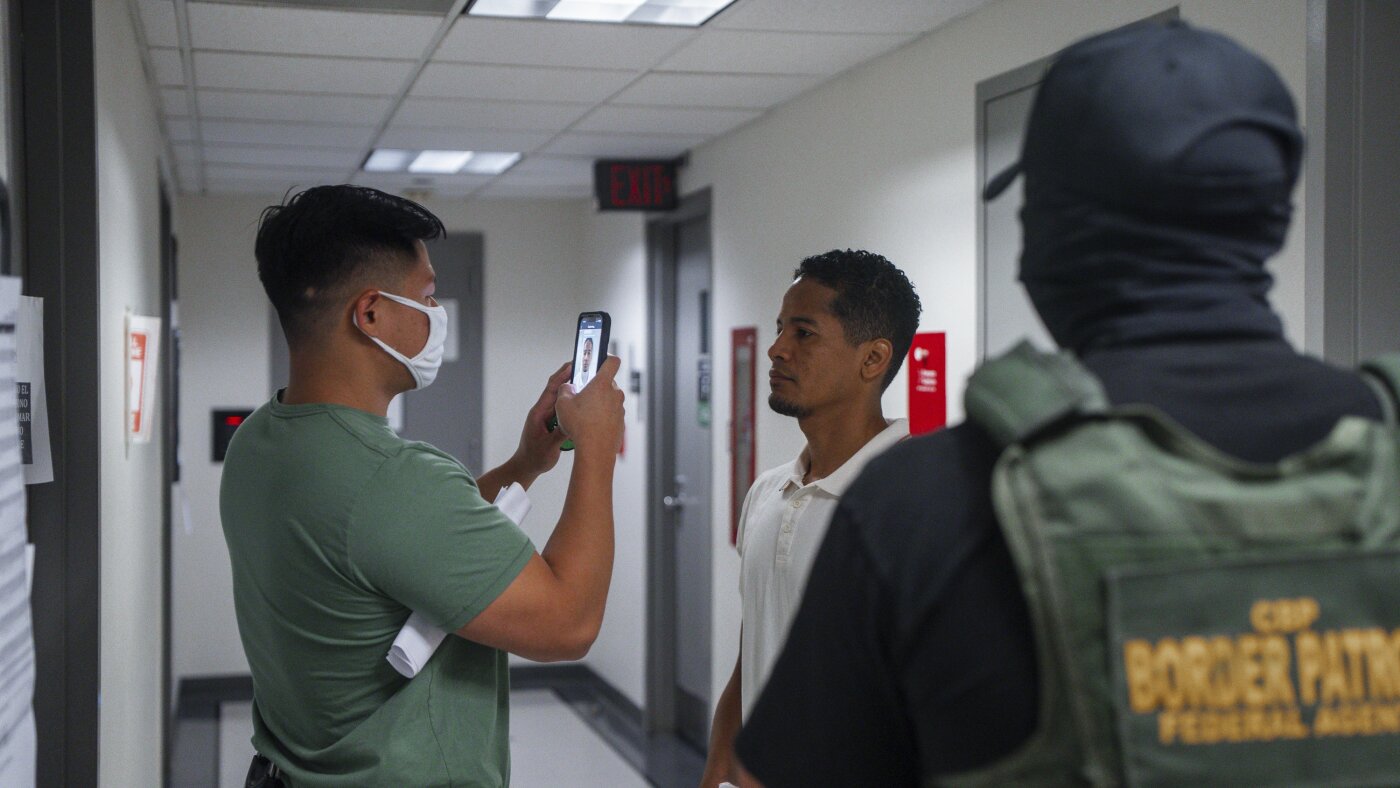
Federal immigration officials utilize facial recognition technology to confirm the identity of an asylum seeker in New York before a hearing on July 30, 2025. The Department of Homeland Security (DHS) is also broadening its application of iris scanners as part of its efforts to identify undocumented immigrants. Olga Fedorova/AP
Olga Fedorova/AP
The Department of Homeland Security is significantly enhancing its capacity to use iris scanning technology in the context of mass deportations. This initiative has sparked worries among privacy advocates regarding the potential collection of biometric data from individuals detained for immigration-related matters.
Recently, DHS awarded a $25 million no-bid contract to BI2 Technologies, a company specializing in iris scanning solutions. This contract represents a substantial increase—over five times the value of BI2’s previous contract with the department signed last fall. Despite numerous attempts by NPR to contact BI2 regarding its collaboration with Immigration and Customs Enforcement (ICE), the company did not respond.
As part of its agreement, DHS has requested access to BI2’s mobile application, which manages over 1,500 iris scanners along with the associated database for storing iris scan data. The unique complexity of the iris pattern makes it as distinct as a fingerprint.
While DHS declined an interview, a spokesperson indicated to NPR that ICE officers deploy iris recognition technology to enhance the accurate identification of individuals encountered during immigration and removal operations. This process includes verifying the identity and background of those potentially subject to enforcement actions.
Take the case of Norély Mejias Cáceres, for instance. Last fall, while she was home in Chicago with her husband and young son, a Black Hawk helicopter filled with federal agents landed near her building. Mejias recounted that, during the raid, agents pointed firearms at her family and forcibly ordered them out of their apartment.
During the chaos, she collapsed, and when she regained her senses, an officer was taking her photo with a smartphone. In a distressed state, she complied with the officer’s request to open her eyes wide for the picture. Despite being in the asylum application process, Mejias was detained and ultimately deported, and now resides in Venezuela with her family.
Nicole Hallett, a law professor and director of the Immigrant Rights Clinic at the University of Chicago, has raised concerns about the intentions of the officers involved. She suspects they were seeking not only a facial image but potentially an iris scan as well. Hallett noted that other individuals reported similar encounters, suggesting that the technology may have been used during these immigration raids.
Law enforcement agencies, particularly sheriffs, have been implementing this technology for decades. In fact, BI2’s iris scanning system was developed two decades ago and previously supplied to law enforcement agencies along the U.S.-Mexico border during the Trump administration. Justin Smith, the former sheriff of Larimer County, Colorado, explained how he successfully utilized a BI2 scanner for booking detainees, enabling immediate identification at the scene without requiring the time-consuming process of fingerprinting.
However, Smith acknowledged the potential misuse of any technology that grants access to personal information, raising important ethical questions surrounding its application. “The issue is how this technology will be implemented,” he said. “While swift identification can be beneficial, there must be safeguards to prevent abuse.” In cases like Mejias’, Hallett emphasized that identification relied on illegal detentions, raising significant ethical concerns about the implications of such practices.
Hallett’s reservations are echoed by privacy advocates like Cooper Quintin from the Electronic Frontier Foundation, who voiced concerns about ICE’s trustworthiness in deploying this technology. He highlighted the agency’s track record of questionable practices, including the unauthorized collection of DNA samples from peaceful demonstrators and legal observers. Such incidents elevate risks regarding the implications of iris scan data on innocent individuals.
Marianna Poyales, a researcher at Georgetown Law’s Center on Privacy and Technology, underscored the complexity of biometric data use in governmental contexts. While biometrics can serve benign purposes, such as airport security, there are pressing concerns when sensitive information is linked or aggregated with other data sources. “What else is being collected? Who oversees these databases? There are many unanswered questions,” she remarked.
In response to such concerns, DHS asserted its commitment to employing all available tools to locate and deport undocumented immigrants. With an expanding budget, the agency has amassed a diverse array of technologies, including facial recognition systems and location tracking tools, raising urgent questions about privacy and ethical usage in immigration enforcement.
