


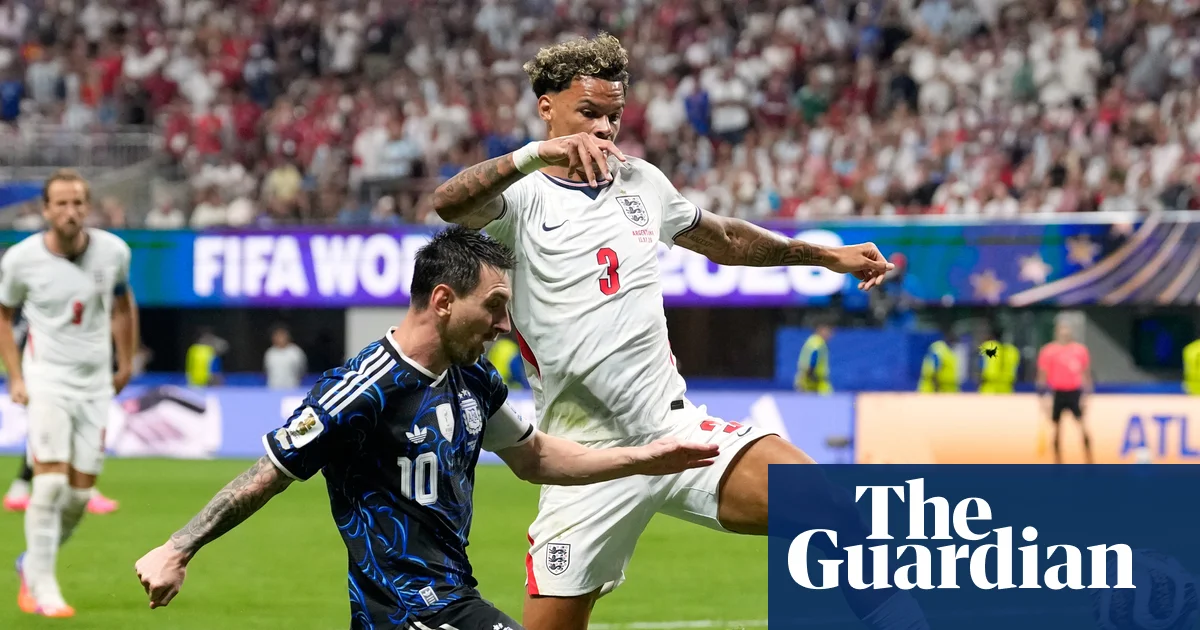
Tuchel’s Tactical Preparations Ahead of England vs. Argentina
Manager Omas Tuchel approaches the upcoming match between England and Argentina with a comprehensive game plan aimed at ensuring success on both offense and defense. He has meticulously considered various scenarios, including how his team might respond to scoring the opening goal, or conversely, how to regain composure if they concede first. Additionally, he has developed strategies for effectively managing one of the tournament’s most formidable players, Lionel Messi.
Messi’s Limited Impact Early in the Game
For much of the first hour, Messi found himself on the periphery of the action, as England succeeded in limiting his influence within dangerous areas. Following Anthony Gordon’s goal, Messi’s only touch in the central penalty area was swiftly negated by a tackle from Elliott Anderson. The statistics revealed that Messi’s sprint speed, accounting for just 4.3% of his total distance traveled, was lower than in England’s previous two matches against Switzerland and Egypt, which recorded 4.6% and 5.4%, respectively.
Tuchel Draws Encouragement from Messi’s Shot Count
Tuchel can take comfort in the fact that Messi attempted very few shots on goal during the match. The Argentine superstar’s only effort was a blocked long-range attempt that never reached the England penalty area. In his 19 previous World Cup appearances where he completed the full 90 minutes, Messi has rarely been so quiet, notably hitting 120 shots on target in the 2014 tournament. In contrast, his performance against Croatia four years later yielded only a single close-range shot. Thus far in this tournament, his subdued showing has been advantageous for England.
Messi’s Heatmap Illustrates Expected Movements
The heatmap from the match reflected Messi’s activity primarily in his preferred area: the right half-space in front of the opposing penalty area. While it may not be entirely accurate to say England effectively placed him there, they at least contained him within a predictable zone, enabling their defensive plans to unfold as intended.
Subtle Shifts in Messi’s Positioning
Analyzing the entire match provides a distorted view of Messi’s tactical movements. In the opening 45 minutes, his only touch in a critical area occurred near the center circle, and a forward pass intended for Giuliano Simeone was flagged offside. However, his influence increased after halftime, particularly from the right side, where he attempted six open-play crosses—a significant spike for a player averaging just 2.3 crosses per 90 minutes in league play since 2015.
Strategic Adjustments in Response to Messi’s Performance
One of Messi’s attempts from a wide position resulted in a header from Nico González, prompting a crucial save from England’s Jordan Pickford just before the second water break. This moment likely influenced Tuchel’s decision to introduce Ezri Konsa shortly thereafter, transitioning to a back five in an effort to contain Argentina’s attack, particularly in light of this strategy’s previous success against Mexico.
Messi’s Proficiency Outshines Other Players
Unlike Mexican players Roberto Alvarado and Jesus Gallardo, who produced a mere 0.05 expected goals from 25 open-play crosses, Messi’s ability to convert opportunities is second to none. His assist for Lautaro Martínez’s winning goal generated 0.53 expected goals, surpassing England’s total output all night. This marked Messi’s second World Cup assist with his right foot, a feat that proved to be much more challenging than his cutback for Julián Álvarez’s goal in the Qatar semi-finals.
In summary, while Messi’s performance may have deviated from statistical norms, his presence on the pitch remains a significant factor. Legendary players like him have an unparalleled ability to shape the outcomes of matches, often turning strategic preparations into tangible results.
